
ENGLISH EDITION · 全球新聞
ASEAN Haze Risk Turns Red as Climate Variability Tests Supply-Chain Transparency
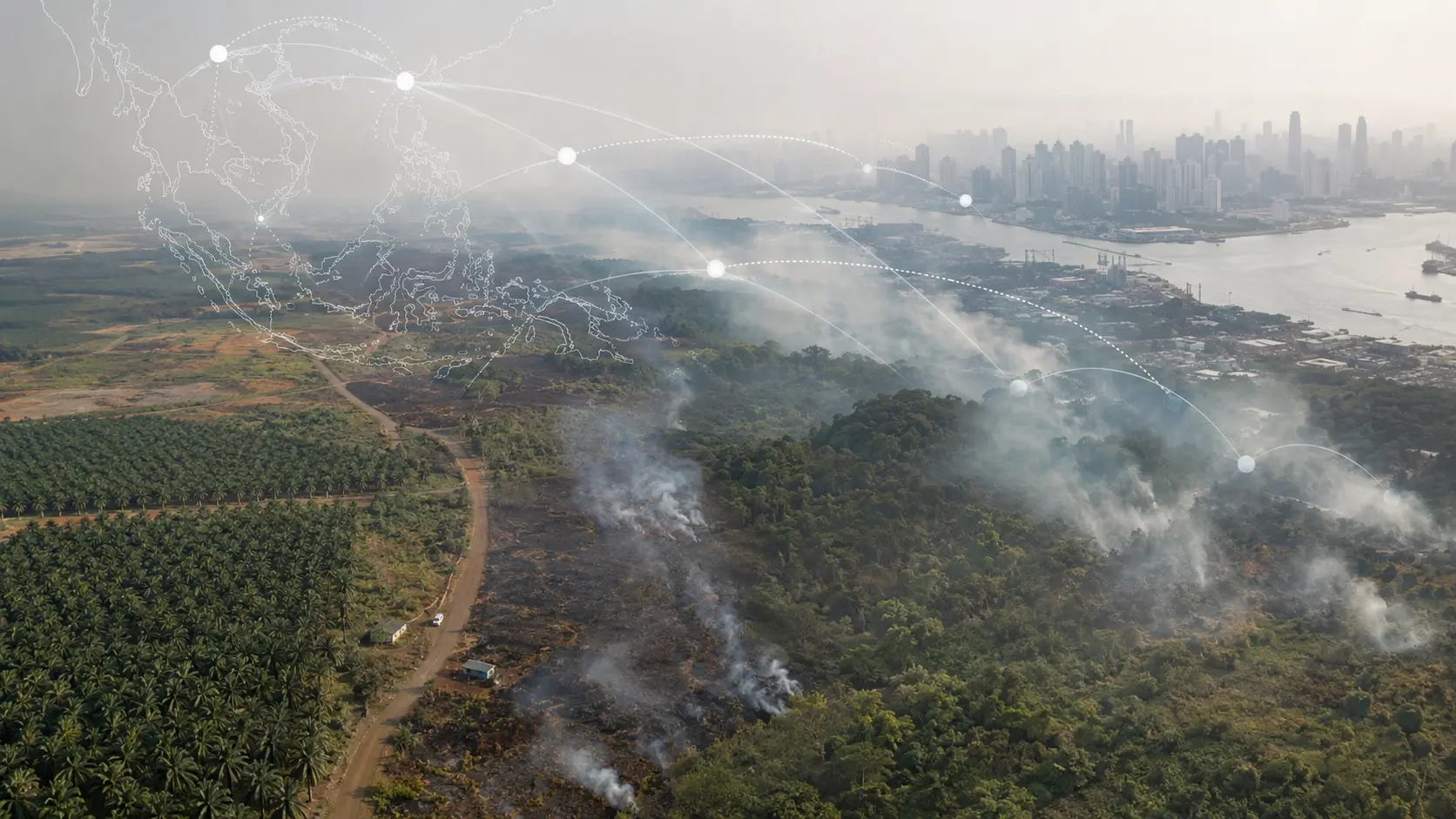
Smoke affected the Philippines on September 1 after alerts involving Malaysia, Brunei and Singapore. SIIA rated haze risk red for the rest of 2026, highlighting gaps in cross-border evidence for hotspots, land rights, concessions and commodity chains.
Executive Summary / Lead
Eco-Business reported that transboundary smoke reached the Philippines on September 1 after affecting Malaysia and Brunei, while Singapore issued alerts. The Singapore Institute of International Affairs rated risk red for the remainder of 2026, with August and September a peak window influenced by El Niño and the Indian Ocean Dipole.
Company & Industry Context
Eco-Business reported that transboundary smoke reached the Philippines on September 1 after affecting Malaysia and Brunei, while Singapore issued alerts. The Singapore Institute of International Affairs rated risk red for the remainder of 2026, with August and September a peak window influenced by El Niño and the Indian Ocean Dipole. ASEAN has had a transboundary haze agreement since 2002, but data on hotspots, land use, concessions and supply-chain responsibility still constrains implementation.
Challenge / Why It Matters
A satellite hotspot does not automatically prove illegal burning by one company, while smoke crosses administrative and national borders. Without parcel, rights, lease, weather and inspection records, responsibility can be oversimplified.
Action / Solution / Implementation
Regional governance needs to connect satellite observations, ground sensors, atmospheric back-trajectories, parcels, concessions, suppliers and commodity batches, with event IDs, evidence strength, investigation status, remedy and public correction.
Evidence / Results / Impact
Evidence chain: ASEAN has had a transboundary haze agreement since 2002, but data on hotspots, land use, concessions and supply-chain responsibility still constrains implementation.
Industry & Institutional Implications
Climate variability amplifies peat and forest-fire risk, so no-deforestation and no-burning commitments cannot rely only on annual supplier declarations. Finance and procurement need event-level evidence and uncertainty.
SNN Editorial / Pre-Disclosure Evidence Infrastructure Perspective
SNN editorial analysis: Taiwan is not a party to the ASEAN haze agreement, but food, rubber, pulp, palm-derivative, tyre, banking and trading companies may inherit nature, health and reputation risk through Southeast Asian supply chains. Pre-Disclosure Evidence Infrastructure should retain plantation or forest parcel identity, rights and concession relationships, suppliers and intermediaries, commodity batches, hotspot timing, atmospheric back-trajectories, ground inspection, suspension or remediation decisions, grievances and restoration evidence. Taiwan companies should distinguish regional haze, a hotspot on a parcel, supplier involvement and attributable violation, while recording uncertainty. This prevents both unsupported accusation and treatment of regional risk as unmanageable. This is editorial interpretation, not a source-verified fact.
Future Outlook
Next review should test execution milestones, updated measurements, methodology changes, adverse outcomes and whether the evidence supports each public claim. Material changes must create a new version rather than overwrite this record.
Sources, evidence chain and editorial responsibility
Source publication: Eco-Business · Original author: Hannah Alcoseba Fernandez · Original publication date:
External institutional and reporting sources
These external announcements, rules, studies and reports support the discussion and are displayed separately from the original publication.
- primary automated discovery and factual sourceEco-BusinessASEAN Haze Risk Turns Red as Climate Variability Tests Supply-Chain Transparency ↗Published 2026-09-02 · Accessed 2026-09-03T03:05:00.000Z
Publication identity, attributed facts and source timing used for the SNN original bilingual summary.
- regional risk assessmentSingapore Institute of International AffairsSIIA Haze Outlook 2026 media release ↗Published 2026-06-24 · Accessed 2026-09-03T03:05:00.000Z
Regional haze risk rating, forecast drivers and attributed assessment.
- underlying reportSingapore Institute of International AffairsHaze Outlook 2026 report ↗Published 2026-06-24 · Accessed 2026-09-03T03:05:00.000Z
Underlying assessment of weather, peatland, policy and commodity-market drivers.
- treaty frameworkASEANASEAN Agreement on Transboundary Haze Pollution ↗Published 2006 · Accessed 2026-09-03T03:05:00.000Z
ASEAN treaty framework, obligations and regional cooperation mechanism; the catalogue provides publication-year precision.
Topic hub: 氣候與能源轉型