01
重點摘要

Executive Summary / Lead

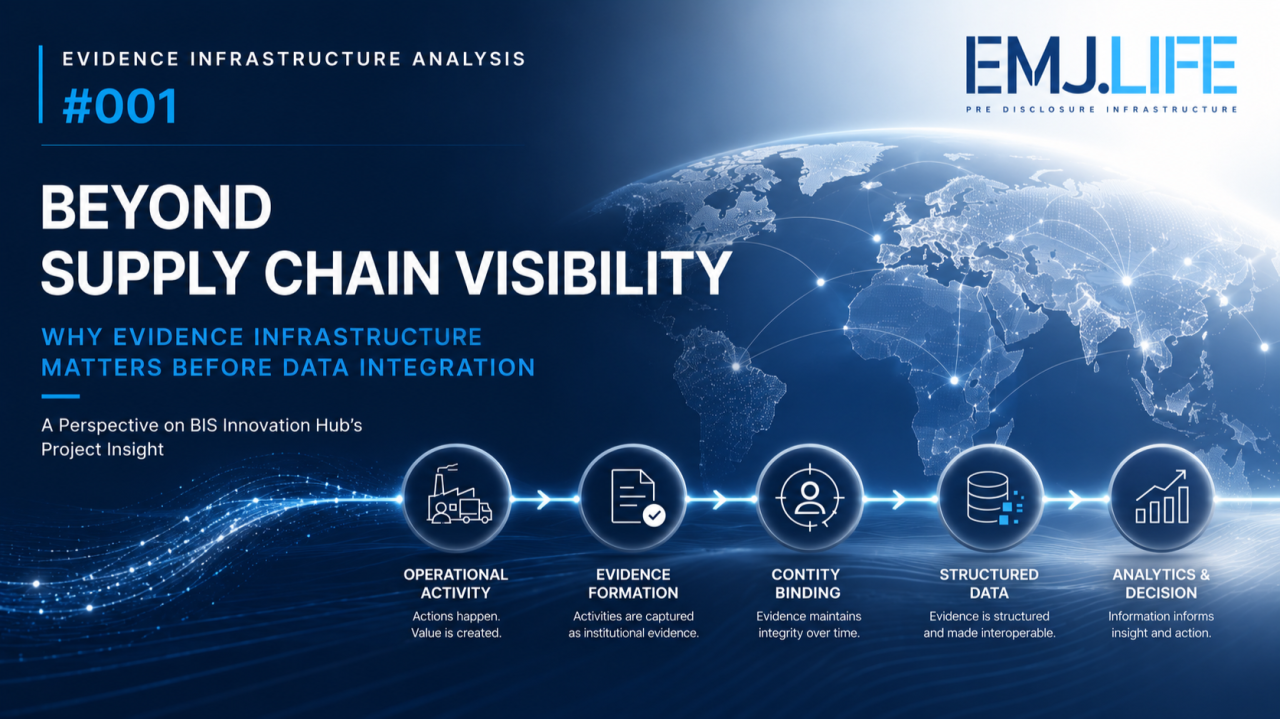
BIS Innovation Hub's Project Insight integrates firm relationships, maritime activity, ownership, trade and macroeconomic data into supply-chain networks, providing granular visibility for policy and financial-stability analysis. Project Insight is institutionally important because it brings corporate relationships, beneficial ownership, shipping, trade and macroeconomic data into one analytical environment. That allows supervisors to look beyond national or sector aggregates and examine how disruption may travel through firm-level networks. It also exposes an upstream constraint: the more the analytical layer depends on entity resolution and probabilistic matching, the more clearly the source activities reveal the absence of stable identity and relationship evidence. This Analysis therefore does not treat the gap between supply-chain visibility and evidence continuity exposed by Project Insight as a self-contained technical or policy update. It separates the institutional facts supported by the official anchor, SNN editorial inference and outcomes that remain unverified. The reader should be able to see where the source ends, where interpretation begins and which conclusions the present evidence cannot support. To make the lead decision-ready, it answers five questions together: what has occurred, which first-party record supports it, through what mechanism the effect may travel, which outcome evidence is still missing, and what next observation could strengthen or overturn the judgement. Any causal relationship not stated by the source remains an editorial inference and is not converted into a factual claim through confident wording.

02
企業與產業背景

Company & Industry Context

Global value chains cross jurisdictions and systems. Aggregate statistics cannot fully represent firm relationships or disruption paths, so the project combines commercial and public data. Supply-chain data are not a single asset class. Company registers establish legal identity, ownership data describe control, shipping records document logistics events, and customs or transaction data describe the movement of goods. Each source has a different time reference, scope and maintenance authority. Integration can create a richer picture, but it must not erase the distinct institutional purpose and uncertainty attached to each source. Institutional context must identify the rule setter, implementer, data owner, reviewer and affected market. Those roles may sit in different organisations or functions, and publication of a document, deployment of a system, enterprise adoption and delivery of an outcome are different evidence states. Time and authority must also be separated. An announcement date is not an effective date; a pilot is not general adoption; a technical specification is not a legal obligation; and voluntary enterprise use is not regulatory approval. Putting these events on one timeline shows when an institutional development actually enters data, contract, investment or disclosure processes and which actor is authorised to make that transition.

03
挑戰與重要性

Challenge / Why It Matters

Extensive identifier harmonisation, entity resolution, classification mapping and timestamp reconciliation show that information is fragmented before analysis. Integration can reconstruct relationships but cannot restore all original evidential context. The principal distortion risk arises when different datasets describe the same company, facility, vessel or transaction as different objects. Similar names do not prove a common legal entity; a shared address does not establish a shared operational responsibility; and a relationship valid on one date may no longer be current. If matching rules, confidence and human review are not preserved, a precise-looking network can silently convert inferred links into apparent facts. When upstream evidence lacks stable identity, formation time, applicable boundary and version, a standardised output may still be impossible to reconstruct. The material risk is not one missing field. It is the silent conversion of the wrong entity, an expired method, an inferred relationship or an unapproved version into an apparent fact as information moves downstream. Concrete failure modes include incorrect entity matching, an incomplete data population, inconsistent boundaries, unversioned methods or factors, exceptions without rationale, approval occurring after publication, and downstream reuse outside the original purpose. Each failure can turn a reasonable individual record into a conclusion that cannot be defended after aggregation, comparison or machine-assisted interpretation.

04
行動、方案與執行

Action / Solution / Implementation

Upstream improvement should bind institutional identity, time, method and responsibility when operational activity occurs, preserving those relationships through later exchange and reducing dependence on probabilistic matching. A stronger model assigns stable identifiers to enterprises, facilities, products, batches, shipments and transactions when operational events are formed. It then binds the source system, event time, controller, transformation rule and later versions to those identities. Every merge, split or entity-resolution decision made in the analytical environment should create its own processing record, allowing a user to move from a risk indicator to the relationship decision and then to the underlying evidence. The implementable control unit is a governed evidence object. Each material claim links to its primary source, calculation or judgement method, organisational and temporal boundary, accountable owner, control state, exception, approval and version. When any component changes, the system preserves the difference and affected uses instead of overwriting the earlier basis. A minimum operating control set includes a claim register, evidence owner, source snapshot, method identity, valid period, control frequency, exception threshold, review, approval and permitted downstream use. High-judgement or high-financial-impact items receive a stronger review tier. Lower-risk records use automated completeness and consistency checks so that governance effort is concentrated where a wrong claim would change a decision.

05
證據、成果與影響

Evidence / Results / Impact

Project Insight demonstrates the institutional value of multi-source integration, network analysis, concentration indicators and resilience assessment. It also makes entity resolution and data cleaning visible as major engineering tasks. The BIS materials support claims about Project Insight's integration methods, network analysis and policy use. They do not establish that all supply-chain data are complete or that every entity-resolution result is inherently correct. This Analysis makes a separate editorial inference: the project's visible burden of cleaning and relationship reconstruction is a signal of upstream identity-governance gaps, not a universal conclusion attributed to the BIS. Evidence assessment begins with the official anchor and uses independent primary or method-transparent sources to test context and limits. The sources support stated institutional facts and explicit figures. Claims of comprehensive adoption, causal improvement or universal cross-market effectiveness require separate implementation evidence. Every material sentence should enter a claim ledger and be classified as official fact, direct measurement, estimate, corporate commitment, delivered outcome or SNN editorial inference. The ledger records the precise scope that each source supports. Conflicting evidence is retained with the resolution rationale; absent evidence is marked pending rather than filled with a convenient analogue from another entity, period or jurisdiction.

06
產業與制度意涵

Industry & Institutional Implications

Data infrastructure improves what institutions can see. Evidence Infrastructure improves confidence in how information was formed. They operate at different stages and will become increasingly interdependent. For financial institutions and enterprises, this changes the division of responsibility around risk data. An analytical team cannot rely only on a finished network graph; it needs to know which links came from authoritative registers, commercial datasets or inference, and when each relationship ceased to be valid. Visibility is therefore an analytical capability. Evidence continuity is the governance capability that makes the result reviewable, updateable and accountable. The purpose of this information density is not length for its own sake. It is to shorten the verification distance between claim and decision. Boards, investors, regulators and operational teams should be able to distinguish fact, estimate, commitment, progress and outcome, then update the judgement when conditions change without reconstructing the case from scattered files and oral explanation. Accountability therefore attaches to decision rights. The data owner maintains the source, the method owner controls calculation, the business function defines the use case, internal control or assurance tests reproducibility, and the approver accepts responsibility for final use. An exception without an expiry date, remediation owner and impact scope stops being temporary treatment and becomes persistent evidence debt.

07
SNN 編輯與揭露前證據基礎設施觀點

SNN Editorial / Pre-Disclosure Evidence Infrastructure Perspective

SNN editorial analysis: BIS global supply-chain visibility matters to Taiwan banks, traders, electronics manufacturers and logistics firms, but integrated data is not automatically trustworthy evidence. To serve European customers and financial institutions, Taiwan enterprises must preserve links among entities, products, batches, transport events, calculation methods and provenance. Taiwan's semiconductor, electronics, machinery and logistics networks contain multilayer contracting, redirected orders, traders and offshore subsidiaries. A group name alone may not identify the entity that manufactured, shipped or paid for a product. If banks, brand customers or European regulators use integrated data to assess concentration and resilience, Taiwan companies need controlled links among business identifiers, facilities, products, batches, shipping events and contractual responsibility; otherwise greater visibility may amplify misattribution. For Taiwan, relevance should be traced through an actual transmission path. An international rule or customer requirement first enters finance, procurement, contract, supplier-data and assurance processes, then changes local systems and controls. It does not automatically become Taiwan law. Companies need to identify the applicable scenario, preserve bilingual mappings and make the evidence chain reviewable under controlled access. Taiwan companies can perform the transmission test on concrete objects: the company and legal entity, facility, product, batch, supplier, contract, financing instrument and disclosure field. Chinese and English names, internal and external classifications and different reporting frameworks should resolve to the same claim identity. Traceability must still preserve commercial confidentiality, personal data and access boundaries; it does not require unrestricted publication.

08
未來展望

Future Outlook

Future review should follow Project Insight applications, identifier standards and cross-border data governance. Human editors must verify BIS materials and keep project facts separate from extended institutional analysis. Future assessment should not ask only whether Project Insight incorporates more datasets. It should examine whether entity-resolution rules, update frequencies, historical relationships and uncertainty can be made inspectable. Companies can begin with critical suppliers and high-risk routes, establish stable identities and event timelines, and test whether an external reviewer can reconstruct one supply relationship and its sources without relying on oral explanation from the original team. Future monitoring should separate final text, technical guidance, adoption scope, operating controls, supervision and observable outcomes. A low-regret step is to select one high-risk claim for an end-to-end reconstruction test and record missing identity, source, method, accountability and version. That is governance preparation, not a compliance guarantee or forecast of results. Monitoring should be event-triggered as well as calendar-based. A final rule, amended technical guidance, expanded scope, supervisory action, adoption data or observed outcome creates a new version and a reassessment of the earlier judgement. The prior conclusion is not erased. It retains its original basis, identifies the new evidence that changed it and states which decisions or downstream uses now require review.