ENGLISH EDITION · 議題探討
When Procurement Becomes an Evidence Infrastructure Problem
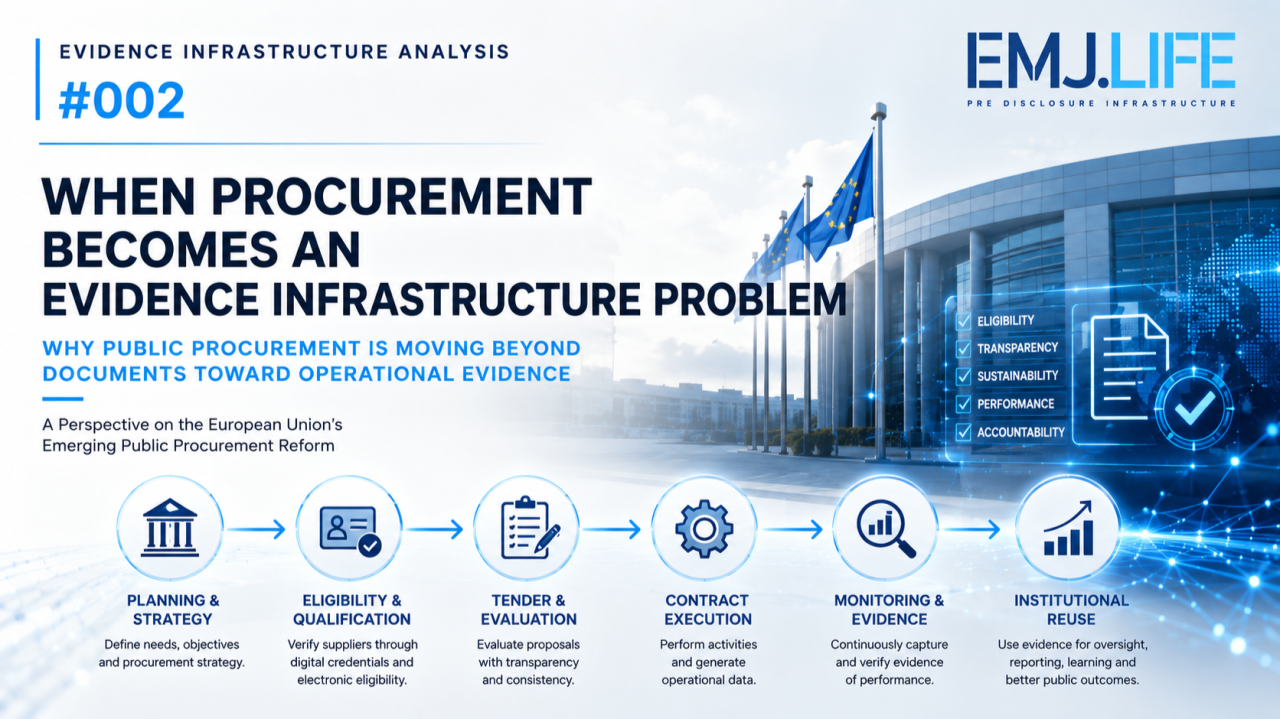
EU procurement reform connects digital credentials, eligibility services, data spaces and lifecycle monitoring, shifting supplier participation from document submission toward continuous operational evidence.
This English edition remains available for review but is excluded from search indexing until editorial approval.
Executive Summary / Lead
EU procurement reform brings digital business credentials, electronic eligibility services, procurement data spaces and lifecycle monitoring into one architecture, moving procurement from document procedure toward a continuous information environment.
Company & Industry Context
Traditional procurement sequences planning, tendering, evaluation, award and contract management, with evidence submitted at administrative milestones. Sustainability, resilience and security make operational performance during delivery equally important.
Challenge / Why It Matters
Digital credentials identify eligible participants but do not prove what happened under a contract. Data spaces also cannot repair upstream evidence that was never formed or has lost its context.
Action / Solution / Implementation
Future systems should link supplier identity, material provenance, service delivery, performance, responsibility and time across the contract lifecycle, allowing eligibility, execution and oversight to share a traceable evidence chain.
Evidence / Results / Impact
The EU is developing PPDS and digital procurement tools to improve transparency, interoperability and policy analysis. The quality of these downstream capabilities depends on operational information entering them.
Industry & Institutional Implications
Institutional participation will depend increasingly on evidence, not documents alone. Identity establishes participation, while continuous evidence establishes confidence in performance. Both are required.
SNN Editorial / Evidence Infrastructure Perspective
SNN editorial analysis: Evidence Infrastructure complements procurement platforms and data spaces. It does not replace procurement law, eligibility decisions or public authority. This remains an institutional interpretation.
Future Outlook
Next steps include EU reform texts, PPDS expansion and digital-credential implementation. Human review must verify formal policy status and avoid describing initiatives or plans as fully implemented.
Sources, author and editorial responsibility
Source publication: SustainabilityNewsNetwork.net · Original author: Anderson Yu · Original publication date: 2026-07-14
International original and supporting sources
- Sustainability News Network original source ↗
- single-market-economy.ec.europa.eu original source ↗
- LinkedIn original source ↗
Topic hub: 企業與供應鏈
Translation status: ai-assisted-pending-review