ENGLISH EDITION · 議題探討
The Evidence Reality Gap: Why Nature Governance Is Becoming an Upstream Evidence Allocation Problem
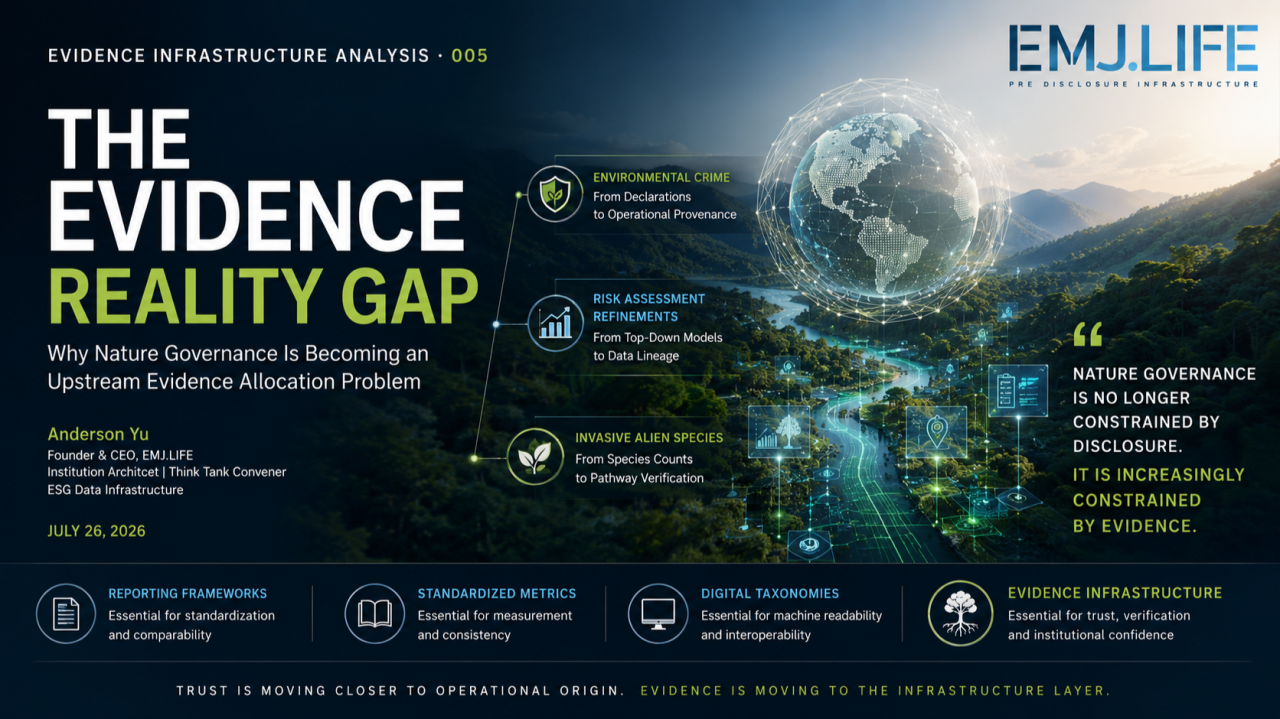
Three 2026 TNFD consultation papers on environmental crime, financial risk and invasive species converge on one need: trustworthy operational evidence formed before disclosure.
This English edition remains available for review but is excluded from search indexing until editorial approval.
Executive Summary / Lead
Three 2026 TNFD consultations address environmental crime, nature-related financial risk and invasive species, yet all depend on trustworthy operational evidence existing before disclosure.
Company & Industry Context
High-risk timber, mining, seafood and agricultural chains may face fraudulent permits, document laundering and provenance manipulation. Nature-related financial effects are also location-specific, ecosystem-dependent and operationally diverse.
Challenge / Why It Matters
Declarations and secondary data can improve consistency without proving actual activity. Paper inspections, contractor statements and proxy models limit auditability and financial quantification when data lineage is weak.
Action / Solution / Implementation
Governance should connect provenance, location, species or commodity, operational action, responsible actor and time. For invasive species, verification can focus on transport pathways and procedures that companies can directly control.
Evidence / Results / Impact
The TNFD materials indicate broad framework adoption while quantitative financial assessment remains limited. They also move attention from outcome metrics toward pathway management and operational proof.
Industry & Institutional Implications
The evidential burden is shifting upstream. Frameworks can define disclosure language and methods but cannot continuously verify the field, so market confidence increasingly depends on evidence capability within operations and value chains.
SNN Editorial / Evidence Infrastructure Perspective
SNN editorial analysis: The Evidence Reality Gap is an integrated interpretation of three TNFD papers, not a formal TNFD definition. Source facts, analytical inference and editorial perspective must remain distinct.
Future Outlook
Next steps include consultation feedback, final TNFD guidance and implementation examples. Human review should check the full scope of all three papers and avoid generalising from one sector.
Sources, author and editorial responsibility
Source publication: SustainabilityNewsNetwork.net · Original author: Anderson Yu · Original publication date: 2026-07-26
International original and supporting sources
Topic hub: 永續制度與揭露
Translation status: ai-assisted-pending-review