ENGLISH EDITION · 議題探討
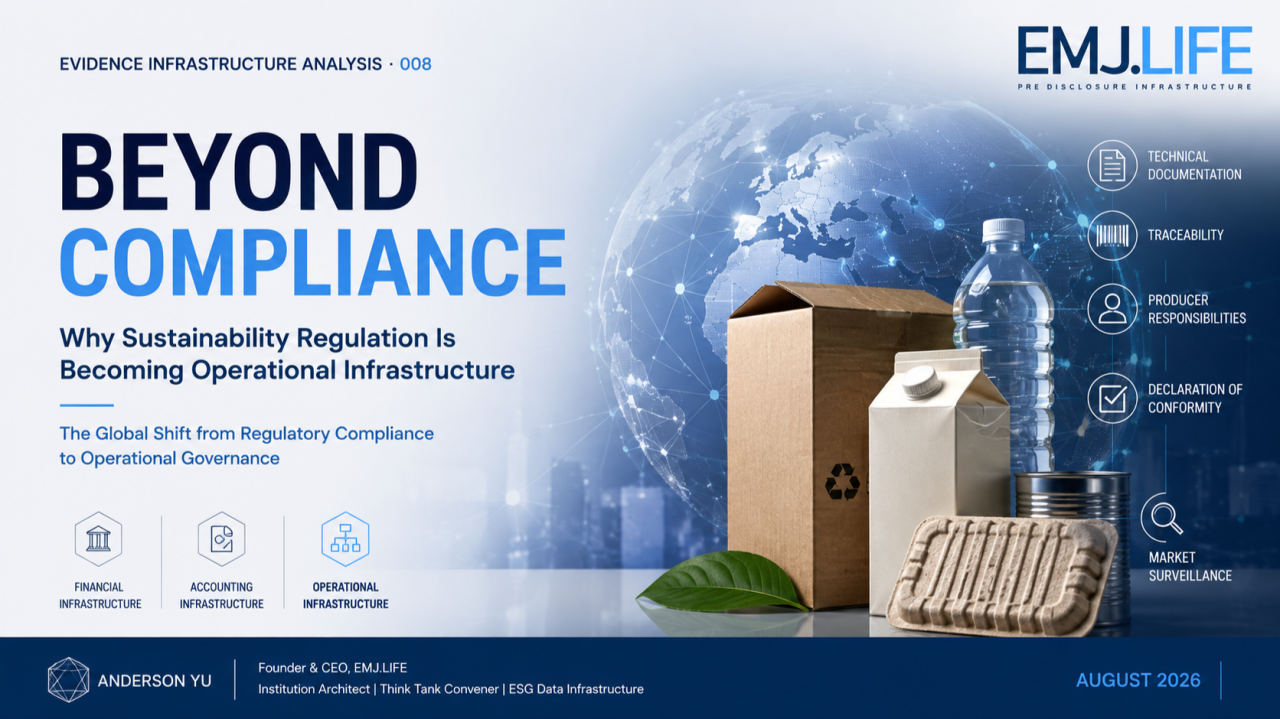
Beyond Compliance: Why Sustainability Regulation Is Becoming Operational Infrastructure
The EU PPWR FAQ connects manufacturer responsibility, technical documentation, declarations of conformity, traceability and market surveillance, showing regulation moving from policy obligations into operational architecture.
This English edition is available for independent reading and search discovery.

Executive Summary / Lead
The 2026 second-edition PPWR FAQ goes beyond policy objectives by connecting manufacturers, product documentation, conformity, traceability and market surveillance. It shows sustainability regulation being translated into operational architecture. The institutional signal of the PPWR is that packaging governance is no longer only a recycling target or environmental policy. It reaches product identity, manufacturer responsibility, technical documentation, declarations of conformity and market surveillance. Once these elements enter the product lifecycle, compliance cannot be assembled by legal or sustainability teams immediately before export; it becomes a joint output of design, procurement, manufacturing and change control. This Analysis therefore does not treat the conversion of sustainability regulation into product operating infrastructure under the PPWR as a self-contained technical or policy update. It separates the institutional facts supported by the official anchor, SNN editorial inference and outcomes that remain unverified. The reader should be able to see where the source ends, where interpretation begins and which conclusions the present evidence cannot support. To make the lead decision-ready, it answers five questions together: what has occurred, which first-party record supports it, through what mechanism the effect may travel, which outcome evidence is still missing, and what next observation could strengthen or overturn the judgement. Any causal relationship not stated by the source remains an editorial inference and is not converted into a factual claim through confident wording.
Company & Industry Context
Packaging rules involve manufacturers, importers, brands, retailers, logistics providers and recyclers. Multinational companies using fragmented local processes will struggle to maintain consistent product evidence and responsibility chains. Packaging may be formed by material suppliers, converters, brand owners, importers and retailers. The entity treated as manufacturer or producer affects documentation, labelling and extended responsibility. One packaging design may also face different requirements because material, weight, use or market changes. A product name is therefore not a sufficient evidence identity; the record must connect to version, batch and actual market role. Institutional context must identify the rule setter, implementer, data owner, reviewer and affected market. Those roles may sit in different organisations or functions, and publication of a document, deployment of a system, enterprise adoption and delivery of an outcome are different evidence states. Time and authority must also be separated. An announcement date is not an effective date; a pilot is not general adoption; a technical specification is not a legal obligation; and voluntary enterprise use is not regulatory approval. Putting these events on one timeline shows when an institutional development actually enters data, contract, investment or disclosure processes and which actor is authorised to make that transition.
Challenge / Why It Matters
The challenge is not only identifying applicable rules. Requirements must be embedded throughout the product lifecycle. Documents, declarations and traceability reconstructed at reporting time may not support supervision or cross-border audit. The main operating risk is misalignment among design, supply and regulatory data. A material formulation changes while the declaration still cites an old test; a brand receives supplier documentation but cannot establish the applicable batch; or one technical file is reused across markets. If surveillance sees only the final declaration, the company may be unable to prove which version was used and who approved it at the relevant time. When upstream evidence lacks stable identity, formation time, applicable boundary and version, a standardised output may still be impossible to reconstruct. The material risk is not one missing field. It is the silent conversion of the wrong entity, an expired method, an inferred relationship or an unapproved version into an apparent fact as information moves downstream. Concrete failure modes include incorrect entity matching, an incomplete data population, inconsistent boundaries, unversioned methods or factors, exceptions without rationale, approval occurring after publication, and downstream reuse outside the original purpose. Each failure can turn a reasonable individual record into a conclusion that cannot be defended after aggregation, comparison or machine-assisted interpretation.
Action / Solution / Implementation
Companies can integrate role identification, technical documentation, conformity assessment, product traceability and market feedback into a common operating model, preserving versions, provenance and responsible parties so compliance becomes a process outcome. Operating infrastructure relates packaging components, materials, suppliers, tests, design versions, product batches, market roles, technical files and declarations. Every material substitution, regulatory update or supplier change triggers an impact assessment. The system retains the previous declaration, replacement evidence, approval and effective date so that the shipped version and documentary version remain aligned. The implementable control unit is a governed evidence object. Each material claim links to its primary source, calculation or judgement method, organisational and temporal boundary, accountable owner, control state, exception, approval and version. When any component changes, the system preserves the difference and affected uses instead of overwriting the earlier basis. A minimum operating control set includes a claim register, evidence owner, source snapshot, method identity, valid period, control frequency, exception threshold, review, approval and permitted downstream use. High-judgement or high-financial-impact items receive a stronger review tier. Lower-risk records use automated completeness and consistency checks so that governance effort is concentrated where a wrong claim would change a decision.
Evidence / Results / Impact
The FAQ repeatedly addresses manufacturer and producer definitions, required documentation, conformity evidence and market surveillance. These implementation details show regulatory obligations reaching the execution layer. Official EU pages and questions-and-answers materials can support the PPWR's institutional scope and implementation direction, but enacted provisions, later delegated acts, guidance and industry interpretation must remain distinct. The operational convergence discussed here is a strategy that companies may adopt to reduce the cost of multiple market systems; it does not give EU requirements global legal effect. Evidence assessment begins with the official anchor and uses independent primary or method-transparent sources to test context and limits. The sources support stated institutional facts and explicit figures. Claims of comprehensive adoption, causal improvement or universal cross-market effectiveness require separate implementation evidence. Every material sentence should enter a claim ledger and be classified as official fact, direct measurement, estimate, corporate commitment, delivered outcome or SNN editorial inference. The ledger records the precise scope that each source supports. Conflicting evidence is retained with the resolution rationale; absent evidence is marked pending rather than filled with a convenient analogue from another entity, period or jurisdiction.
Industry & Institutional Implications
When regulation reshapes operations, multinationals may extend a higher standard beyond Europe to reduce the cost of maintaining multiple systems. This is operational convergence, not global legal harmonisation. When product evidence is formed in daily operations, conformity becomes an operating outcome. If evidence is gathered only before audit, compliance remains an expensive endpoint project. A mature company can identify affected products, documents requiring update, inventory transition dates and the version received by each customer, then scope market surveillance or recall quickly. The purpose of this information density is not length for its own sake. It is to shorten the verification distance between claim and decision. Boards, investors, regulators and operational teams should be able to distinguish fact, estimate, commitment, progress and outcome, then update the judgement when conditions change without reconstructing the case from scattered files and oral explanation. Accountability therefore attaches to decision rights. The data owner maintains the source, the method owner controls calculation, the business function defines the use case, internal control or assurance tests reproducibility, and the approver accepts responsibility for final use. An exception without an expiry date, remediation owner and impact scope stops being temporary treatment and becomes persistent evidence debt.
SNN Editorial / Pre-Disclosure Evidence Infrastructure Perspective
SNN editorial analysis: For Taiwan food, electronics, retail-brand and packaging suppliers, EU PPWR reaches beyond customs clearance into material composition, packaging design, supplier identity, batch-level technical files and declarations of conformity. Taiwan companies need Pre-Disclosure Evidence Infrastructure to form product evidence during operations rather than reconstruct it only before shipment. Taiwan food, electronics, retail-brand and packaging suppliers exporting to Europe need connected records for material formulation, recycled content, weight, supplier declarations, tests, product batches and EU market roles. Smaller suppliers that deliver only PDF certificates to brand customers lose continuity after a change. Reusable evidence objects can jointly support customer audit, PPWR, product design and other market requirements. For Taiwan, relevance should be traced through an actual transmission path. An international rule or customer requirement first enters finance, procurement, contract, supplier-data and assurance processes, then changes local systems and controls. It does not automatically become Taiwan law. Companies need to identify the applicable scenario, preserve bilingual mappings and make the evidence chain reviewable under controlled access. Taiwan companies can perform the transmission test on concrete objects: the company and legal entity, facility, product, batch, supplier, contract, financing instrument and disclosure field. Chinese and English names, internal and external classifications and different reporting frameworks should resolve to the same claim identity. Traceability must still preserve commercial confidentiality, personal data and access boundaries; it does not require unrestricted publication.
Future Outlook
Future review should track PPWR implementing measures, sector guidance and national surveillance practices. Editors must verify the FAQ version and effective dates before presenting analytical trends as settled legal outcomes. Future work should follow delegated acts, labelling, recycled-content calculations and national surveillance practice. A low-regret action is to select one product exported to the EU, create a controlled product dossier from packaging design to shipped batch, and simulate a material change to test whether the system immediately identifies affected tests, declarations, inventory and customers. Future monitoring should separate final text, technical guidance, adoption scope, operating controls, supervision and observable outcomes. A low-regret step is to select one high-risk claim for an end-to-end reconstruction test and record missing identity, source, method, accountability and version. That is governance preparation, not a compliance guarantee or forecast of results. Monitoring should be event-triggered as well as calendar-based. A final rule, amended technical guidance, expanded scope, supervisory action, adoption data or observed outcome creates a new version and a reassessment of the earlier judgement. The prior conclusion is not erased. It retains its original basis, identifies the new evidence that changed it and states which decisions or downstream uses now require review.
Sources, evidence chain and editorial responsibility
Source publication: sustainabilitynewsnetwork.net · Original author: Anderson Yu · Original publication date:
Original publication
External institutional and reporting sources
These external announcements, rules, studies and reports support the discussion and are displayed separately from the original publication.
- Primary analysis sourceEuropean CommissionPackaging and Packaging Waste Regulation ↗Published date not provided · Accessed 2026-08-16 19:26:49
Official primary source selected through publication-level web research.
- Taiwan industry-context source經濟部中小及新創企業署歐盟PPWR法規對我國中小企業之影響與因應策略 ↗Published 2026-03-25 · Accessed 2026-08-25
Supports the Taiwan industry implications for document-based compliance, technical files, declarations of conformity and EU market access under PPWR.
Topic hub: Pre-Disclosure Evidence Infrastructure
中文版 ↗