ENGLISH EDITION · 議題探討
The Boundary Governance Shift: What ESRS 40a Reveals About Cross-Border Sustainability Reporting
EFRAG's ESRS 40a exposure draft allows different reporting populations across sustainability topics, turning reporting boundaries from assumed administrative conditions into governance objects that must be explained and reconstructed.
This English edition remains available for review but is excluded from search indexing until editorial approval.
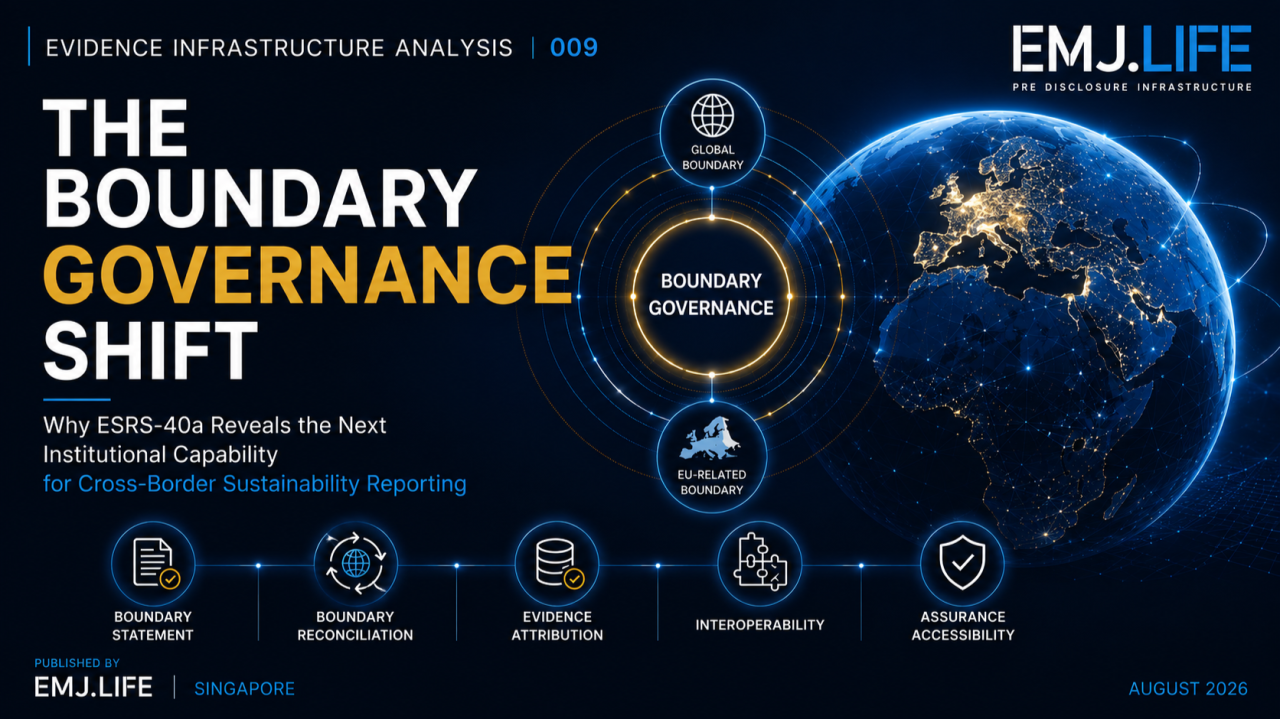
Executive Summary / Lead
The ESRS 40a exposure draft proposes a mixed approach in which climate information remains global while some non-climate information may be limited to EU-related impacts. Reporting boundaries are no longer a fixed background condition.
Company & Industry Context
Multinational reporting has traditionally followed legal entities, consolidation scopes and established operating systems. When different topics may use different populations, the single-boundary model requires redesign.
Challenge / Why It Matters
The main challenge is faithful representation and comparability. Companies must explain how a reporting population was formed, why allocation methods are reasonable and whether assurance providers can independently reconstruct the same boundary.
Action / Solution / Implementation
Practical boundary governance requires scope determination, methodology control, evidence attribution, reconciliation and reconstruction. These mechanisms must operate before disclosure and preserve the rationale and version of each boundary decision.
Evidence / Results / Impact
The consultation focuses on reporting populations, allocation methods, interoperability, implementation feasibility and boundary transparency. Together these issues show that the boundary itself has become a governed object.
Industry & Institutional Implications
Cross-border reporting may legitimately contain several scopes. Institutional quality depends less on forcing uniformity than on ensuring that each scope remains connected to the same operational reality and can be verified.
SNN Editorial / Evidence Infrastructure Perspective
SNN editorial analysis: Boundary Governance is not another reporting standard. It is an upstream evidence capability. Reviewers must distinguish the EFRAG proposal from EMJ.LIFE's independent institutional interpretation.
Future Outlook
Next steps include EFRAG finalisation, EU adoption and implementation testing. Human review should verify the consultation version, the entities covered by Article 40a and the final wording of the mixed approach.
Sources, author and editorial responsibility
Source publication: SustainabilityNewsNetwork.net · Original author: Anderson Yu · Original publication date: 2026-08-06
International original and supporting sources
Topic hub: 永續制度與揭露
Translation status: ai-assisted-pending-review