ENGLISH EDITION · 議題探討
After Deployment: Why High-Risk AI Requires a Continuous Evidence System
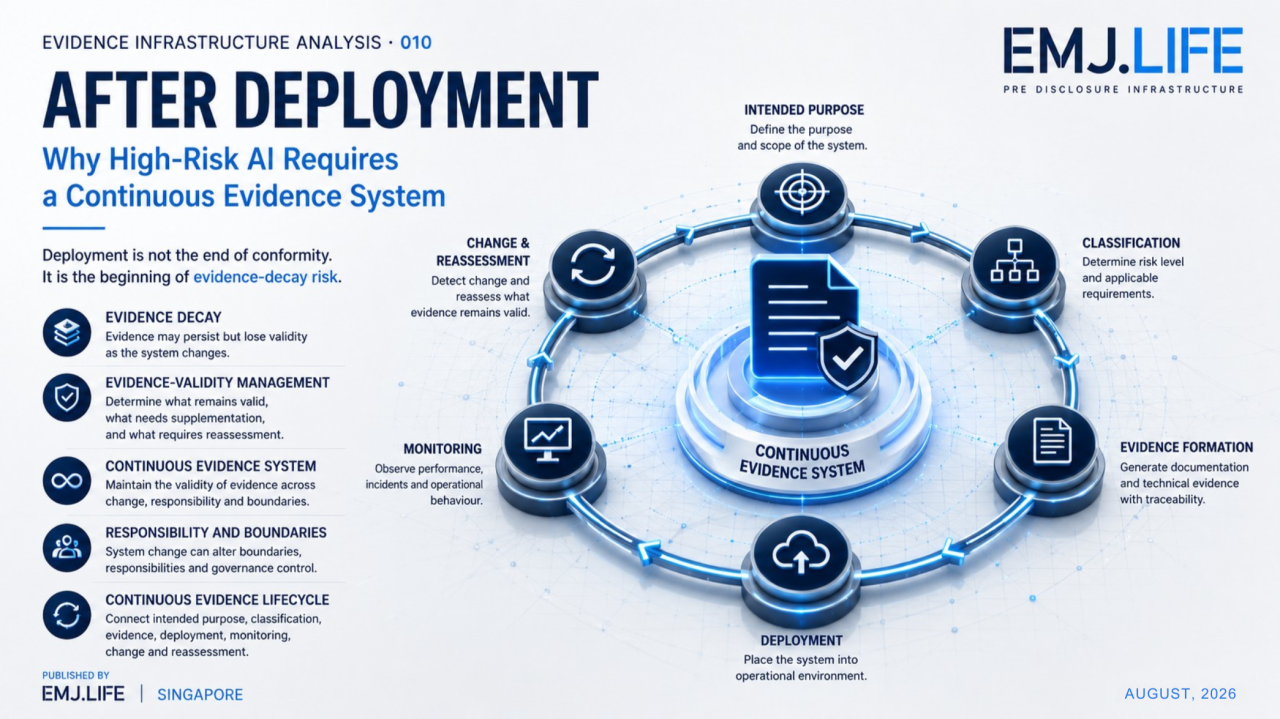
A 2026 European Commission study shows why high-risk AI governance cannot stop at pre-deployment documentation. Changing data, configurations, uses and responsibilities require evidence validity to be maintained throughout operations.
This English edition remains available for review but is excluded from search indexing until editorial approval.
Executive Summary / Lead
The Commission study indicates that deployment is not the end of conformity. Once a high-risk AI system operates, its data, version, users, integrations and intended purpose may change, weakening the representativeness of earlier evidence.
Company & Industry Context
Providers, integrators and deployers control different parts of the AI lifecycle. Conventional governance concentrates classification, risk assessment, technical documentation and conformity decisions before release, followed by post-market monitoring.
Challenge / Why It Matters
The risk is not limited to system failure. Records may remain available while no longer describing the operating system. Distributed responsibility and incremental modifications make governance boundaries and reassessment duties harder to determine.
Action / Solution / Implementation
A continuous evidence system should bind system versions, purposes, data, responsible actors and governance boundaries. When material change occurs, it should identify which evidence remains valid, which needs supplementation and which requires reassessment.
Evidence / Results / Impact
The study draws on 544 consultation responses, three expert workshops with 166 recorded participations and a follow-up survey. Intended purpose, role allocation, value-chain information and substantial modification repeatedly emerged as implementation concerns.
Industry & Institutional Implications
Conformity therefore becomes a maintained condition rather than a one-time conclusion. Monitoring may detect change, but governance must also determine boundary shifts, responsibility and whether previous evidence still supports institutional reliance.
SNN Editorial / Evidence Infrastructure Perspective
SNN editorial analysis: Evidence Decay and the Continuous Evidence System are EMJ.LIFE institutional interpretations, not legal conclusions of the European Commission. Their value is the distinction between evidence that exists and evidence that remains valid.
Future Outlook
Future high-risk AI governance will depend on evidence flowing back from deployment, updates, incidents and corrective actions. Human review should verify the official study, the AI Act scope and the responsibilities assigned to each actor.
Sources, author and editorial responsibility
Source publication: SustainabilityNewsNetwork.net · Original author: Anderson Yu · Original publication date: 2026-08-10
International original and supporting sources
- Sustainability News Network original source ↗
- doi.org original source ↗
- EUR-Lex original source ↗
- digital-strategy.ec.europa.eu original source ↗
- LinkedIn original source ↗
Topic hub: 企業與供應鏈
Translation status: ai-assisted-pending-review