ENGLISH EDITION · 議題探討
When the Reader Is No Longer Human: Why Institutional Evidence Needs Machine-Readable Infrastructure
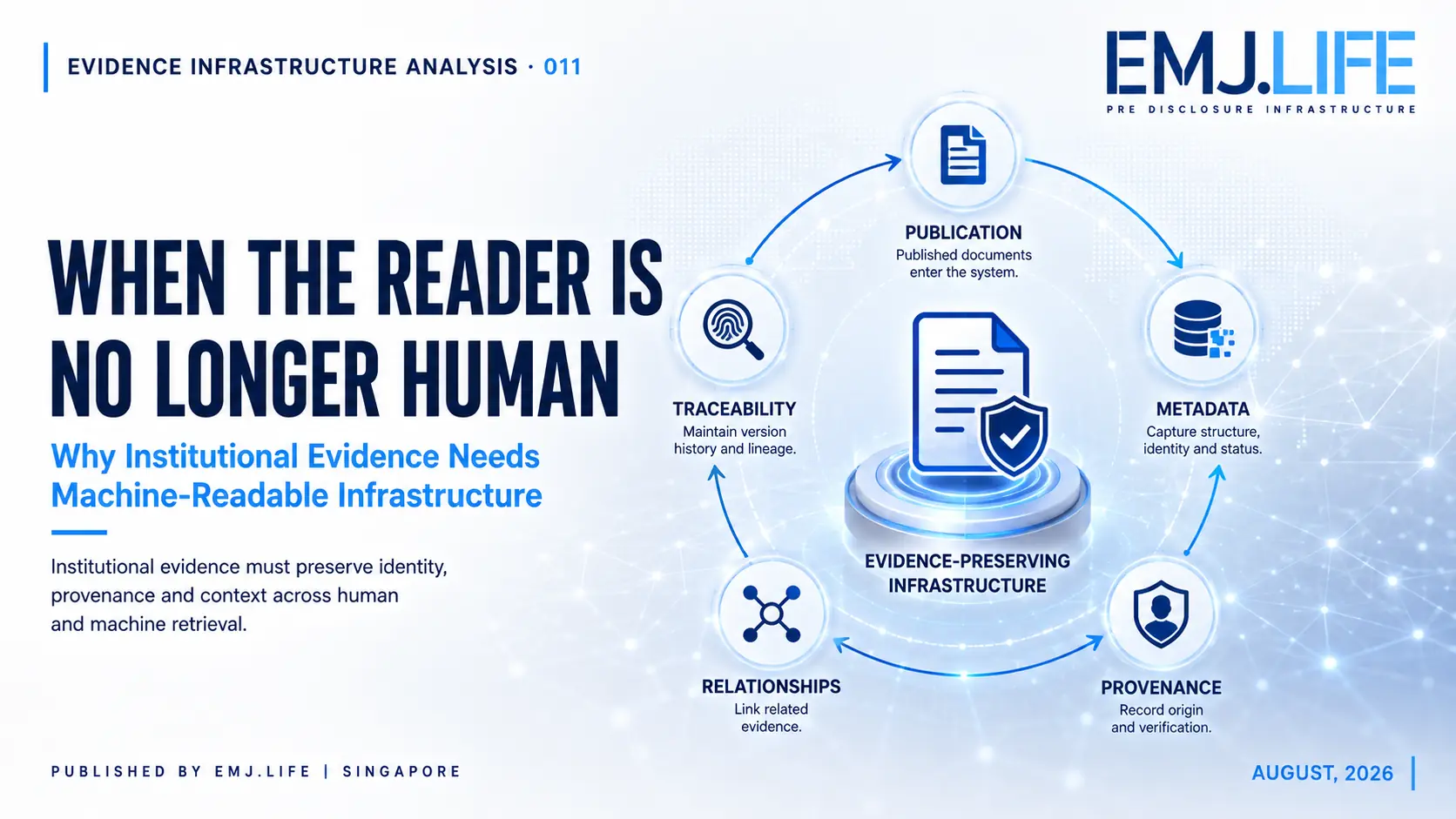
Institutional evidence must preserve identity, provenance and context across human and machine retrieval. The challenge is whether institutional meaning can survive when the first reader is no longer human.
This English edition is available for independent reading and search discovery.
Executive Summary / Lead
Search systems, automated research tools and AI increasingly participate in the discovery, retrieval and interpretation of institutional information before it reaches a human reader. The resulting challenge is not simply whether information can be found. It is whether its institutional meaning can survive retrieval.
Company & Industry Context
The institutional web has traditionally relied on human readers to reconstruct context. They recognize institutional branding, infer hierarchy from page structure, distinguish a regulator from a commentator, compare publication dates, and understand that analysis about a standard is not the standard itself. Much of this context exists around the information object rather than inside it.
Challenge / Why It Matters
The environment in which information is published may no longer be the environment in which it is encountered. This creates the Retrieval Boundary. If only the text survives, source, publication type, version relationships and status may disappear. Evidence Ambiguity arises when the information required to interpret institutional significance no longer travels with the evidence.
Action / Solution / Implementation
An Evidence Object carries identity, origin, type, time, status, version, relationship, provenance and authority. Evidence-Preserving Infrastructure connects persistent evidence identity, explicit evidence type, structured metadata, provenance, version and relationship management, canonical discovery and evidence-preserving retrieval. The progression is Published, Discoverable, Machine-Readable, Machine-Interpretable, Traceable, Institutionally Contextualized and Evidence-Preserving.
Evidence / Results / Impact
This publication is informed by institutional publication, standards navigation, persistent repositories, structured metadata, provenance and machine-readable information environments. Relevant environments include the IFRS Sustainability Standards Navigator, the International Trade Centre Standards Map, the European Commission Joint Research Centre Publications Repository, and emerging research on provenance-aware sustainability knowledge infrastructures.
Industry & Institutional Implications
A publication can be discoverable without being correctly interpretable. It can be machine-readable without being institutionally identifiable, retrieved without preserving provenance, and cited without distinguishing primary evidence from secondary interpretation. Search optimization improves the probability that information will be found. Evidence-Preserving Infrastructure improves the probability that found information will still be understood correctly.
SNN Editorial / Evidence Infrastructure Perspective
Evidence Decay asks whether evidence still describes reality. Evidence Ambiguity asks whether retrieved evidence still describes itself. Evidence does not remain trustworthy merely because it continues to exist. Evidence Object, Retrieval Boundary, Evidence Ambiguity, Evidence-Preserving Discovery and Evidence-Preserving Infrastructure are EMJ.LIFE institutional interpretations, not adopted terminology or regulatory requirements of the institutions referenced.
Future Outlook
The future institutional web may need to function as an Evidence Environment in which identity persists, provenance remains traceable, versions remain distinguishable, relationships remain reconstructable, evidence classes remain separate and institutional meaning survives retrieval. The next challenge may not be producing more content. It may be ensuring that evidence carries the conditions required to interpret it correctly.
Sources, author and editorial responsibility
Source publication: SustainabilityNewsNetwork.net · Original author: Anderson Yu · Original publication date: 2026-08-20
International original and supporting sources
Topic hub: Evidence Infrastructure
Translation status: source-preserved