
ENGLISH EDITION · 議題探討
Interoperability Is Not Binary: Why AI Agents Need Relationship Strength to Govern Sustainability Evidence
EIA-014 uses six DOI-registered Direct Mapping Guides to examine why AI Agents need governed relationship types, strengths, conditions and claims boundaries when moving evidence across GRI, ESRS, TNFD, COSO, Scope 3 and the SDGs.
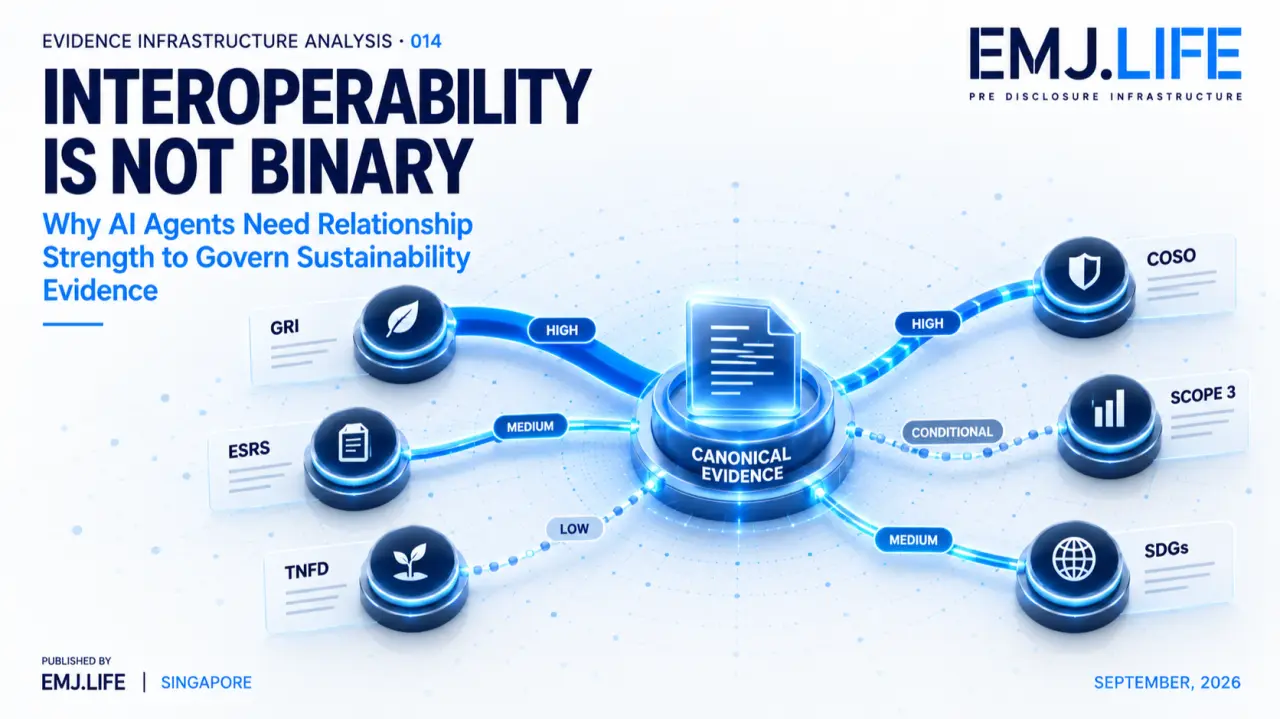
Executive Summary / Lead
Evidence Infrastructure Analysis 014 does not ask only whether sustainability frameworks can be cross-referenced. It asks whether an AI Agent can move evidence across frameworks without changing the institutional meaning of each relationship. The canonical edition draws on six controlled Direct Mapping Guides covering GRI, ESRS, TNFD, COSO, the GHG Protocol Scope 3 Standard and the United Nations Sustainable Development Goals. All six begin from the same 128 canonical MME task positions, but they do not compress the use of common evidence into a binary mapped or unmapped result. The central proposition is that interoperability is not binary. If an Agent receives only an A-to-B signal, it may treat candidate relevance as applicability, support as proof, a strong route as sufficient evidence, or a route in one framework as a compliance conclusion in another. Machine execution requires relationship type, relationship strength, activation conditions, evidence state, claims boundaries, authority and method version, together with the governance decisions that remain reserved for authorised people. This edition describes that capability as Relationship-Governed Interoperability. It is an independent EMJ.LIFE analytical construct, not terminology adopted by the six framework institutions and not evidence of their approval. The purpose is to govern when an Agent may Route, when it must Hold, when it must Escalate and when No Route is the correct result.
Company & Industry Context
Many crosswalks reduce interoperability to a question: does A map to B? A knowledgeable human may understand that the relationship does not automatically establish applicability, materiality, compliance, control effectiveness, inventory completeness, contribution or assurance. An AI Agent should not be expected to reconstruct those distinctions from a Boolean flag. The six DOI publications therefore separate multiple governance dimensions. Relationship Type identifies whether a route is direct, supporting, contextual, conditional or control-related. Routing Relevance identifies whether the evidence should enter a next process. Route State distinguishes active, pending, held and unavailable routes. Evidence Sufficiency asks whether evidence is adequate for its intended role. Assurance Readiness asks whether the evidence and controls are ready for an assurance procedure. Framework-specific states may separately address materiality, control, inventory or contribution. Relationship strength may be described as HIGH, MEDIUM, CONDITIONAL, LOW and NO-DEFAULT-ROUTE. These labels are not model confidence probabilities. HIGH does not mean a disclosure is satisfied. MEDIUM does not mean fifty per cent confidence. CONDITIONAL does not mean weak evidence. NO-DEFAULT-ROUTE does not mean the system failed. They describe how an institutional relationship may be used. The boundary must remain explicit: Relationship Strength is not Decision Confidence. The first is a governance attribute of a route. The second, if used, belongs to a separate model or decision assessment. Combining them allows reusable evidence relationships to expand into conclusions that the original source never authorised.
Challenge / Why It Matters
A human analyst who sees Activity A routed toward TNFD will usually understand that entity context, nature-related dependencies and impacts, materiality, an applicable disclosure and a LEAP assessment remain to be considered. An Agent receiving only TNFD=true may retrieve, rank, combine and execute the relationship in another workflow, producing an institutionally invalid conclusion from a technically correct mapping. The same failure takes different forms across the six environments. A GRI route does not determine impact materiality. An ESRS route marked PENDING-DMA does not establish disclosure applicability. A TNFD relationship does not demonstrate that LEAP has been completed. COSO CONTROL-SUPPORT does not prove that a control is designed, implemented or operating effectively. A Scope 3 route does not establish category applicability, inventory completeness or emissions quantity. An SDG Target relationship does not demonstrate contribution, outcome or achievement. The risk becomes greater when machine-readable relationships propagate. Scope 3 relevance can become category applicability, then inventory coverage and finally an emissions conclusion. Each step may appear plausible while the final claim exceeds the authority of the first relationship. EIA-014 calls this Relationship Inflation. The governing question is therefore not whether a larger mapping can be built. It is what the Agent must know before it is allowed to act. At minimum, it needs the reason for the relationship, its governed strength, the facts that activate it, the current evidence state, prohibited claims and the point at which an authorised human decision is still required.
Action / Solution / Implementation
Moving from binary mappings to governed relationships changes the executable path to: Evidence Object → Relationship Type → Relationship Strength → Activation Condition → Evidence State → Claims Boundary → Governance Action. Each layer answers a different question and cannot be substituted for another. Canonical Evidence Identity keeps the same operational evidence identifiable across several framework routes. Typed Relationships distinguish direct, supporting, contextual, conditional and control-related uses. Relationship Strength records institutional routing relevance. Activation Conditions prevent a conditional route from becoming active before entity, period, location, method or materiality facts are present. Independent Evidence States keep routing relevance separate from Evidence Sufficiency and Assurance Readiness. Claims Boundaries should be machine-readable. A route to GRI topic assessment is not a materiality conclusion. A COSO support route is not control effectiveness. An SDG relationship is not measurable contribution. Authority and Version Control must connect the route to its governing methodology, release status and effective version so a later user can reconstruct which rule applied at the time. The correct reasoning path is Evidence → Relationship → Strength → Governance Check → Route / Hold / Escalate / No Route, not Find Mapping → Generate Answer. NO-DEFAULT-ROUTE is a positive governance instruction. The Agent should not fill an institutional gap with the nearest concept. It may need to stop, preserve a negative result, wait for entity-specific facts or escalate the decision. An implementable relationship record should contain at least evidence_id, relationship_type, strength, activation_condition, evidence_state, claims_boundary, authority, method_version, effective_date, review_owner and decision_state. A state change creates a new version rather than overwriting the earlier decision. That record makes it possible to reconstruct why an Agent routed, why it stopped and which authorised decision changed the outcome.
Evidence / Results / Impact
The evidence chain is deliberately separated into three layers so that source volume does not create false independence. The first layer is the canonical EIA-014 publication on sustainabilitynewsnetwork.net. It supports the series identity, original English analysis, author, publication date and analytical boundary. It is the synchronisation source and is not counted as external evidence. The second layer contains the six direct DOI links for DMG01 through DMG06. They are the publication basis and source data for the analysis. They support persistent identity, version, publication date, the common 128 MME task positions and the stated limitations for each framework. Because all six are issued by EMJ LIFE HOLDINGS PTE. LTD., they are not represented as independent external validation. The third layer contains seventeen independent official or standard-setting sources, exceeding the required fifteen-source threshold. GRI Universal Standards, IFRS S1, IFRS S2, the SASB international-applicability update, the joint GRI and IFRS Foundation GHG interoperability resource, and the IFRS Foundation and EFRAG interoperability guidance support the distinct purposes, users and materiality perspectives of reporting systems. The ESRS legal text on EUR-Lex and EFRAG materiality and value-chain guidance support the boundaries that a technical mapping cannot replace. TNFD Recommendations and LEAP guidance support nature-related identification, assessment and disclosure as separate processes. COSO ICSR and COSO/WBCSD ERM guidance support the separation between a relationship and control or risk conclusions. The GHG Protocol Scope 3 Standard supports category, method and inventory-boundary requirements. The UN 2030 Agenda and Global Indicator Framework distinguish Goals, Targets and Indicators. W3C PROV-O supports preservation of entities, activities, agents and provenance across systems. Every external record includes title, institution, source role, publication date, access date and claims supported. These records support framework and technical boundaries. They do not imply that any issuing institution reviewed or endorsed Relationship-Governed Interoperability, Relationship Inflation or the 128 MME task architecture.
Industry & Institutional Implications
For enterprises, Relationship-Governed Interoperability changes both the data model and the allocation of responsibility. Sustainability, finance, risk, internal control, technology and assurance functions cannot treat a mapping table as a completed decision. Data teams preserve identity, version and transformation history. Framework owners define relationship types and activation conditions. Management or governance bodies authorise materiality, applicability and claims. Internal control and audit test whether relationship rules operate as designed. External assurance reaches conclusions only within an agreed scope. For technology providers, retrieval relevance, vector similarity and model confidence cannot substitute for institutional relationship strength. A system may suggest candidate routes, but candidate, active, conditional, held, pending and no-default-route states must remain distinct. Interfaces should expose activation conditions and prohibited claims instead of displaying only a matched indicator. For standard setters and regulators, interoperability extends beyond shared fields or aligned taxonomies. When two frameworks serve different users, decisions, materiality perspectives or accountability structures, common evidence may be reused upstream while the downstream governance decision must be performed again. The practical principle is: Reuse the evidence. Re-perform the governance decision. The same evidence can therefore have a HIGH relationship to one framework, MEDIUM to another, CONDITIONAL to a third and NO-DEFAULT-ROUTE to a fourth. That is not inconsistency. It reflects different institutional questions. Mature interoperability preserves differences, records transformations and limits inference distance instead of forcing apparent equivalence.
SNN Editorial / Pre-Disclosure Evidence Infrastructure Perspective
For Taiwan industries, the six international systems can enter the enterprise and supply chain through different routes. Listed companies may prepare IFRS sustainability disclosures while responding to customer requests based on GRI or ESRS, performing nature-related assessment, governing internal controls and compiling Scope 3 inventories. Electronics, semiconductor, manufacturing, finance and export supply chains may also receive overlapping requests from group headquarters, global customers, financial institutions and assurance providers. A single framework crosswalk may reduce repeated collection while concealing differences in materiality, entity boundary, control state, emissions category and contribution claims. Pre-Disclosure Evidence Infrastructure allows Taiwan enterprises to assign stable evidence identities to factories, equipment, supplier questionnaires, procurement transactions, emission factors, calculation models, approvals and assurance procedures before reporting begins. Each cross-framework route can retain relationship type, strength, activation condition, claims boundary, method version and accountable owner. Chinese and English disclosures should point to the same governed claim instead of creating a second uncontrolled conclusion through translation. Supply-chain information must not become verified merely because it can be routed to Scope 3, ESRS or TNFD. Enterprises should distinguish supplier representation, estimation, original record, platform transformation, internal review and independent assurance, while enabling assurance services to trace each transformation. When conditions are missing, the system should preserve Hold or Escalate instead of generating the nearest answer to complete a report. For Taiwan boards, audit committees and the assurance-services market, the important questions are who may promote a candidate relationship into a disclosure claim, which controls validated the state transition and whether new evidence affects the continuing validity of an earlier conclusion. This is an SNN.TW Taiwan industry transmission analysis. It is not a new requirement issued by a Taiwan authority and does not constitute reporting, legal, inventory or assurance advice.
Future Outlook
The next stage is not an unlimited expansion of crosswalk fields. It is testing whether relationship governance remains stable in real workflows. Enterprises can select high-reuse evidence across GRI, ESRS, TNFD, COSO, Scope 3 and the SDGs, then test whether the same evidence object retains its identity, method, period, entity and authority under each route. They should also confirm that the Agent stops when a relationship has NO-DEFAULT-ROUTE. Four minimum tests are useful. First, an independent reviewer should travel from a final disclosure to source evidence and every relationship transition. Second, a method-version or materiality change should update only affected routes. Third, removing an activation condition should move the Agent to Hold rather than allowing continued inference. Fourth, users should be able to distinguish relationship strength, model confidence and evidence sufficiency as separate fields. The six DOI publications provide a controlled research basis and the seventeen independent external records provide framework and technical boundaries. Neither layer replaces entity-specific decisions on applicability, materiality, controls, inventories, contribution or assurance. The continuing question is whether an AI Agent can reuse the evidence without changing what the relationship means.
Sources, evidence chain and editorial responsibility
Source publication: sustainabilitynewsnetwork.net · Original author: Anderson Yu · Original publication date:
External institutional and reporting sources
These external announcements, rules, studies and reports support the discussion and are displayed separately from the original publication.
- canonical EIA-014 source publication and analytical boundarysustainabilitynewsnetwork.net / EMJ.LIFEInteroperability Is Not Binary ↗Published 2026-09-07 · Accessed 2026-09-07T09:40:00.000Z
Canonical series identity, original English analysis, author, publication date, six-guide analytical basis and claims boundary.
- DOI source data and publication basis; not independent external validationEMJ LIFE HOLDINGS PTE. LTD.DMG01 | EMJ.NEXUS IFRS ISSB + SASB to GRI Direct Mapping Guide ↗Published 2026-09-07 · Accessed 2026-09-07T09:40:00.000Z
Supports the GRI routing source data, version 1.2, common 128 MME task positions and the boundary that a route does not determine impact materiality or compliance.
- DOI source data and publication basis; not independent external validationEMJ LIFE HOLDINGS PTE. LTD.DMG02 | EMJ.NEXUS IFRS ISSB + SASB to ESRS Direct Mapping Guide ↗Published 2026-09-07 · Accessed 2026-09-07T09:40:00.000Z
Supports the ESRS routing source data, version 1.0, common 128 MME task positions and the boundary that a route does not determine double materiality, applicability or compliance.
- DOI source data and publication basis; not independent external validationEMJ LIFE HOLDINGS PTE. LTD.DMG03 | EMJ.NEXUS IFRS ISSB + SASB to TNFD Direct Mapping Guide ↗Published 2026-09-07 · Accessed 2026-09-07T09:40:00.000Z
Supports the TNFD routing source data, version 1.0, common 128 MME task positions and the boundary that a route does not establish LEAP completion or nature-related materiality.
- DOI source data and publication basis; not independent external validationEMJ LIFE HOLDINGS PTE. LTD.DMG04 | EMJ.NEXUS IFRS ISSB + SASB to COSO Direct Mapping Guide ↗Published 2026-09-07 · Accessed 2026-09-07T09:40:00.000Z
Supports the COSO control-support source data, version 1.0, common 128 MME task positions and the boundary that a relationship does not establish control design, operation or effectiveness.
- DOI source data and publication basis; not independent external validationEMJ LIFE HOLDINGS PTE. LTD.DMG05 | EMJ.NEXUS IFRS ISSB + SASB to GHG Protocol Scope 3 Direct Mapping Guide ↗Published 2026-09-07 · Accessed 2026-09-07T09:40:00.000Z
Supports the Scope 3 routing source data, version 1.0, common 128 MME task positions and the boundary that a relationship does not establish category applicability, inventory completeness or emissions quantity.
- DOI source data and publication basis; not independent external validationEMJ LIFE HOLDINGS PTE. LTD.DMG06 | EMJ.NEXUS IFRS ISSB + SASB to United Nations Sustainable Development Goals Direct Mapping Guide ↗Published 2026-09-07 · Accessed 2026-09-07T09:40:00.000Z
Supports the SDG Goal and Target routing source data, version 1.0, common 128 MME task positions and the boundary that a relationship does not demonstrate contribution, outcome or achievement.
- Primary official framework sourceGlobal Reporting InitiativeGRI raises the global bar for due diligence and human rights reporting ↗Published 2021-10-05 · Accessed 2026-09-07T09:40:00.000Z
Supports the launch, architecture and impact-materiality orientation of the revised GRI Universal Standards.
- Primary official framework sourceInternational Sustainability Standards Board / IFRS FoundationIFRS S1 General Requirements for Disclosure of Sustainability-related Financial Information ↗Published 2023-06-26 · Accessed 2026-09-07T09:40:00.000Z
Supports the investor-focused general requirements and the separate institutional judgement required when applying IFRS S1.
- Primary official framework sourceInternational Sustainability Standards Board / IFRS FoundationIFRS S2 Climate-related Disclosures ↗Published 2023-06-26 · Accessed 2026-09-07T09:40:00.000Z
Supports the climate-disclosure requirements and incorporation of industry-based guidance derived from SASB Standards.
- Supporting official framework sourceIFRS FoundationNew and updated resources to help companies apply IFRS S1 and IFRS S2 from 2024 ↗Published 2023-12-14 · Accessed 2026-09-07T09:40:00.000Z
Supports the international-applicability updates to SASB Standards and their role as guidance when applying IFRS S1.
- Primary interoperability sourceIFRS Foundation and Global Reporting InitiativeNew resource on emissions reporting using GRI and ISSB Standards ↗Published 2024-01-18 · Accessed 2026-09-07T09:40:00.000Z
Supports documented interoperability considerations between GRI emissions reporting and IFRS S2 without implying general framework equivalence.
- Primary interoperability sourceIFRS Foundation and EFRAGIFRS Foundation and EFRAG publish interoperability guidance ↗Published 2024-05-02 · Accessed 2026-09-07T09:40:00.000Z
Supports alignment and difference analysis between ISSB Standards and ESRS, including climate disclosures.
- Primary legal framework sourceEuropean Union / EUR-LexCommission Delegated Regulation (EU) 2023/2772 as regards sustainability reporting standards ↗Published 2023-12-22 · Accessed 2026-09-07T09:40:00.000Z
Supports the authoritative ESRS architecture, disclosure requirements and legal boundary that a technical mapping cannot replace.
- Primary official implementation sourceEFRAGFinalization of Three EFRAG ESRS Implementation Guidance Documents ↗Published 2024-05-31 · Accessed 2026-09-07T09:40:00.000Z
Supports the distinct ESRS materiality-assessment and datapoint implementation processes and their non-authoritative guidance status.
- Supporting official value-chain sourceEFRAGEFRAG IG 2: Value Chain Implementation Guidance ↗Published 2024-05-31 · Accessed 2026-09-07T09:40:00.000Z
Supports the ESRS value-chain reporting boundary and the need to preserve entity, operational-control and value-chain context.
- Primary official framework sourceTaskforce on Nature-related Financial DisclosuresRecommendations of the Taskforce on Nature-related Financial Disclosures ↗Published 2023-09-18 · Accessed 2026-09-07T09:40:00.000Z
Supports TNFD disclosure recommendations and the boundary between candidate relevance and completed nature-related disclosure assessment.
- Primary official implementation sourceTaskforce on Nature-related Financial DisclosuresGuidance on the identification and assessment of nature-related issues: the LEAP approach ↗Published 2023-09-18 · Accessed 2026-09-07T09:40:00.000Z
Supports LEAP as a separate identification and assessment process that a relationship route cannot itself complete.
- Primary official control sourceCommittee of Sponsoring Organizations of the Treadway Commission / Institute of Internal AuditorsCOSO Releases New Supplemental Guidance on Achieving Effective Internal Control Over Sustainability Reporting ↗Published 2023-03-30 · Accessed 2026-09-07T09:40:00.000Z
Supports application of the COSO Internal Control Integrated Framework to sustainability reporting and the need for effective controls beyond mapping relevance.
- Supporting official governance sourceWorld Business Council for Sustainable Development and COSOApplying enterprise risk management to environmental, social and governance-related risks ↗Published 2018-10-22 · Accessed 2026-09-07T09:40:00.000Z
Supports a governed enterprise-risk process for ESG-related risks rather than inferring a risk conclusion from a relationship alone.
- Primary official framework sourceGHG Protocol / World Resources Institute / World Business Council for Sustainable DevelopmentCorporate Value Chain (Scope 3) Accounting and Reporting Standard ↗Published 2011-10-04 · Accessed 2026-09-07T09:40:00.000Z
Supports the fifteen Scope 3 categories, value-chain inventory methodology and the boundary that routing relevance does not establish inventory completeness or emissions quantity.
- Primary official framework sourceUnited NationsTransforming our world: the 2030 Agenda for Sustainable Development ↗Published 2015-09-25 · Accessed 2026-09-07T09:40:00.000Z
Supports the institutional definition of the Sustainable Development Goals and Targets and the boundary between relevance and demonstrated achievement.
- Primary official measurement sourceUnited Nations Statistics DivisionGlobal indicator framework for the Sustainable Development Goals and targets of the 2030 Agenda ↗Published 2017-07-06 · Accessed 2026-09-07T09:40:00.000Z
Supports the separately governed global indicator framework adopted in General Assembly resolution 71/313 and the distinction among Goals, Targets and Indicators.
- Supporting technical provenance standardWorld Wide Web ConsortiumPROV-O: The PROV Ontology ↗Published 2013-04-30 · Accessed 2026-09-07T09:40:00.000Z
Supports machine-readable representation and exchange of provenance relationships among entities, activities and agents across systems.
Topic hub: Pre-Disclosure Evidence Infrastructure