
ENGLISH EDITION · 議題探討
Machine-Readable Is Not Yet Machine-Verifiable: Why the IASB and ISSB Taxonomy Consultations Point to a Pre-Disclosure Evidence Gap
Why the IASB and ISSB Taxonomy Consultations Point to a Pre-Disclosure Evidence Gap
This English edition is available for independent reading and search discovery.
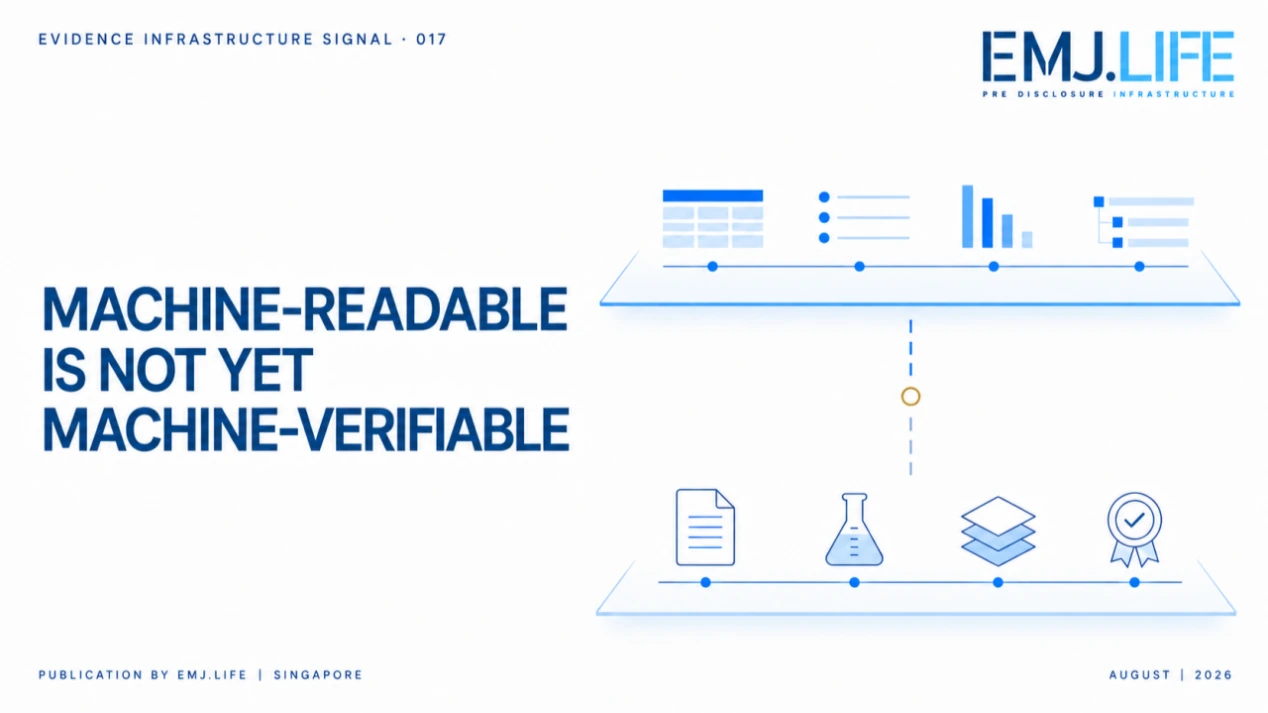
Executive Summary / Lead
The IASB and ISSB are consulting separately on updates to two different digital taxonomies. The IASB proposal concerns narrative elements in the IFRS Accounting Taxonomy. The ISSB proposal reflects amendments to greenhouse gas emissions disclosures in the IFRS Sustainability Disclosure Taxonomy. They involve different boards, requirements and comment deadlines; this editorial does not present them as one coordinated proposal. Viewed side by side, however, they expose the same upstream implementation question. A disclosure can be consistently tagged, extracted and compared without enabling a machine—or an authorised reviewer—to verify which source records, methods, boundaries, controls and approvals produced it. A taxonomy improves the readability of the disclosure layer. It does not by itself make the supporting evidence complete, connected, current or reproducible. The central signal is therefore precise: machine-readable is a necessary capability, but it is not a synonym for machine-verifiable. If institutions standardise the final tag without connecting the evidence beneath it, digital reporting can produce a highly structured output resting on a fragmented evidence environment.
Company & Industry Context
On 3 June 2026, the IFRS Foundation published IFRS Accounting Taxonomy 2025—Proposed Update 1 General Improvements for public comment, with a 7 September 2026 deadline. The proposal includes categorising text block elements by intended use, streamlining existing narrative elements and making targeted improvements to documentation labels and element types. Its focus is the consistent digital representation of narrative financial information. On 29 July 2026, the ISSB published a separate proposed update to the IFRS Sustainability Disclosure Taxonomy, reflecting amendments to greenhouse gas emissions disclosures issued in December 2025. The project page identifies 28 September 2026 as the comment deadline. This proposal translates new or amended disclosure requirements into structures that can be digitally tagged; it does not create a separate evidence-verification regime. Digital taxonomies provide substantial institutional value. They give reported elements consistent names, definitions and relationships, supporting discovery, comparison and processing by investors, regulators and analytical systems. But their normal starting point is information that has already become disclosure. Between an operational event and the final report sit data capture, transformation, estimation, judgement, internal control, approval and version management—the institutional space in which pre-disclosure evidence infrastructure operates.
Challenge / Why It Matters
The implementation challenge is not only whether the tag is technically valid. It is whether the tag can lead an authorised user back through a governed formation path. A digital element may identify a greenhouse gas emissions figure, an accounting policy or a narrative disclosure. It cannot independently establish which plant, system or supplier record supplied the data; which factor and calculation version were used; whether the organisational boundary remained consistent; who exercised judgement; or which evidence was reviewed and approved. Narrative reporting raises the same issue. Larger text blocks and more precise narrative elements may preserve context, but they do not prove that the documents supporting management judgement were complete, current or controlled at the reporting date. A taxonomy describes what a disclosure is. It does not automatically establish why the disclosure was formed. When these relationships remain dispersed across spreadsheets, ERP systems, consultant workpapers, email approvals and separate team repositories, an entity may produce a technically valid machine-readable filing while internal audit, assurance providers and regulators remain unable to reproduce the source-to-disclosure path reliably. Digitalisation then accelerates circulation without resolving evidential discontinuity.
Action / Solution / Implementation
A practical response is to treat every material disclosure as a governed evidence object, not merely as a field in the final report. At minimum, that object should connect the reported claim, primary source, calculation or judgement method, applicable boundary, data owner, control status, reviewer, approving authority, taxonomy element, and the exact version and time that entered the report. This architecture does not replace an IFRS Accounting or Sustainability Disclosure Taxonomy and does not alter their technical elements. It positions the digital tag at the final stage of an evidence chain and governs the upstream relationships. When source data, emissions factors, estimation methods or boundaries change, the system should preserve the previous evidence state and its impact rather than overwrite the basis on which an earlier disclosure was prepared. Implementation can begin with high-risk or judgement-intensive disclosures. Assign a stable identity and accountable owner; preserve source snapshots, method records, control evidence and approvals; and link them to the taxonomy mapping. Filing teams remain responsible for tagging quality, while finance, sustainability, data governance, internal control and assurance teams jointly maintain the evidence beneath the tag. Machine-verifiable does not mean automated truth. It means that authorised users can reconstruct the formation process consistently and inspect its governance state.
Evidence / Results / Impact
The two official sources support a clear but limited set of institutional facts. The IASB consultation page confirms publication on 3 June 2026, describes the principal changes to narrative elements and sets a 7 September 2026 deadline. The ISSB project page confirms that the board is considering taxonomy changes arising from greenhouse gas emissions disclosure amendments issued in December 2025 and that a proposed update was published on 29 July 2026 for public comment. Neither source states that the consultations form a joint programme, and neither uses the term Pre-Disclosure Evidence Infrastructure. Bringing them together is EMJ.LIFE's independent analytical interpretation of a shared upstream question: as accounting and sustainability disclosures become easier for machines to process, can the origin, method, version and authority behind those disclosures also be traced reliably? The resulting impact claim should remain disciplined. A consistent taxonomy can improve discoverability and comparability. Governed upstream evidence relationships can improve traceability and reproducibility. Used together, they may reduce assurance rework, version ambiguity and machine interpretation detached from context. This is an institutional design direction, not evidence that either consultation—or any market—has already achieved machine-verifiable reporting.
Industry & Institutional Implications
For enterprises, digital reporting can no longer be treated solely as a final-mile XBRL or tagging exercise. If financial reporting, sustainability data, internal control, information systems and assurance processes maintain different versions, the final digital tag merely packages those inconsistencies into an output that is easier to distribute. Governance must extend from who applies the tag to who owns the source, method, boundary, control and version. For investors and regulators, machine-readability increases the efficiency of large-scale comparison while also increasing the likelihood that information will be extracted without its original context. Without explicit source status, reporting period, version and authority, analytical systems may flatten distinctions between estimates and measurements, drafts and final records, or management narrative and controlled evidence. The next industry capability is therefore not simply a larger set of structured fields. It is the ability for structured disclosure and institutional evidence to travel together. That requires stable canonical references, explicit evidence types, traceable provenance, unambiguous versions and reconstructable disclosure-to-source relationships. A taxonomy supplies shared language; evidence governance determines whether that language remains connected to an inspectable factual basis.
SNN Editorial / Pre-Disclosure Evidence Infrastructure Perspective
For Taiwan industries, the issue is close to the operating reality of export manufacturing, electronics and semiconductor supply chains. Taiwan companies serving international and European markets may assemble reporting data from plant meters, energy-management platforms, ERP systems, supplier questionnaires, emissions-factor tables, consultant models and manual review. A single cross-border disclosure can span subsidiaries, languages and reporting systems. If digital tags are applied only at filing, a machine may read the number while the enterprise cannot promptly show the source snapshot, calculation version, organisational boundary and approving authority behind it. Taiwan listed companies, financial institutions and assurance providers can turn this signal into preparation that does not depend on a particular local mandate or filing date. Give each material disclosure a stable identity; preserve source evidence and calculation versions; map Chinese and English labels to the same governed claim; record data, control and approval owners; and connect each international taxonomy element to internal fields, methods and evidence locations. This can reduce repeated evidence requests during subsidiary consolidation, supply-chain follow-up and external assurance. The two IFRS Foundation consultations do not themselves impose a new obligation on Taiwan companies, and not every supporting record should be public. The more careful market inference is that, as global capital markets, cross-border customers and digital analytical systems rely more heavily on machine-readable disclosure, Taiwan enterprises will benefit from being able to reconstruct the underlying evidence chain quickly within appropriate access and confidentiality controls.
Future Outlook
The immediate institutional milestones are distinct. Comments on the IASB General Improvements proposal close on 7 September 2026; comments on the ISSB greenhouse gas emissions taxonomy update close on 28 September 2026. Stakeholders may respond to each consultation separately and should not allow this editorial's shared analytical lens to blur their governance, technical scope or decision authority. Whatever the final proposals contain, organisations can take low-regret steps now. Inventory high-risk and judgement-intensive disclosures, build disclosure-to-source mappings, preserve method and boundary versions, connect approval records to reporting snapshots, and test whether assurance personnel can reconstruct a material disclosure within a reasonable time. Those capabilities support financial and sustainability reporting, internal control, regulatory response and AI-assisted analysis without depending on a single taxonomy release. Future maturity should therefore be measured by more than whether a report can be read by a machine. The stronger question is whether authorised machines and people can identify origin, method, status, version and authority, then reconstruct the path from evidence to disclosure. Moving from machine-readable to machine-verifiable is not about attaching an automated truth label. It is about making the institutional conditions that produced the disclosure consistently, securely and auditably inspectable.
Sources, evidence chain and editorial responsibility
Source publication: sustainabilitynewsnetwork.net · Original author: Anderson Yu · Original publication date:
Original publication
External institutional and reporting sources
These external announcements, rules, studies and reports support the discussion and are displayed separately from the original publication.
- Primary institutional sourceIASB / IFRS FoundationIFRS Accounting Taxonomy 2025—Proposed Update 1 General Improvements ↗Published 2026-06-03 · Accessed 2026-08-28 11:24:08
Official IASB consultation page for the proposed update on narrative elements in the IFRS Accounting Taxonomy. Comments close on 7 September 2026.
- Primary institutional sourceISSB / IFRS FoundationIFRS Sustainability Disclosure Taxonomy—Proposed Update 1 Amendments to Greenhouse Gas Emissions Disclosures ↗Published 2026-07-29 · Accessed 2026-08-28 11:24:08
Official ISSB project page for the proposed taxonomy update reflecting amendments to greenhouse gas emissions disclosures. Comments close on 28 September 2026.
Topic hub: Pre-Disclosure Evidence Infrastructure