
ENGLISH EDITION · 議題探討
A Reporting Boundary Is Not Yet an Evidence Boundary: What ESRS-40a Reveals About Cross-Border Evidence Continuity
What ESRS-40a reveals about Cross-Border Evidence Continuity: law can define the reporting perimeter, but enterprises must preserve source, method, responsibility and version relationships before disclosure.
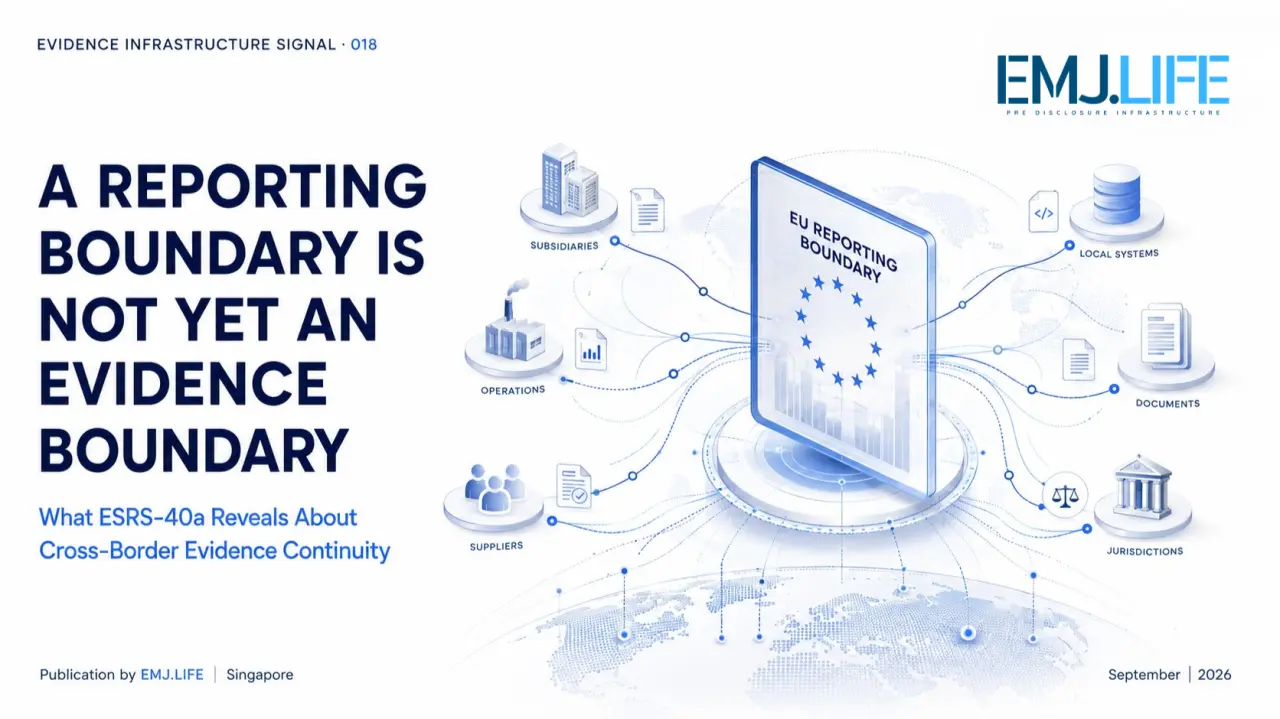
Executive Summary / Lead
EFRAG began international outreach on ESRS-40a in September 2026 while the exposure-draft consultation remains open until 31 October. The events invite feedback from non-EU companies that may fall within the reporting architecture established under Article 40a of the Accounting Directive. On the surface, this is an extension of a European sustainability-reporting perimeter toward certain third-country undertakings. The deeper implementation question is whether the evidence supporting that reporting can extend across companies, jurisdictions, information systems and value chains at the same pace. Law can define who reports. A standard can define what is disclosed. A data architecture can provide fields for consolidation. None of those steps automatically creates the identity, method, period, responsibility and version relationships attached to each underlying record. An organisation may complete its group reporting population and still be unable to reconstruct how a material statement moved from local operating evidence into the final sustainability report. This Signal therefore separates Reporting Completeness from Evidence Completeness. The first asks whether required fields have been populated. The second asks why each material claim can be relied upon and whether an authorised reviewer can follow the cross-border path back to the originating record. This publication calls that capability Cross-Border Evidence Continuity. The term is an independent EMJ.LIFE institutional interpretation; it is not terminology adopted by EFRAG, the European Commission or the European Union.
Company & Industry Context
EFRAG's ESRS-40a project concerns sustainability reporting by certain non-EU undertakings under Article 40a of the Accounting Directive. On 23 July 2026 EFRAG opened a 100-day consultation on the exposure draft. Its project material describes the scope following the 2026 changes, including certain third-country undertakings generating more than EUR 450 million of net turnover in the Union in each of the previous two consecutive financial years and satisfying specified subsidiary or branch conditions. EFRAG indicates that reporting is expected for financial years beginning on or after 1 January 2028. On 1 September 2026 EFRAG announced a series of outreach events during the month for non-EU companies potentially affected by Article 40a. Consultation topics include how EU-law concepts should be handled when operations sit outside their direct legal context, whether the reporting perimeter should address global impacts or an EU-related scope, and interoperability with jurisdictional standards based on IFRS Sustainability Disclosure Standards. These are institutional facts supported by EFRAG's formal records. A reporting population, however, is not a single database. A group sustainability statement may rely on subsidiaries, countries, operational systems, internal controls, measurement methods and value-chain participants that operate under different conditions. The same indicator can come from different systems, employ different estimation techniques, preserve different levels of detail and be owned by different functions. Placing those inputs inside one legal reporting boundary does not make their evidence automatically comparable, attributable or continuous.
Challenge / Why It Matters
The central implementation risk is that the reporting boundary can expand faster than the evidence boundary. An enterprise can identify every entity administratively in scope and issue a common collection template. Yet if source identity, methodology, jurisdictional context, control responsibility and transformation history do not travel with the data, the group receives values that can be aggregated without necessarily receiving an evidence chain that can be reconstructed. Cross-border consolidation can flatten material differences. One site may use direct equipment measurement while another relies on invoices or estimation. One subsidiary may preserve transaction-level records while another provides only consolidated totals. Supplier information may pass through a questionnaire, platform transformation or consultant model before it reaches the enterprise system. Those values can occupy the same reporting field, but they should not be treated as equivalent evidence without source and method attributes. The distance from evidence to disclosure grows when information crosses entities, languages, systems and jurisdictions. The loss of an identity or version relationship at any stage can create repeated work during assurance, internal audit, regulatory enquiry or correction. The relevant question is not merely whether information was delivered. It is whether an authorised reviewer can determine where it originated, which entity it belongs to, which period and boundary it represents, which method formed it, who controlled it and how it entered the consolidated disclosure. Evidence Boundary Expansion is not presented here as a new legal concept. It describes an operational condition: when the information required for disclosure extends across more entities and environments, the supporting evidence system must extend with it. Reporting scope can be defined by regulation. Evidence continuity must be established through operating governance.
Action / Solution / Implementation
A practical cross-border reporting architecture can be organised around seven connected capabilities. The first is Entity Binding: every record remains attributable to the subsidiary, branch, site, supplier or operating unit that produced it. The second is Evidence Identity: an underlying record keeps a stable identity independent of the consolidated disclosure into which it eventually flows. A value should not survive only as a number in a group field. The third capability is Jurisdictional Context. The regulatory setting, operational constraint, language, unit and retention rule applicable when evidence was produced remain identifiable. The fourth is Method Binding. Measurement procedures, calculation formulae, emissions factors, estimation assumptions, transformation rules and their versions stay connected to the result. The fifth is Provenance: group information can be traced back through intermediate transformations to local records and external sources. The sixth capability is Responsibility Binding. Roles for production, review, approval, control and correction are explicit. The seventh is Controlled Consolidation. When local evidence becomes group reporting, the organisation preserves eliminations, exchange rates, unit conversions, scope adjustments, missing-data treatments and management judgements. Together, the chain is Entity → Evidence → Jurisdiction → Method → Provenance → Consolidation → Disclosure. This is Cross-Border Evidence Continuity. Implementation can begin with a disclosure-to-source map. Each material statement connects to the reporting entity, operating boundary, authoritative record, calculation method, data owner, control owner, approving authority and report version. When a source, method or boundary changes, the system creates a new version and impact assessment rather than overwriting the basis of an earlier disclosure. A common group data model is useful, but it should expose local differences rather than erase them. Prioritisation should start with claims that cross many sites, rely on estimation, require supplier data, involve significant management judgement or are expected to receive external assurance. Teams can test whether an authorised reviewer can travel from the final number back to the source evidence within a reasonable period before expanding the model. Pre-Disclosure Evidence Infrastructure is neither another reporting standard nor a demand that every record become public. It is the governed layer that keeps source, method, responsibility and version relationships traceable within authorised access before disclosure is produced.
Evidence / Results / Impact
This Signal uses fifteen formal records to establish the institutional context, covering EFRAG, EU legal and European Commission materials, the IFRS Foundation, GRI, IAASB, CEAOB and WBCSD. EFRAG and EUR-Lex support the ESRS-40a process, legal architecture and timeline. IFRS Foundation and GRI records support cross-standard interoperability and differences in jurisdictional adoption. IAASB and CEAOB materials add assurance context concerning consistent evidence, material misstatement and method reconstruction. WBCSD's PACT methodology provides an operational reference for product-carbon data exchange, verification and version control across supply chains. None of these sources says that cross-border reporting has already produced a unified evidence system. Nor do they use Evidence Boundary Expansion, Evidence Boundary, Reporting Completeness, Evidence Completeness or Cross-Border Evidence Continuity as institutional terms. Combining the records into a Pre-Disclosure Evidence Infrastructure problem frame is an independent EMJ.LIFE interpretation. The Taiwan industry section is a further SNN.TW editorial inference. Neither should be attributed to EFRAG, the European Union, the IFRS Foundation or the other source institutions. The supported impact assessment remains directional. A wider cross-border reporting perimeter causes information to move across more organisations, standards and systems. Interoperability material can reduce duplicate preparation, but it does not automatically create entity, method, responsibility or version relationships. Assurance standards can define procedural quality, but they do not generate missing source records for an enterprise. The source set does not quantify implementation cost, reductions in assurance hours or market-pricing effects, so this article makes no quantitative or causal claim about those outcomes.
Industry & Institutional Implications
For multinational enterprises, the ESRS-40a signal is not a request for another central collection spreadsheet. It makes local evidence governance part of group reporting capability. If headquarters specifies only the final fields without defining source identity, method, responsibility and retention requirements, consolidation technology can accelerate collection while hiding differences and uncertainty beneath a single value. For information and data teams, a common model should preserve entity ID, source ID, method version, reporting period, control status and transformation history. For finance, sustainability and internal-control functions, accountability must cover data formation and correction, not only submission of the report. For assurance providers, group-level testing should extend to whether cross-border samples can return to authoritative source records. For standard setters and regulators, interoperability is not limited to compatible field names. Jurisdictions may use similar disclosure requirements while relying on evidence types, methods and control states that remain different. A technical mapping can therefore create superficial consistency. A more mature form of interoperability keeps differences visible and transformations traceable instead of assuming that information acquires the same institutional quality when placed in a shared template. Reporting Completeness and Evidence Completeness consequently require connected but distinct checks. One validates scope and populated disclosures. The other validates whether every material statement can be reconstructed. Cross-border sustainability reporting becomes ready for internal and external challenge only when both conditions are addressed.
SNN Editorial / Pre-Disclosure Evidence Infrastructure Perspective
For Taiwan industries, the transmission from ESRS-40a should not be reduced to a claim that every company immediately acquires a new EU obligation. A more precise view is conditional. Taiwan enterprises with significant EU turnover and the relevant subsidiary or branch conditions may need to assess direct scope. Other export manufacturers, electronics and semiconductor companies, financial institutions and supply-chain participants may experience indirect demand through group consolidation, European customer requests or value-chain data collection. Actual legal application requires entity-specific assessment. Taiwan enterprise data may be distributed across headquarters, overseas subsidiaries, factories, utility equipment, ERP platforms, supplier portals, consultant workpapers and manual approval processes. If cross-border reporting is designed only as a common headquarters template, a local value can lose its originating site, original language, calculation version, organisational boundary and control owner after consolidation. A European reporting request then travels into Taiwan operations as repeated evidence requests, reconciliation work and assurance delay. Pre-Disclosure Evidence Infrastructure moves that work upstream. Enterprises can assign stable identities to each legal entity and operating site; make Chinese and English fields point to the same governed claim; preserve original records, method versions, exchange-rate and unit transformations; distinguish measurement, estimation and supplier representation; record data owners, reviewers and approvers; and test the reconstruction path from an EU-level disclosure back to Taiwan or another originating jurisdiction. This Taiwan industry perspective is a conditional SNN.TW editorial inference based on the EFRAG and EUR-Lex records. It does not represent a new uniform requirement announced by a Taiwan authority. Its practical value is that, whatever the final legal perimeter, an enterprise facing cross-border requests from customers, a group or an assurance process can explain within appropriate confidentiality controls where information came from, how it was formed, who was responsible and when it entered the final disclosure.
Future Outlook
The clearest near-term institutional milestone is the ESRS-40a consultation deadline of 31 October 2026, accompanied by EFRAG's September outreach to non-EU companies. Enterprises and industry bodies responding to the consultation should separate legal scope, global versus EU-related reporting boundaries, data-access feasibility, jurisdictional differences and interoperability. A single technical answer should not be allowed to conceal distinct governance questions. Low-regret measures can begin now: inventory material claims likely to cross borders, establish an entity-to-disclosure register, record method and source versions, define consolidation transformations, test cross-border reconstruction time and identify relationships that still depend on unversioned spreadsheets or email. These steps do not presume the content of the final standard and do not treat an exposure draft as a present obligation. The next evidence points include how EFRAG addresses global and EU-related scope, how interoperability works with jurisdictional standards based on IFRS Sustainability Disclosure Standards, which operational difficulties non-EU companies identify for EU-law concepts, and whether final materials provide clearer direction on methodology, boundary and traceability. The mature question will not be only how many reporting fields are complete. It will be whether the evidence boundary remains coherent, controlled and reconstructable when the reporting boundary expands.
Sources, evidence chain and editorial responsibility
Source publication: sustainabilitynewsnetwork.net · Original author: Anderson Yu · Original publication date:
Original publication
External institutional and reporting sources
These external announcements, rules, studies and reports support the discussion and are displayed separately from the original publication.
- Primary institutional project recordEFRAGESRS for Certain Non-EU Undertakings in Accordance with Article 40a of the Accounting Directive ↗Published 2026-07-23 · Accessed 2026-09-04
Supports the ESRS-40a exposure-draft project, consultation period, proposed scope, timing and consultation topics for certain non-EU undertakings.
- Primary institutional outreach recordEFRAGSave the Dates: EFRAG Outreach Events on the ESRS for Certain Non-EU Undertakings ↗Published 2026-09-01 · Accessed 2026-09-04
Supports the September 2026 outreach programme directed to non-EU companies potentially affected by Article 40a.
- Primary legal sourceEUR-Lex / European UnionConsolidated text of Directive 2013/34/EU — Article 40a ↗Published 2024-05-28 · Accessed 2026-09-04
Supports the legal architecture in Article 40a for sustainability reports concerning certain third-country undertakings.
- Primary consultation launch recordEFRAGEFRAG Launches Public Consultation on the ESRS-40a Exposure Draft for Certain Non-EU Undertakings ↗Published 2026-07-23 · Accessed 2026-09-04
Supports the 100-day consultation, 31 October 2026 response deadline, technical-advice process and expected reporting timetable.
- Cross-framework interoperability anchorIFRS FoundationIFRS Foundation and EFRAG Publish Interoperability Guidance ↗Published 2024-05-02 · Accessed 2026-09-04
Supports the alignment analysis between ISSB Standards and ESRS, including the need to govern data once while preserving framework-specific disclosure requirements.
- Cross-jurisdiction implementation recordIFRS FoundationIFRS Foundation Publishes Jurisdictional Profiles Providing Transparency on Adoption of ISSB Standards ↗Published 2025-06-12 · Accessed 2026-09-04
Supports the use of jurisdiction-specific profiles and snapshots to distinguish finalised adoption decisions from approaches still under development.
- Impact-and-investor framework interoperability recordGlobal Reporting InitiativeGRI and IFRS Foundation Collaboration to Deliver Full Interoperability ↗Published 2024-05-24 · Accessed 2026-09-04
Supports coordinated identification and alignment of common disclosures while each standard setter retains its distinct scope and due process.
- GHG disclosure mapping recordGlobal Reporting InitiativeNew Resource on Emissions Reporting Using GRI and ISSB Standards ↗Published 2024-01-18 · Accessed 2026-09-04
Supports the mapping of Scope 1, Scope 2 and Scope 3 emissions requirements across GRI 305 and IFRS S2 and the need to preserve method choices.
- ESRS-to-GRI datapoint crosswalk recordGlobal Reporting InitiativeESRS-GRI Standards Data Point Mapping ↗Published 2025-04-28 · Accessed 2026-09-04
Supports the availability and publication date of the official ESRS-GRI data-point mapping used to connect disclosure requirements across frameworks.
- Global sustainability assurance anchorIAASBInternational Standard on Sustainability Assurance 5000, General Requirements for Sustainability Assurance Engagements ↗Published 2024-11-12 · Accessed 2026-09-04
Supports a framework-neutral assurance standard applicable across sustainability topics, reporting frameworks and practitioner types.
- EU assurance interoperability guidanceIAASBISSA 5000 Frequently Asked Questions: Relevance to Assurance on Sustainability Reports in the European Union ↗Published 2025-11-03 · Accessed 2026-09-04
Supports the relevance of ISSA 5000 to EU sustainability assurance and identifies materiality, scalability and interoperability considerations.
- EU implementation interpretation anchorEuropean CommissionFrequently Asked Questions on the Implementation of the EU Corporate Sustainability Reporting Rules ↗Published 2024-08-07 · Accessed 2026-09-04
Supports official implementation explanations covering reporting scope, value chains, Article 40a and sustainability assurance under EU rules.
- EU limited-assurance procedure anchorCEAOBCEAOB Guidelines on Limited Assurance on Sustainability Reporting ↗Published 2024-09-30 · Accessed 2026-09-04
Supports a common EU approach to limited-assurance engagements, including material misstatement, evidence procedures and the distinction from reasonable assurance.
- Primary ESRS legal instrumentEUR-Lex / European UnionCommission Delegated Regulation (EU) 2023/2772 as Regards Sustainability Reporting Standards ↗Published 2023-12-22 · Accessed 2026-09-04
Supports the legal adoption and architecture of the first set of European Sustainability Reporting Standards used as the EU reporting-system context.
- Value-chain data exchange methodologyWorld Business Council for Sustainable DevelopmentPACT Methodology Version 3 ↗Published 2026-06-02 · Accessed 2026-09-04
Supports harmonised product-carbon accounting, verification pathways, revision control and more reliable emissions-data exchange across supply chains.
Topic hub: Pre-Disclosure Evidence Infrastructure