
ENGLISH EDITION · 全球新聞
Google and Fervo Sign 396 MW Geothermal PPA With an Option Nearing 1 GW
Fervo will supply Google with 396 MW of firm geothermal power from Cape Station in Utah, with an option for roughly 600 MW more, shifting data-centre procurement toward locational and time-matched carbon-free electricity.
Executive Summary / Lead
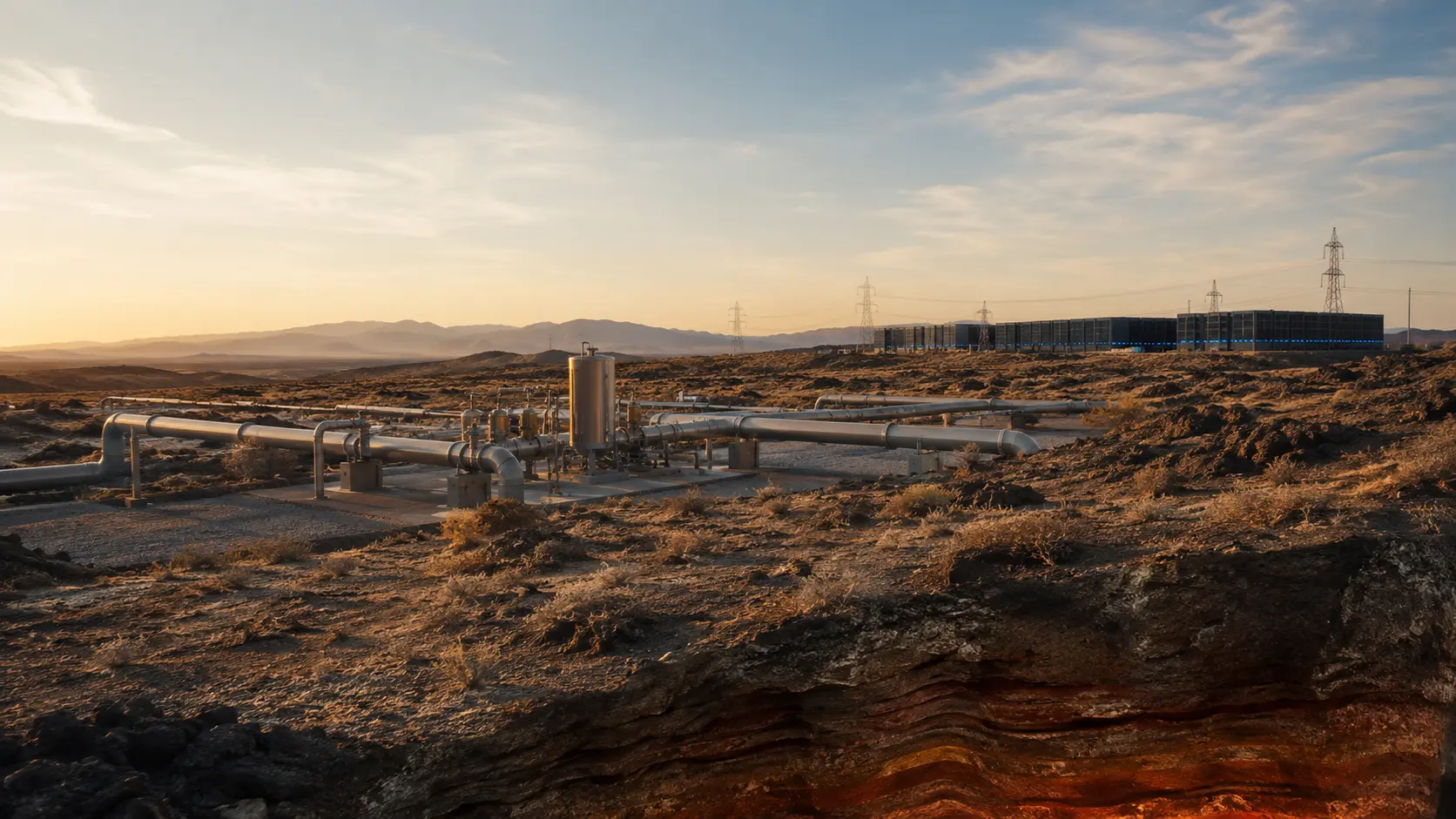
Fervo Energy announced a 396 MW power purchase agreement with Google for enhanced-geothermal electricity from Cape Station in Utah. Google also receives an option for roughly 600 MW more, taking potential offtake close to 1 GW. The source describes it as the largest enhanced-geothermal PPA globally, while delivery still depends on construction, interconnection and exercise of the option.
Company & Industry Context
Fervo applies horizontal drilling and distributed fibre-optic sensing, techniques associated with oil and gas, to enhanced-geothermal systems. Water is injected into hot subsurface rock, recovered and used to generate power that is less weather-dependent than wind or solar. Cape Station is expected to deliver first power in 2026 and reach about 100 MW in early 2027. Google is simultaneously managing rapidly growing electricity demand from AI and data-centre expansion.
Challenge / Why It Matters
Annual renewable-energy matching does not necessarily mean that carbon-free electricity is available in every hour or at the same grid location. Enhanced geothermal can provide firmer output, but development retains geological, drilling-cost, water, induced-seismicity, transmission and completion risks. Contracted capacity also cannot be treated as realised emissions reduction before delivery.
Action / Solution / Implementation
The agreement fixes an initial 396 MW tranche while preserving demand flexibility through an expansion option. Fervo will enlarge Cape Station and Google positions the electricity as foundational supply for a potential Utah data centre. Execution requires well-field works, generation equipment, grid connection, metering boundaries, delivery-hour rules and environmental-attribute treatment to be aligned before the commercial promise becomes an auditable operating record.
Evidence / Results / Impact
The source supports the contracted capacity, the roughly 600 MW option, the expansion horizon to 2030 and the background that Google electricity demand rose 37 percent in 2025. It also reports a 2 percent decline in Scope 1 and 2 emissions while value-chain emissions increased. These facts show procurement scale and operating pressure, but do not prove full Cape Station delivery, hourly matching or a specific emissions outcome.
Industry & Institutional Implications
The transaction moves enhanced geothermal from smaller demonstrations toward long-duration contracts with large electricity users. It also raises the evidentiary bar for additionality, location, time and system reliability. The governance question is no longer only how many megawatts were contracted, but which units supplied which hours, whether capacity was genuinely additional and whether certificates stayed connected to physical delivery.
SNN Editorial / Pre-Disclosure Evidence Infrastructure Perspective
SNN editorial analysis: Taiwan semiconductor, cloud and AI supply chains facing 24/7 carbon-free-energy expectations should not rely only on annual renewable certificates. Pre-Disclosure Evidence Infrastructure should connect each PPA version, generating-unit and meter identity, interconnection point, hourly generation, environmental attributes, outage records and allocation rules in a traceable chain. Calculation logic should remain reproducible by suppliers, customers and assurance providers. The transferable lesson is not to copy Utah geology, but to separate capacity commitment, physical delivery, temporal matching and emissions attribution before a public claim is drafted. That separation reduces the risk of reconstructing evidence only after sustainability reporting begins. This is editorial interpretation, not a fact verified by the source.
Future Outlook
Next checkpoints include Cape Station construction and interconnection, initial and expanded capacity, exercise of Google's option, hourly delivery, water and geological monitoring, and whether a new data centre creates a demonstrable relationship between additional demand and additional firm clean supply. Emissions conclusions should await operating and marginal-grid evidence.
Sources, evidence chain and editorial responsibility
Source publication: ESG Today · Original author: Mark Segal · Original publication date:
External institutional and reporting sources
These external announcements, rules, studies and reports support the discussion and are displayed separately from the original publication.
- Primary automated discovery and factual sourceESG TodayGoogle and Fervo Sign 396 MW Geothermal PPA With an Option Nearing 1 GW ↗Published 2026-09-01 · Accessed 2026-09-02T03:25:00.000Z
Publication identity, event facts, attributed statements and date used in this original bilingual summary.
- PPA and project anchorFervo EnergyFervo Energy and Google Sign 396 MW PPA ↗Published 2026-09-01 · Accessed 2026-09-02T04:15:00.000Z
396 MW PPA, Cape Station location, expected 2028 delivery, potential Utah data-centre use, and approximately 600 MW expansion option.
- contract terms and risk-factor corroborationU.S. Securities and Exchange CommissionFervo Energy Company Form 8-K dated August 26, 2026 ↗Published 2026-09-01 · Accessed 2026-09-02T04:15:00.000Z
396 MW PPA, four 99 MW tranches, 15-year term, approximately 600 MW option, 2028 target timing, and regulatory dependencies.
Topic hub: 氣候與能源轉型