
ENGLISH EDITION · 全球新聞
Indonesia Nickel Captive Coal Reaches 15.4 GW, Linking Community Health With Supply-Chain Accountability
An Eco-Business and Dialogue Earth update reports 15.4 GW of operating captive coal for Indonesian nickel and 2.5 GW under construction, alongside community concerns about air pollution, marine livelihoods, relocation and participation in Sulawesi and North Maluku. SNN records this as v4 of the existing logical article.
Executive Summary / Lead
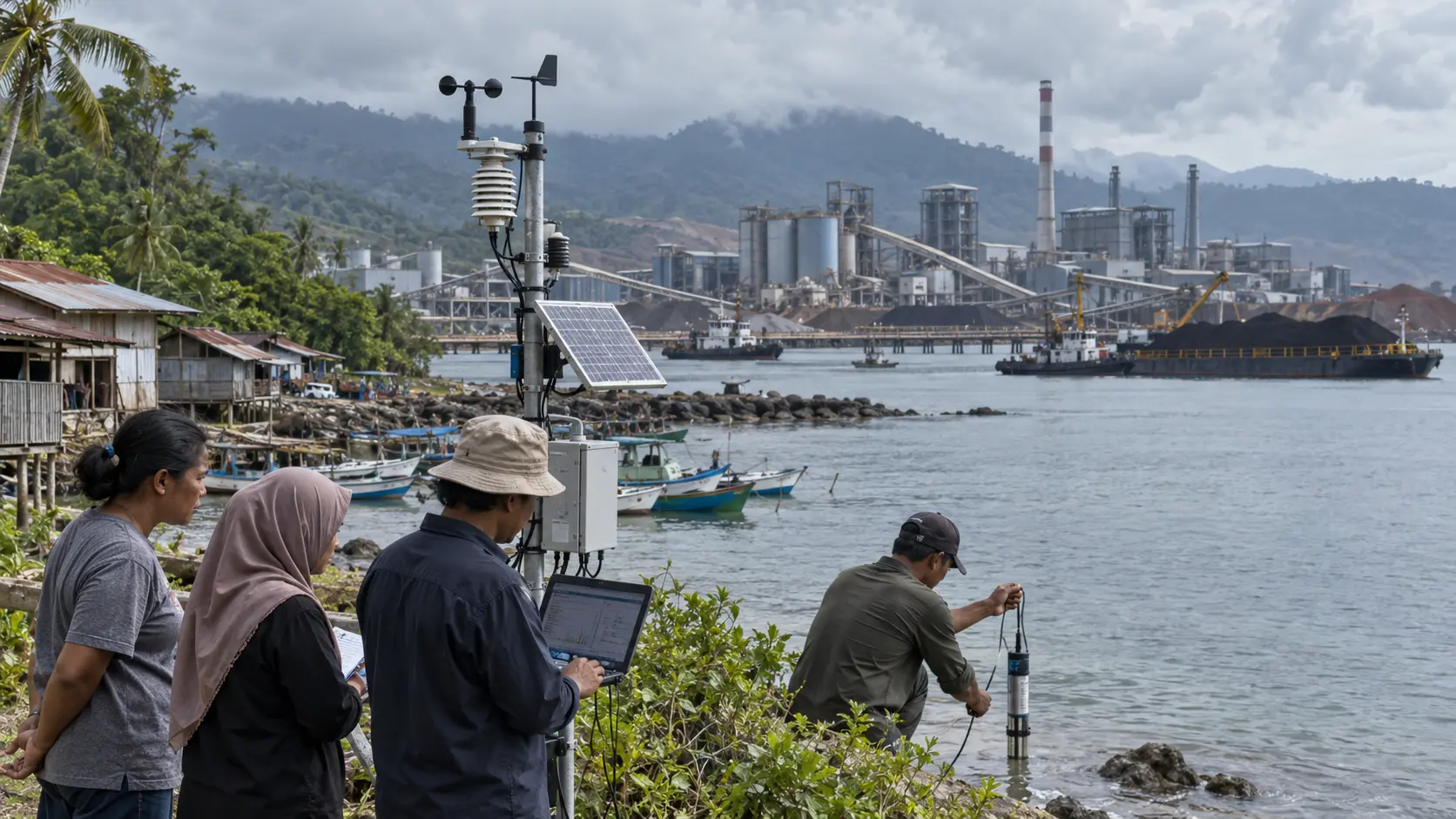
The Dialogue Earth report published by Eco-Business on 7 September updates captive coal serving Indonesian nickel to 15.4 GW operating and 2.5 GW under construction. The new evidence is not only capacity. It records community accounts from Morowali in Central Sulawesi and Obi Island in North Maluku concerning coal ash, noise, marine livelihoods, respiratory health, relocation compensation and participation.
Company & Industry Context
Captive plants sit outside the public grid and directly power nickel smelting and processing parks. Dedicated generation at the Morowali industrial park is reported at 3.36 GW. National strategic projects can qualify for exemptions from the ban on new coal generation, allowing nickel processing to enter transition supply chains while continuing to create coal assets and local external costs.
Challenge / Why It Matters
The previous article centred on 13.9 GW of nickel captive power and carbon lock-in. The new source provides 15.4 GW operating and 2.5 GW under construction and adds community outcomes to the same event. Health cases, seawater temperature, fishing distance, ash and relocation promises come from different evidence sources and cannot be combined into one causal total. The use of nickel in electric vehicles does not neutralise electricity or rights risks.
Action / Solution / Implementation
Implementation should give every plant, boiler, stack, fuel lot, smelter line, product lot and downstream buyer a linkable identity. Records should preserve continuous emissions, ash and wastewater, marine and air baselines, health-statistic definitions, community notice, relocation consent, land and compensation, grievances and remediation. Renewable substitution and closure plans also need dated engineering, finance and acceptance milestones.
Evidence / Results / Impact
The sources support 15.4 GW of operating nickel captive coal and 2.5 GW under construction. They also report nearly 340,000 acute respiratory infection cases in Central Sulawesi in 2024, about 66,000 in Bahodopi, and statements from residents and officials about industrial impacts. These data establish a need for investigation and governance, not proof that one facility caused every illness. The nickel figure should also remain distinct from the national 31 GW operating-and-pipeline measure used by CREA and GEM.
Industry & Institutional Implications
If captive coal remains outside public-power and transition inventories, automakers, batteries, steel, banks and export markets cannot compare the actual electricity emissions and social risk of nickel products. A just transition is therefore not only fuel substitution. It requires shared visibility into the costs, benefits and decision rights of parks, power plants, communities and products.
SNN Editorial / Pre-Disclosure Evidence Infrastructure Perspective
SNN editorial analysis: Taiwan battery-material, automotive-electronics, metal-processing, electronics-brand and financial institutions buying or financing Indonesian nickel should not rely only on a smelter annual average carbon intensity. Pre-Disclosure Evidence Infrastructure should connect each mine, industrial park, generating unit, meter, fuel lot, stack and wastewater monitor, community location, health-data definition, relocation and compensation agreement, grievance, smelter batch, shipment and Taiwan receiving lot. Every decarbonisation or responsible-sourcing claim should retain a versioned baseline, evidence of delivered replacement electricity, proof of coal retirement, the scope of third-party assurance and unresolved exceptions. A company risk committee should be able to return to one product lot and see which plant powered it, who owns each monitoring gap, whether a community grievance remains open and when a supplier statement changed. Lenders should link credit conditions, remediation milestones, consequences of non-performance and field results to the same identity framework. This prevents a national JETP commitment or an electric-vehicle use case from substituting for batch-level carbon, rights and local outcomes. It also lets customers and lenders trace which risks remain open. This is editorial interpretation, not a source-verified fact.
Future Outlook
Next checkpoints are unit-level lists behind 15.4 GW and 2.5 GW, actual generation and emissions, health and marine monitoring, relocation and compensation, national-strategic-project exemptions, JETP finance, renewable substitution, closure schedules, and buyer requirements for batch traceability and independent social assurance.
Sources, evidence chain and editorial responsibility
Source publication: Eco-Business · Original author: Miriam Bahagijo / Dialogue Earth · Original publication date:
External institutional and reporting sources
These external announcements, rules, studies and reports support the discussion and are displayed separately from the original publication.
- primary automated discovery and factual sourceEco-BusinessIndonesia Nickel Captive Coal Reaches 15.4 GW, Linking Community Health With Supply-Chain Accountability ↗Published 2026-09-07T00:01:00Z · Accessed 2026-09-07T02:20:00.000Z
Publication timing, nickel captive-coal capacity, community testimony, health data, relocation claims and participation concerns.
- original reportingDialogue EarthIndonesia captive coal: Who is this really for? ↗Published 2026-09 · Accessed 2026-09-07T02:20:00.000Z
Original community reporting and regional context reproduced by Eco-Business under a Creative Commons licence.
- capacity and policy evidenceCREA and Global Energy MonitorOut of sight, out of control: 31 GW of captive coal is jeopardizing Indonesia economic and emissions goals ↗Published 2026-01-27 · Accessed 2026-09-07T02:20:00.000Z
National captive-coal capacity, nickel concentration, project pipeline, policy exemptions and methodology.
- independent corroborationReutersIndonesia captive power plants putting energy transition at risk ↗Published 2026-01-27 · Accessed 2026-09-07T02:20:00.000Z
Independent reporting on captive-power expansion, transition-plan omissions and economic risk.
- community and gender impact evidenceSolidaritas Perempuan PaluParticipatory action research on women near captive coal facilities ↗Published 2025 · Accessed 2026-09-07T02:20:00.000Z
Reported livelihood, marine, household and gendered burdens near industrial captive-coal facilities.
Topic hub: 氣候與能源轉型