
ENGLISH EDITION · 全球新聞
Maersk Will Test a Rotor Sail on an 8,700 TEU Container Ship
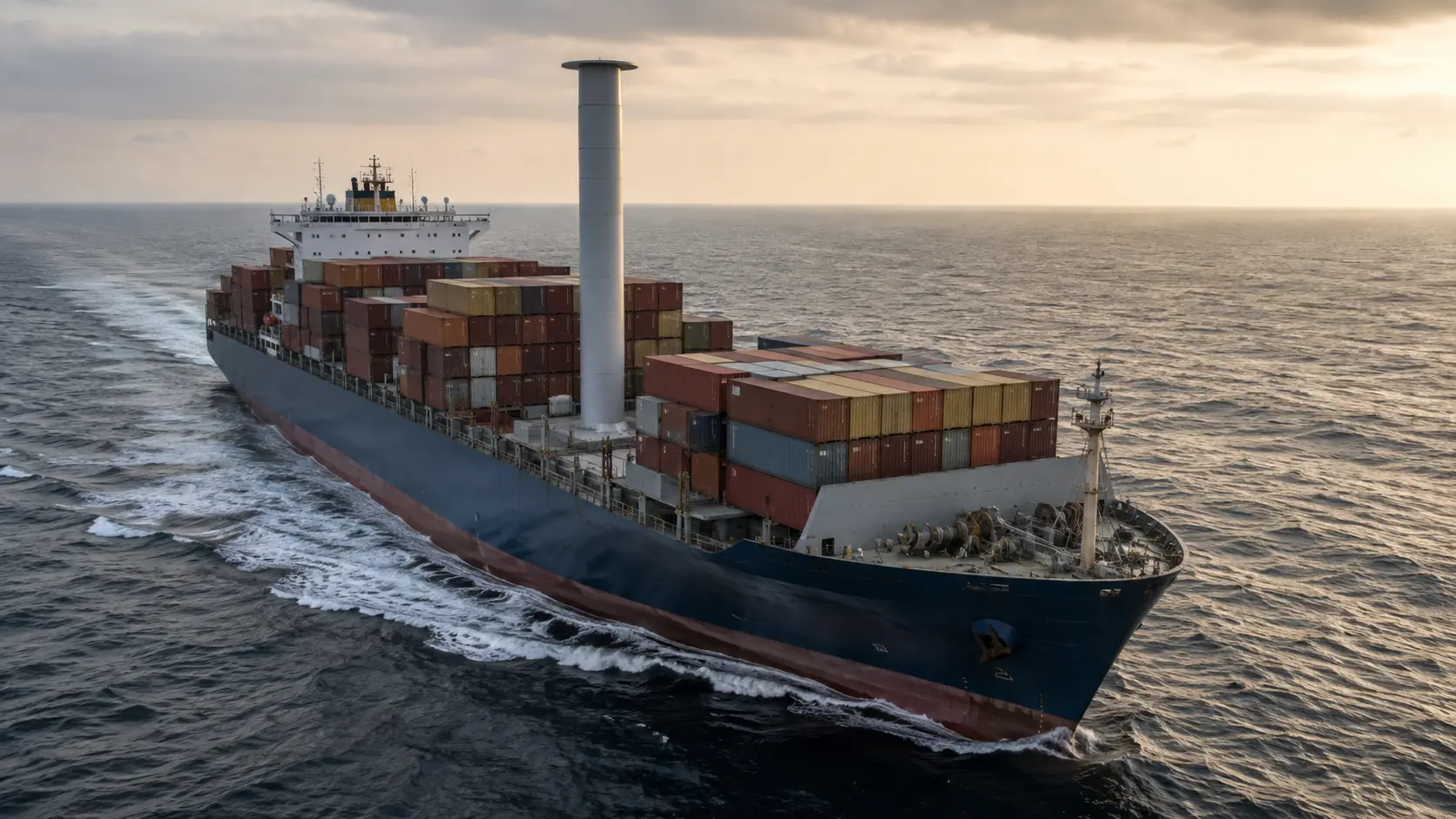
Maersk plans to install a 35-metre rotor sail on a Lima-class container ship in mid-2027 and test it on North and South Atlantic commercial routes. Fuel and emissions claims will require voyage, weather, speed and baseline evidence.
Executive Summary / Lead
Anemoi will supply a fixed rotor sail five metres in diameter and 35 metres high for one of Maersk’s 8,700 TEU Lima-class container ships. Installation is planned for mid-2027 while the vessel remains in commercial service, primarily on North and South Atlantic routes.
Company & Industry Context
Anemoi will supply a fixed rotor sail five metres in diameter and 35 metres high for one of Maersk’s 8,700 TEU Lima-class container ships. Installation is planned for mid-2027 while the vessel remains in commercial service, primarily on North and South Atlantic routes. The rotating cylinder uses the Magnus effect for auxiliary thrust. General supplier fuel-saving estimates cannot be treated as achieved results for this vessel.
Challenge / Why It Matters
Deck space, cargo handling, stability, route winds and operating speed all influence performance. Without comparable-voyage baselines, auxiliary electricity and weather correction, fuel changes cannot be reliably attributed to the rotor sail.
Action / Solution / Implementation
The pilot should predefine baseline vessel condition and accounting boundaries, retaining voyage-level wind, speed, draft, load, engine power, rotor electricity, fuel flow, deviations and downtime. An independent method should compare enabled and disabled periods.
Evidence / Results / Impact
Evidence chain: The rotating cylinder uses the Magnus effect for auxiliary thrust. General supplier fuel-saving estimates cannot be treated as achieved results for this vessel.
Industry & Institutional Implications
Wind-assisted propulsion may improve existing fleets, but procurement, chartering and cargo-owner allocation require consistent rules. Scalability depends on measured savings, maintenance, port compatibility and carbon costs.
SNN Editorial / Pre-Disclosure Evidence Infrastructure Perspective
SNN editorial analysis: Taiwan ports, carriers, cargo owners and export manufacturers can treat this pilot as transport-emissions data governance rather than only an equipment story. Pre-Disclosure Evidence Infrastructure should connect vessel IMO identity, equipment serial number, installation acceptance, voyage and container manifests, calibrated fuel and electricity meters, weather data, baseline-model version, saving uncertainty, charter responsibility and cargo-allocation rules. Taiwan supply chains incorporating maritime reductions into Scope 3 should distinguish engineering estimate, vessel measurement, route average and allocation to an individual shipment, while preserving reproducible calculations for assurance. This is editorial interpretation, not a source-verified fact.
Future Outlook
Next review should test execution milestones, updated measurements, methodology changes, adverse outcomes and whether the evidence supports each public claim. Material changes must create a new version rather than overwrite this record.
Sources, evidence chain and editorial responsibility
Source publication: ESG Today · Original author: Kenny Fisher · Original publication date:
External institutional and reporting sources
These external announcements, rules, studies and reports support the discussion and are displayed separately from the original publication.
- primary automated discovery and factual sourceESG TodayMaersk Will Test a Rotor Sail on an 8,700 TEU Container Ship ↗Published 2026-09-02 · Accessed 2026-09-03T03:05:00.000Z
Publication identity, attributed facts and source timing used for the SNN original bilingual summary.
- technology-provider announcementAnemoi Marine TechnologiesAnemoi and Maersk rotor-sail announcement ↗Published 2026-09-01 · Accessed 2026-09-03T03:05:00.000Z
Installation plan, vessel context, rotor-sail configuration and provider claims.
- official ship-efficiency guidanceInternational Maritime Organization2024 Guidelines for the Development of a Ship Energy Efficiency Management Plan ↗Published 2024-10-04 · Accessed 2026-09-03T03:05:00.000Z
Official efficiency-management guidance identifying wind-assisted propulsion and Flettner rotors as retrofit options.
Topic hub: 氣候與能源轉型