
ENGLISH EDITION · 全球新聞
Nepal Glacier Disaster Exposes Cascading Risks to Hydropower and Early Warning
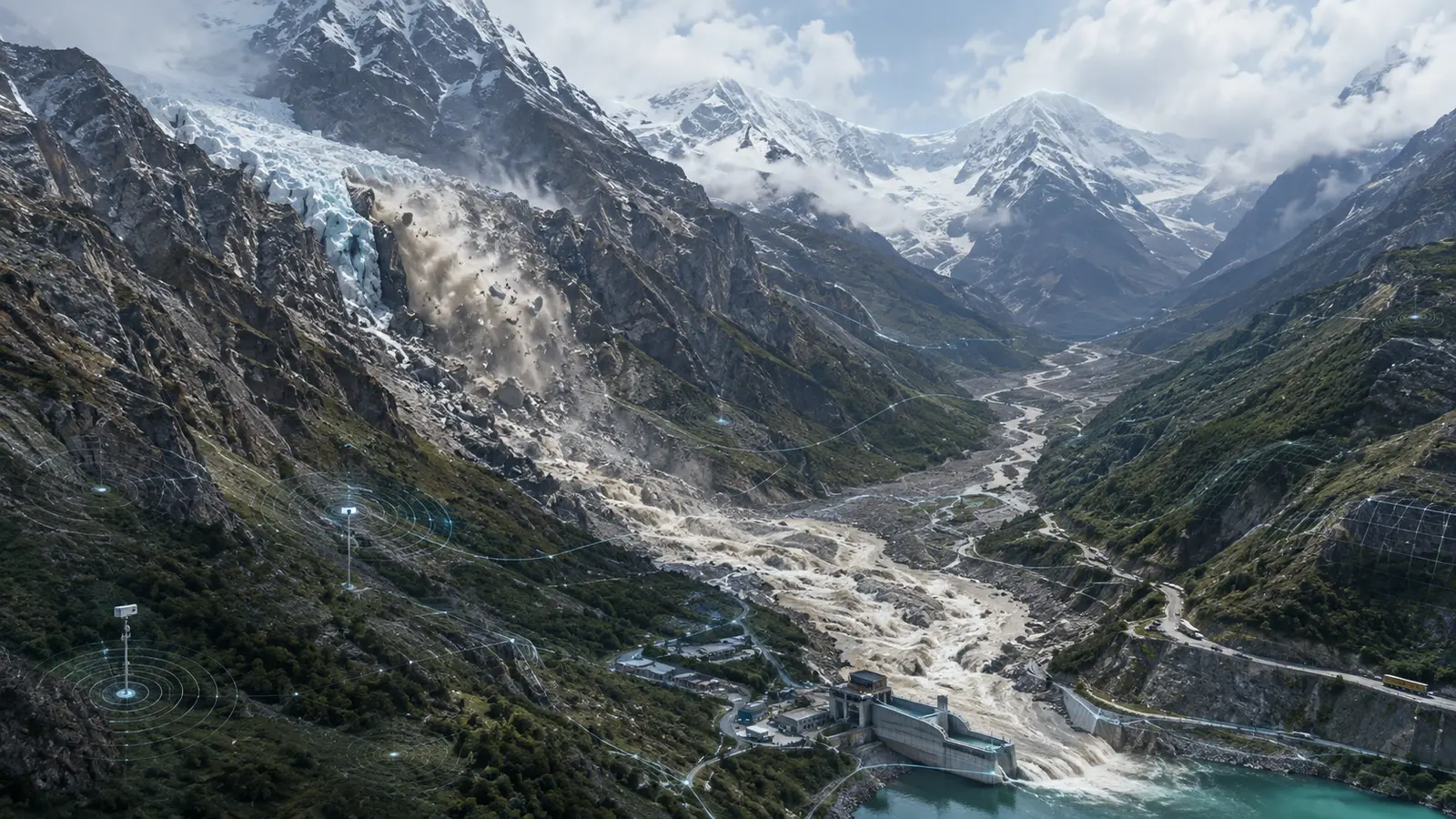
Nepal and Tibet suffered a disaster potentially linking ice and rock collapse, river blockage and outburst flooding, causing major casualties and hydropower damage while the precise trigger remains under investigation.
Executive Summary / Lead
Nepal and Tibet suffered a disaster potentially linking ice and rock collapse, river blockage and outburst flooding, causing major casualties and hydropower damage while the precise trigger remains under investigation. The event shows mountain hazards cascading through hydropower, roads, communications and cross-border communities rather than remaining a single flood.
Company & Industry Context
Hindu Kush Himalayan snow and ice support water, food and energy systems for nearly two billion people. Warming, glacier retreat, permafrost change and mountain infrastructure exceed conventional flood models. Cryosphere warming, slope instability, blockage and infrastructure exposure jointly determine loss, requiring cross-disciplinary data.
Challenge / Why It Matters
Scientists cannot directly attribute this single event to climate change. Geology, rainfall, seismic activity, glacier movement and river blockage may all contribute, while real-time and cross-border data remain limited. Post-event attribution remains uncertain, so satellite, seismic, field and time-series evidence should carry separate confidence.
Action / Solution / Implementation
WMO and ICIMOD call for stronger glacier, slope, river and satellite monitoring, resilient observation networks and faster cross-border delivery of risk information to local decision-makers. Warning governance needs a complete timeline across sensors, models, thresholds, communication, shutdown and evacuation decisions.
Evidence / Results / Impact
The source reports more than 900 deaths, nearly 5,000 missing, over 90,000 affected and more than 430 MW of generation offline. These early disaster figures may be revised. Reuters, ICIMOD and the source support glacier-collapse plausibility and regional risk, while the precise trigger still requires investigation.
Industry & Institutional Implications
Low-carbon hydropower can still be exposed to cryosphere and slope hazards. Assessment and finance need the full cascade from ice-rock failure through blockage, outburst and downstream flooding. Hydropower and transport investment should combine upstream hazard, downstream exposure and operational disruption in one asset model.
SNN Editorial / Pre-Disclosure Evidence Infrastructure Perspective
SNN editorial analysis: Taiwan has no glaciers, but mountain roads, reservoirs, hydropower, transmission, communications and settlements face cascading landslide, blockage, extreme-rainfall and earthquake risks. Pre-Disclosure Evidence Infrastructure should preserve hazard origin, sensors and calibration, model versions, alert thresholds, warning issue and receipt times, asset coordinates and design assumptions, shutdown and evacuation decisions, damage, outage and recovery records. This enables public works, energy and finance users to trace which terrain, climate and asset dataset underpinned a physical-risk disclosure. The transferable lesson for Taiwan is a cross-agency event identifier, not a claim that Himalayan and Taiwan hazard scales are identical. This is editorial interpretation.
Future Outlook
Next checks include official casualty updates, attribution, monitoring restoration, hydropower recovery, cross-border data agreements and whether mountain engineering standards include cascading hazards. Follow-up should cover attribution, monitoring networks, recovery, cross-border data and design standards.
Sources, evidence chain and editorial responsibility
Source publication: Eco-Business · Original author: Taejun Kang · Original publication date:
External institutional and reporting sources
These external announcements, rules, studies and reports support the discussion and are displayed separately from the original publication.
- Primary editorial discovery and event sourceEco-BusinessNepal Glacier Disaster Exposes Cascading Risks to Hydropower and Early Warning ↗Published 2026-09-01 · Accessed 2026-09-01T03:50:00.000Z
Publication identity, event facts, attributed statements and source timing used for the SNN bilingual summary.
- event attribution supportReutersGlacier collapse may have triggered deadly Nepal flash flood, experts say ↗Published 2026-08-26 · Accessed 2026-09-01T03:50:00.000Z
Expert attribution, event timing and uncertainty.
- regional hazard contextInternational Centre for Integrated Mountain DevelopmentWorld Glacier, Water and Meteorology Days ↗Published 2025-03-21 · Accessed 2026-09-01T03:50:00.000Z
Himalayan cryosphere, water and multi-hazard context.
- Taiwan mountain-risk contextTCCIP, National Science and Technology Center for Disaster Reduction, TaiwanMountain climate-change impacts and cascading infrastructure risks ↗Published 2022-09-14 · Accessed 2026-09-01T03:50:00.000Z
Taiwan mountain hazard, cascading impact and infrastructure context.
Topic hub: 企業與供應鏈