ENGLISH EDITION · 議題探討
The Authority to Verify: Why CBAM Is Building an Institutional Recognition Chain for Carbon Evidence
The European Union CBAM is turning carbon-data credibility into an institutional question: who has the recognised authority to transform information into evidence that regulation can rely on?
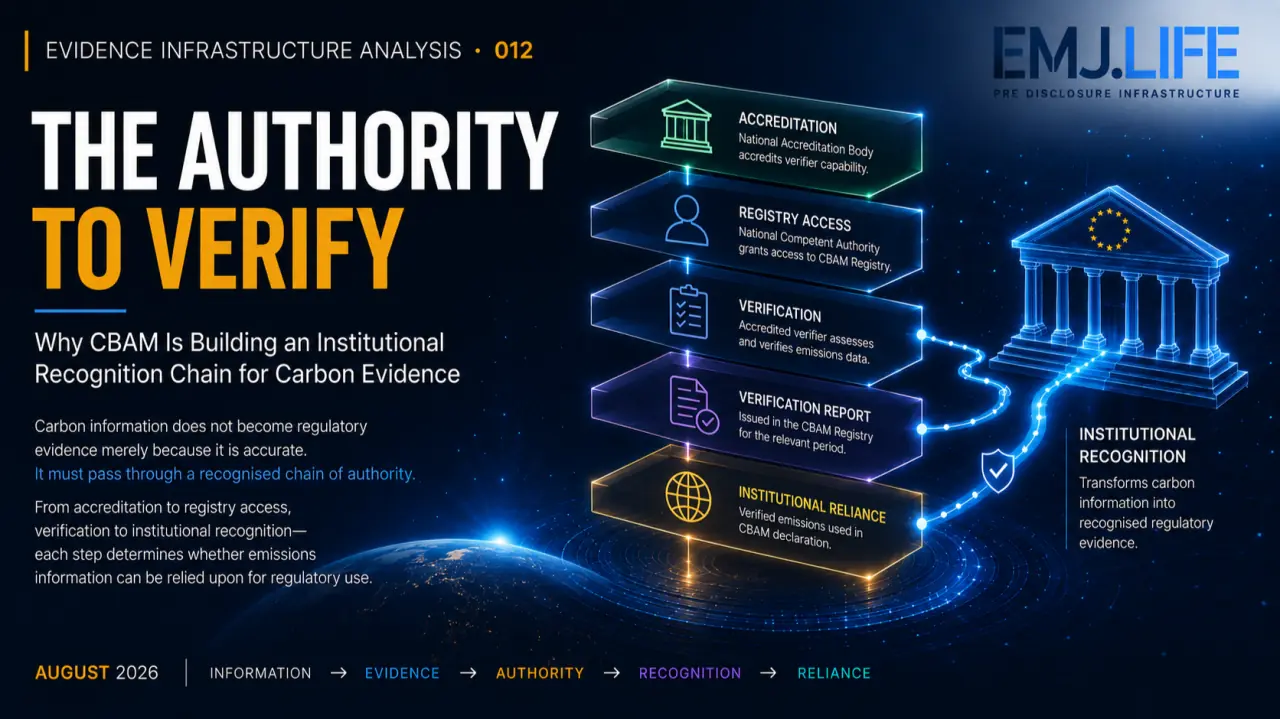
Executive Summary / Lead
On 24 August 2026, the European Commission published guidance that connects National Accreditation Bodies, accredited verifiers, the CBAM Registry, declarants and competent authorities. EIA 012 argues that carbon information becomes usable in regulation only when technical credibility is joined to a recognised chain of authority.
Company & Industry Context
In the definitive CBAM period, non-EU installation operators monitor and calculate embedded emissions. When importers use actual emissions, an independent verifier accredited under CBAM rules must verify the data. Accreditation, Registry access, case-specific verification, report issuance and declarant use are connected but distinct institutional stages.
Challenge / Why It Matters
Technical competence is not accreditation. Accreditation is not Registry permission. Registry permission does not prove that a particular installation and reporting period have been verified. Collapsing these states into a single verified label makes it difficult to show who reached which conclusion, under what authority, scope and evidence.
Action / Solution / Implementation
An operational evidence-authority chain links technical competence, independence and impartiality, accreditation by a National Accreditation Body, confirmation and Registry access, case-specific verification, controlled report issuance, declarant use and regulatory review. Each node should preserve actor identity, authority scope, installation, reporting period, version, permission and status.
Evidence / Results / Impact
Commission guidance states that verifiers must register in the CBAM Registry within two months of accreditation and not before 1 September 2026. From January 2027, accredited verifiers can issue verification reports in the Registry. Regulation (EU) 2023/956, Delegated Regulation (EU) 2025/2551 and Implementing Regulation (EU) 2025/2546 provide the legal and technical basis for verification, accreditation, oversight and reporting.
Industry & Institutional Implications
Taiwan export supply chains need more than emissions totals and calculation files. The usability of actual emissions also depends on installation identity, verifier accreditation scope, Registry status, reporting period, traceable evidence and continuity between the verified report and the declarant. Verifier authority therefore becomes part of cross-border evidence governance.
SNN Editorial / Pre-Disclosure Evidence Infrastructure Perspective
SNN editorial analysis: EU CBAM affects around 2,600 Taiwan operators, led by steel-related products. Steel, fastener, aluminium, cement and downstream exporters need continuity across installation identity, product and batch, calculation version, verifier accreditation, Registry status, reporting period and declarant. This evidence-authority chain is part of Taiwan export competitiveness.
Future Outlook
Next steps include Registry enrolment from 1 September 2026, National Accreditation Body capacity, report issuance from January 2027, the applicability of non-EU verification firms and competent-authority review. Enterprises should build Pre-Disclosure Evidence Infrastructure that preserves both evidence quality and the authority attached to it.
Sources, evidence chain and editorial responsibility
Source publication: sustainabilitynewsnetwork.net · Original author: Anderson Yu · Original publication date:
Original publication
External institutional and reporting sources
These external announcements, rules, studies and reports support the discussion and are displayed separately from the original publication.
- Primary institutional anchorEuropean Commission, Directorate-General for Taxation and Customs UnionThe European Commission publishes guidance for CBAM verifiers and accreditation bodies ↗Published 2026-08-24 · Accessed 2026-08-25
Supports the publication date, accreditation-first sequence, Registry access from September 2026 and report issuance from January 2027.
- Supporting official implementation sourceEuropean Commission, Directorate-General for Taxation and Customs UnionVerification of CBAM emissions ↗Published 2026-08-24 · Accessed 2026-08-25
Supports the roles of operators, verifiers, accreditation bodies, declarants and authorities, plus the verification timeline.
- Primary legal basisEuropean Union / Official JournalRegulation (EU) 2023/956 establishing a carbon border adjustment mechanism ↗Published 2023-05-16 · Accessed 2026-08-25
Articles 8 and 18 and Annex VI establish verified embedded emissions, verifier accreditation and verification-report requirements.
- Supporting accreditation lawEuropean Union / Official JournalCommission Delegated Regulation (EU) 2025/2551 ↗Published 2025-12-22 · Accessed 2026-08-25
Defines accreditation conditions, oversight, withdrawal, mutual recognition and peer evaluation for CBAM verifiers and accreditation bodies.
- Supporting verification lawEuropean Union / Official JournalCommission Implementing Regulation (EU) 2025/2546 ↗Published 2025-12-22 · Accessed 2026-08-25
Defines the application of verification principles for declared embedded emissions under CBAM.
- Taiwan export-industry context source行政院國家永續發展委員會環境部與經濟部攜手成立CBAM服務平台 做產業最強後盾 ↗Published 2026-04-02 · Accessed 2026-08-25
Supports the estimated number of affected Taiwan operators, the concentration in steel-related products and the cross-ministry CBAM support context.
Topic hub: 永續制度與揭露