
議題探討
不同框架,相似問題
IFRS、GRI、TNFD、TISFD、SBTN 與 EFRAG 的任務不同,卻越來越集中於可追溯、互通、連結、決策有用性與信任。
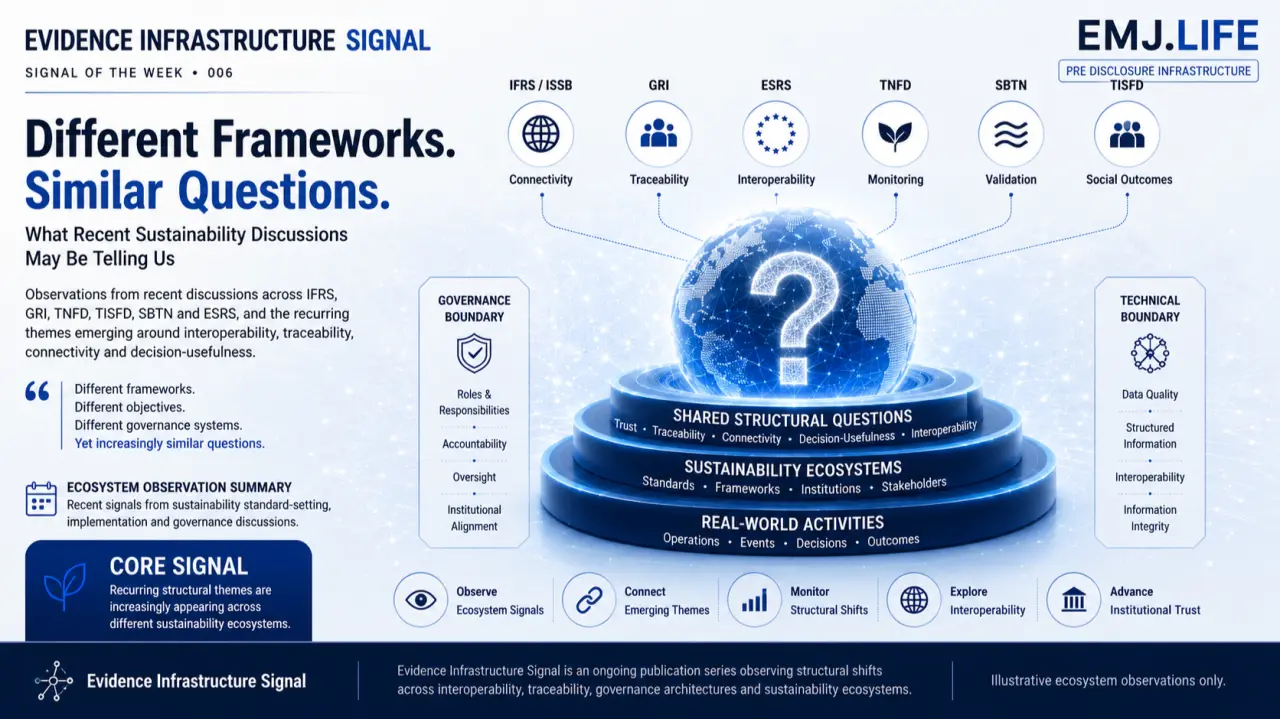
Different Frameworks. Similar Questions.
What Recent Sustainability Discussions May Be Telling Us
重點摘要
Executive Summary / Lead多個永續框架擁有不同任務、利害關係人與重大性觀點,近期討論卻反覆出現相似資訊問題。 IFRS、GRI、TNFD、TISFD、SBTN 與 EFRAG 的任務不相同,卻反覆提出可追溯、互通、連結、決策有用性與信任。這不是標準內容正在合併,而是不同制度要有效運作,都需要資料保留來源、語境、關係與責任。共同方向位於資訊條件,而非重大性或制度目的。 本期 Signal 將 不同框架之間共同資訊條件的浮現 視為多個制度行動逐步收斂的方向,而不是任何一個機構已宣布的共同計畫。各訊號的法律地位、發布時間與適用對象仍須分列,交叉閱讀只能支持方向判斷,不能把相似語言改寫成統一義務。 為使摘要能直接支援決策,本段同時回答五個問題:已發生什麼、由哪一第一方紀錄支持、影響透過什麼機制傳導、目前仍缺少哪些結果證據,以及下一個可推翻或強化判斷的檢查點。任何未被來源明示的因果關係都保留為編輯推論,不以肯定語氣包裝。
Sustainability frameworks have different mandates, stakeholders and materiality perspectives, yet recent discussions repeatedly surface similar information questions. IFRS, GRI, TNFD, TISFD, SBTN and EFRAG have different mandates, yet repeatedly invoke traceability, interoperability, connectivity, decision usefulness and trust. This does not mean their standards are merging. It means that each regime requires information to retain provenance, context, relationships and responsibility. The common direction lies in information conditions, not materiality or institutional purpose. This Signal treats the emergence of common information conditions across different frameworks as a direction emerging across institutional actions, not as a joint programme announced by any one authority. Legal status, publication date and population remain source-specific. Cross-reading supports a directional judgement only; similar language must not be converted into a single obligation. To make the lead decision-ready, it answers five questions together: what has occurred, which first-party record supports it, through what mechanism the effect may travel, which outcome evidence is still missing, and what next observation could strengthen or overturn the judgement. Any causal relationship not stated by the source remains an editorial inference and is not converted into a factual claim through confident wording.
企業與產業背景
Company & Industry ContextIFRS 聚焦投資人與財務連結,GRI 聚焦衝擊與盡職調查,TNFD、TISFD 與 SBTN 分別處理自然、社會及目標驗證,EFRAG 則面對雙重重大性與數位報導。 投資人重大性、衝擊重大性、自然依賴、社會風險與科學目標使用不同問題與使用者。同一活動進入這些框架時,可能採不同邊界、指標與判斷。若共用資料層沒有保存原始活動與轉換規則,企業為追求一致會犧牲制度差異,或為保留差異而重複建立資料。 訊號收斂的判斷基礎不是關鍵字相似,而是不同制度是否開始要求相近的資料身分、來源、方法、責任、控制與版本能力。每筆來源仍保留自己的治理權限與時間點,避免把跨機構比較誤讀成制度合併。 時間與權限也必須分開記錄:公告日不等於生效日,試點不等於普遍採用,技術規格不等於法律義務,企業自願導入也不等於監理核准。把這些節點放在同一時間軸,才能判斷一項制度變動何時真正進入資料、合約、投資或揭露流程。
IFRS emphasizes investors and financial connectivity; GRI impacts and due diligence; TNFD, TISFD and SBTN nature, social outcomes and target validation; EFRAG double materiality and digital reporting. Investor materiality, impact materiality, nature dependency, social risk and science-based targets use different questions and users. The same activity may enter them with different boundaries, metrics and judgements. If a shared data layer does not preserve the original activity and transformation rules, an enterprise either sacrifices institutional difference for consistency or recreates data to preserve the difference. Convergence is not established by repeated vocabulary. It is established when independent institutions begin to require comparable capabilities around identity, origin, method, accountability, control and version. Every source retains its own authority and time reference so that comparison does not become a claim of institutional merger. Time and authority must also be separated. An announcement date is not an effective date; a pilot is not general adoption; a technical specification is not a legal obligation; and voluntary enterprise use is not regulatory approval. Putting these events on one timeline shows when an institutional development actually enters data, contract, investment or disclosure processes and which actor is authorised to make that transition.
挑戰與重要性
Challenge / Why It Matters制度差異不會消失,但各系統都需要資訊品質、可比較性、可追溯性、透明度與決策相關性。缺乏共同底層條件,框架愈成熟,實作摩擦可能愈明顯。 共同條件最容易被誤解為建立一套超級標準。這會造成定義被壓平、重大性被混用、框架權威錯置。另一個風險則是每個團隊維持獨立版本,導致相同排放、供應商或自然地點在不同報告中不一致,無法說明哪一版本源於何種目的。 上游證據若沒有穩定識別、形成時間、適用邊界與版本,最終輸出即使格式一致,覆核者仍可能無法重建形成過程。真正風險不是單一欄位缺失,而是錯誤主體、過期方法、推定關係或未核准版本在傳遞中被當成確定事實。 具體失效模式至少包括主體配對錯誤、資料人口不完整、邊界前後不一致、方法或係數未版本化、例外未留下理由、核准與發布時間倒置,以及下游重用時脫離原用途。每一種失效都可能讓合理的單筆資料,在彙總後形成無法防禦的結論。
Institutional differences remain, but all systems need quality, comparability, traceability, transparency and decision relevance. Weak underlying conditions create implementation friction. A shared condition can be misread as a super-standard. That flattens definitions, mixes materiality and misplaces authority. The opposite risk is that every team maintains an independent version, causing the same emission, supplier or nature location to differ across reports without an explanation of purpose or provenance. When upstream evidence lacks stable identity, formation time, applicable boundary and version, a standardised output may still be impossible to reconstruct. The material risk is not one missing field. It is the silent conversion of the wrong entity, an expired method, an inferred relationship or an unapproved version into an apparent fact as information moves downstream. Concrete failure modes include incorrect entity matching, an incomplete data population, inconsistent boundaries, unversioned methods or factors, exceptions without rationale, approval occurring after publication, and downstream reuse outside the original purpose. Each failure can turn a reasonable individual record into a conclusion that cannot be defended after aggregation, comparison or machine-assisted interpretation.
行動、方案與執行
Action / Solution / Implementation各制度應保留自身目的,同時建立能跨框架支援來源、轉換、連結與使用脈絡的資訊條件,減少重複重建。 實作上,企業可保存一層制度中立的營運證據,包括活動、主體、地點、期間、方法與控制,再為每一框架建立有權威來源的映射、邊界、重大性及揭露規則。任何轉換都可回到同一原始事實,並清楚顯示框架特有的增補與排除。 可執行的控制單位應是受治理的證據物件:每項重要主張連接原始來源、計算或判斷方法、組織與時間邊界、責任人、控制狀態、例外、核准及版本。當任何元件改變時,系統保存差異與影響範圍,不以覆寫舊檔取代變更紀錄。 營運上可建立最小控制集:主張登錄、證據擁有人、來源快照、方法識別、適用期間、控制頻率、例外門檻、覆核與核准,以及允許的下游用途。高判斷或高財務影響項目採更嚴格的覆核層級;低風險資料則以自動化完整性檢查降低重工。
Each institution can preserve its purpose while developing information conditions that carry origin, transformation, relationships and use context across frameworks. A company can preserve an institution-neutral layer of operational evidence—activity, entity, location, period, method and control—then maintain authoritative mappings, boundaries, materiality and disclosure rules for each framework. Every transformation returns to the same source fact and displays framework-specific additions and exclusions. The implementable control unit is a governed evidence object. Each material claim links to its primary source, calculation or judgement method, organisational and temporal boundary, accountable owner, control state, exception, approval and version. When any component changes, the system preserves the difference and affected uses instead of overwriting the earlier basis. A minimum operating control set includes a claim register, evidence owner, source snapshot, method identity, valid period, control frequency, exception threshold, review, approval and permitted downstream use. High-judgement or high-financial-impact items receive a stronger review tier. Lower-risk records use automated completeness and consistency checks so that governance effort is concentrated where a wrong claim would change a decision.
證據、成果與影響
Evidence / Results / Impact本期整理近期會議、諮詢、草案與實作討論,包括 EFRAG 25 週年會議所觸及的報導連結、AI 可稽核性、數位架構與資本市場信任。 本期來源支持框架互補、會議與實作合作,不表示 IFRS、GRI、TNFD、TISFD、SBTN 或 ESRS 已達成等同。SNN 的共同資訊條件是一項結構歸納,不應被引用為標準制定者共同核准的正式模型。 證據判讀採來源對照而非票數累加。多筆文件若都引用同一基礎資料,仍只構成一條證據路徑;不同機構出現相近要求,則可提高方向性訊號,但不能證明執行成效、法律等同性或所有市場已同步成熟。 每一項關鍵句都應進入 claim ledger,標示其為官方事實、直接量測、估算、企業承諾、已交付結果或 SNN 編輯推論,並記錄來源所能支持的精確範圍。若兩筆來源衝突,保留衝突與處理理由;若資料尚未出現,明確標成待驗證,而不是以相近案例補成確定答案。
The edition reviews conferences, consultations, exposure drafts and implementation discussions, including EFRAG topics on connectivity, AI auditability, digital architecture and market trust. The sources support complementarity, meetings and implementation collaboration, but not equivalence among IFRS, GRI, TNFD, TISFD, SBTN or ESRS. SNN's common information conditions are a structural inference and must not be cited as a formally approved joint model of the standard setters. Evidence is assessed through source comparison rather than a simple source count. Documents that repeat one underlying dataset remain one evidential path. Similar requirements from independent institutions can strengthen a directional signal, but they do not prove implementation results, legal equivalence or equal market maturity. Every material sentence should enter a claim ledger and be classified as official fact, direct measurement, estimate, corporate commitment, delivered outcome or SNN editorial inference. The ledger records the precise scope that each source supports. Conflicting evidence is retained with the resolution rationale; absent evidence is marked pending rather than filled with a convenient analogue from another entity, period or jurisdiction.
產業與制度意涵
Industry & Institutional Implications真正的共同方向可能不在標準內容趨同,而在支援標準運作的資訊條件逐漸趨同。 這項訊號對企業的意義,是資料治理投資應服務多個制度但不支配制度。共用來源降低重工,受控轉換保存差異,權責與版本讓確信及決策者知道何時可重用。成熟度不在報告數量,而在相同事實能否支援不同問題而不失真。 這種資訊密度的目的不是增加篇幅,而是縮短主張到決策之間的查核距離。董事會、投資人、監理者與營運團隊應能辨識哪些內容是事實、估算、承諾、進度或結果,並在情境改變時更新判斷,而不是重新尋找散落的檔案與口頭說明。 責任分工因此必須落到決策權:資料擁有人維護來源,方法擁有人控制計算,業務單位說明使用情境,內控或確信人員測試可重建性,核准者承擔最終採用責任。例外若沒有到期日、補救人與影響範圍,就會從暫時處置變成永久的證據債務。
The common direction may be convergence of information conditions supporting standards rather than convergence of the standards themselves. For companies, the signal means that data-governance investment should serve multiple institutions without governing them. Shared sources reduce rework, controlled transformations preserve difference, and responsibility and version tell assurance providers when reuse is valid. Maturity is not the number of reports, but whether one fact supports different questions without distortion. The purpose of this information density is not length for its own sake. It is to shorten the verification distance between claim and decision. Boards, investors, regulators and operational teams should be able to distinguish fact, estimate, commitment, progress and outcome, then update the judgement when conditions change without reconstructing the case from scattered files and oral explanation. Accountability therefore attaches to decision rights. The data owner maintains the source, the method owner controls calculation, the business function defines the use case, internal control or assurance tests reproducibility, and the approver accepts responsibility for final use. An exception without an expiry date, remediation owner and impact scope stops being temporary treatment and becomes persistent evidence debt.
SNN 編輯與揭露前證據基礎設施觀點
SNN Editorial / Pre-Disclosure Evidence Infrastructure PerspectiveSNN 編輯分析:IFRS、GRI、TNFD、TISFD 與 EFRAG 的制度目的不同,台灣上市櫃公司與出口企業不應強行把定義壓成一套。更可行的做法,是在歐洲與全球規則發布後一週內辨識共同證據需求,並保留重大性、邊界、期間及責任差異,讓同一營運事實可被不同框架正確引用。 台灣上市櫃公司與出口企業同時面對 IFRS S1/S2、GRI、歐洲客戶及自然或社會要求時,不應用一張對照表宣稱全面相容。企業應保存共同營運事實,再記錄各框架的重大性、邊界、期間與責任;這能讓政策發布後快速轉譯,也避免為追求一致而錯誤刪除台灣或供應鏈情境。 對台灣市場的意義應沿實際傳導路徑判斷:國際制度或客戶要求先進入融資、採購、合約、供應商資料與確信流程,再影響台灣企業的系統與控制。這不等於外國規則自動成為台灣法律義務;本地企業要做的是辨識適用情境、保留跨語言對應並建立可授權覆核的證據鏈。 台灣企業可把傳導測試落在具體物件:公司與法律主體、廠區、產品、批次、供應商、合約、融資工具及揭露欄位。中英文名稱、內外部分類與不同框架之間應連到同一主張識別,同時保留商業機密、個資與權限邊界,避免可追溯被誤解為全面公開。
SNN editorial analysis: IFRS, GRI, TNFD, TISFD and EFRAG serve different institutional purposes, so Taiwan listed and exporting companies should not flatten their definitions. Within one week of a European or global update, the Taiwan layer should identify shared evidence needs while preserving differences in materiality, boundary, period and responsibility. Taiwan listed companies and exporters facing IFRS S1 and S2, GRI, European customers, and nature or social demands should not claim universal compatibility through one mapping table. They should retain common operational facts and record each framework's materiality, boundary, period and responsibility. This supports rapid policy translation without deleting Taiwan or supply-chain context for superficial consistency. For Taiwan, relevance should be traced through an actual transmission path. An international rule or customer requirement first enters finance, procurement, contract, supplier-data and assurance processes, then changes local systems and controls. It does not automatically become Taiwan law. Companies need to identify the applicable scenario, preserve bilingual mappings and make the evidence chain reviewable under controlled access. Taiwan companies can perform the transmission test on concrete objects: the company and legal entity, facility, product, batch, supplier, contract, financing instrument and disclosure field. Chinese and English names, internal and external classifications and different reporting frameworks should resolve to the same claim identity. Traceability must still preserve commercial confidentiality, personal data and access boundaries; it does not require unrestricted publication.
未來展望
Future Outlook後續應觀察跨框架連結、資料血緣與數位報導架構是否能降低實作成本並保留制度差異。 後續應觀察互通文件是否進入資料血緣、數位分類與確信實作。低後悔行動是選擇一項重大活動,建立框架需求矩陣,逐欄標示共同來源、制度特有判斷與不可互換之處,並由不同團隊共同覆核。 後續追蹤應分開最終文件、技術指引、採用範圍、執行控制、監督活動與可觀察結果。現階段的低後悔行動,是挑選一項高風險主張做端到端重建測試,記錄缺少的身分、來源、方法、責任與版本;這是治理準備,不是合規保證或結果預測。 監測不只依日曆,而應由事件觸發:最終規則發布、技術指引變更、適用範圍擴大、主管機關執法、企業採用數據或實際成果出現時,都建立新版本並重評原判斷。舊結論不刪除,而是標示當時依據、被何種新證據修正,以及哪些決策需要重新檢視。
Future evidence should show whether framework links, data lineage and digital reporting reduce implementation cost while preserving institutional differences. Future work should examine whether interoperability publications enter lineage, digital taxonomies and assurance practice. A low-regret action is to select one material activity, build a framework-requirement matrix, identify shared sources, regime-specific judgements and non-interchangeable elements, and have the relevant teams review it together. Future monitoring should separate final text, technical guidance, adoption scope, operating controls, supervision and observable outcomes. A low-regret step is to select one high-risk claim for an end-to-end reconstruction test and record missing identity, source, method, accountability and version. That is governance preparation, not a compliance guarantee or forecast of results. Monitoring should be event-triggered as well as calendar-based. A final rule, amended technical guidance, expanded scope, supervisory action, adoption data or observed outcome creates a new version and a reassessment of the earlier judgement. The prior conclusion is not erased. It retains its original basis, identifies the new evidence that changed it and states which decisions or downstream uses now require review.
來源、證據鏈與責任編輯
來源媒體:sustainabilitynewsnetwork.net · 原文作者:Anderson Yu · 原文發布:
原始出版
外部論述與制度來源
以下外部公告、法規、研究或新聞用於支撐本文論述,並與原始出版分開呈現。
- Primary analysis sourceIFRS Foundation and GRIGRI and IFRS Foundation reaffirm commitment to complementary disclosures ↗出版日期 日期未標示 · 查核時間 2026-08-17 03:26 (UTC+8)
Official primary source selected through publication-level web research.
- Taiwan market-context source金融監督管理委員會金管會發布我國接軌IFRS永續揭露準則藍圖 ↗出版日期 2023-08-17 · 查核時間 2026-08-25(時間未記錄)
Supports Taiwan phased adoption of IFRS S1 and S2 and the domestic reporting context for international standards transmission.