
議題探討
當互通性變得可衡量:768 個路由位置揭示跨框架證據架構
EIS-019 以六份 DOI Direct Mapping Guide 的完整母體為基礎,分析 768 個路由位置、88.28% 可路由密度及跨框架任務可攜性,並界定這些數字不可被解讀為合規、等價或重大性結論。
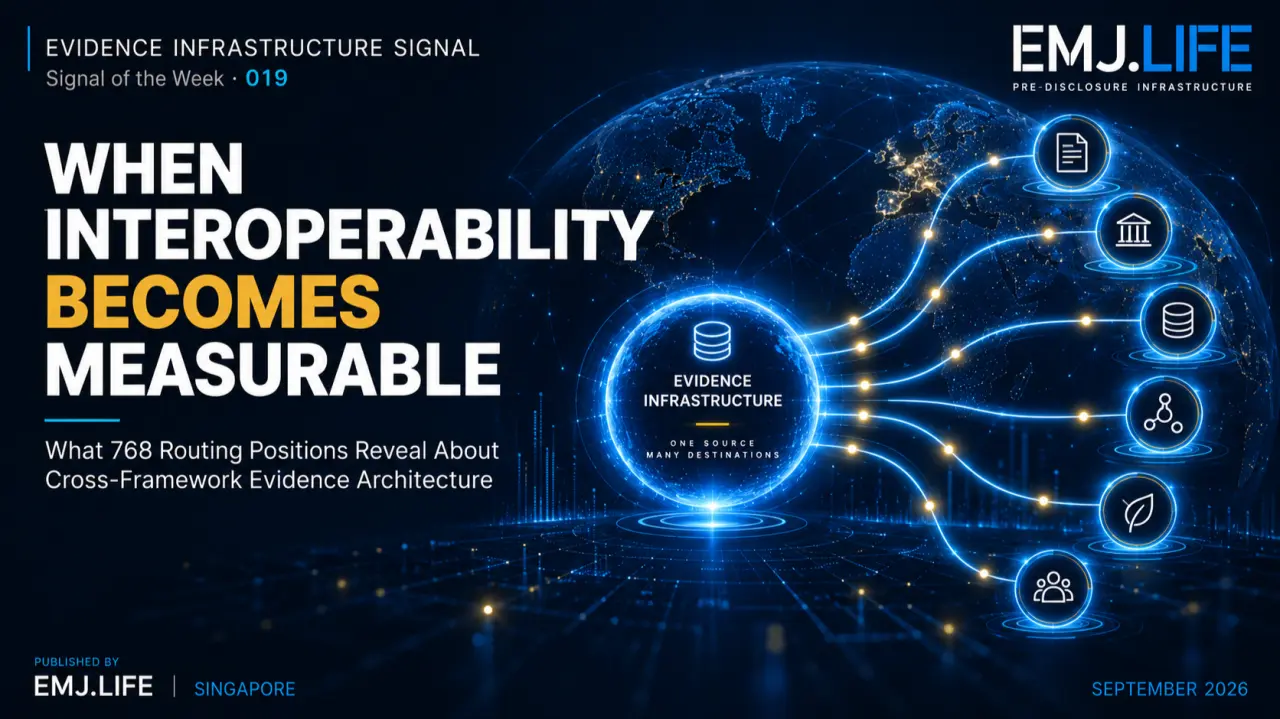
When Interoperability Becomes Measurable: What 768 Routing Positions Reveal About Cross-Framework Evidence Architecture
EIS-019 examines 768 routing positions, an observed routability density of 88.28 per cent and cross-framework task portability across six DOI-registered Direct Mapping Guides, while preserving the boundary against compliance, equivalence and materiality claims.
重點摘要
Executive Summary / LeadEvidence Infrastructure Signal 019 提出一個可被重複驗證的觀察:當上游證據架構固定、目的制度環境改變,跨框架互通性就不必只停留在「可以對照」或「不能對照」的描述。六份 DOI Direct Mapping Guide 都以 IFRS ISSB 與 SASB 為上游錨點,使用同一組 128 個 canonical MME task positions,再分別路由至 GRI、ESRS、TNFD、COSO、GHG Protocol Scope 3 與聯合國永續發展目標。 固定的 128 個任務乘以六個目的環境,形成 768 個可比較路由位置。完整母體中有 678 個位置保存受治理路由,90 個位置沒有預設路由,因此觀察到的 routability density 為 88.28%。這個百分比不是合規率、框架等價率、重大性結論或全球 ESG 活動涵蓋率。它只描述在既定六份指南、既定版本與既定判定規則下,有多少位置存在可辯護的路由關係。 更重要的訊號不是 88.28% 本身,而是互通性已可在固定分母下被觀察、比較、追蹤與治理。EIA-014 說明為何互通性不是二元關係,EIS-019 則把問題推進至分布層:一個受治理的關係母體如何呈現密度、可攜性與保留空白。本文稱其為 Distributional Interoperability。這是 EMJ.LIFE 對自有方法出版物的分析構念,不是六個制度機構採用的正式術語,也不是第三方獨立基準。
Evidence Infrastructure Signal 019 presents a repeatable observation: when the upstream evidence architecture is held constant and the destination environment changes, cross-framework interoperability no longer has to remain a qualitative claim that two systems can or cannot be compared. Six DOI-registered Direct Mapping Guides use IFRS ISSB and SASB as the upstream anchor, apply the same 128 canonical MME task positions, and route those positions separately into GRI, ESRS, TNFD, COSO, the GHG Protocol Scope 3 Standard and the United Nations Sustainable Development Goals. The fixed set of 128 tasks across six destinations creates 768 comparable routing positions. Within that full population, 678 positions preserve a governed route and 90 positions preserve the absence of a default route. The observed routability density is therefore 88.28 per cent. This percentage is not a compliance rate, framework-equivalence score, materiality decision or estimate of global ESG activity coverage. It describes only how many positions contain a defensible route under the specified six guides, versions and decision rules. The stronger signal is not the percentage itself. It is that interoperability can now be observed, compared, tracked and governed against a stable denominator. EIA-014 explained why interoperability is not a binary relationship. EIS-019 moves the analysis to a distributional layer: how a governed relationship population expresses density, portability and intentionally preserved gaps. This publication describes the layer as Distributional Interoperability. It is an EMJ.LIFE analytical construct derived from its own methodology corpus, not terminology adopted by the six destination institutions and not an independent third-party benchmark.
企業與產業背景
Company & Industry Context傳統 interoperability 討論常把焦點放在欄位是否相容、概念是否可對照,或某一披露要求能否重用既有資料。這些做法可以降低搜尋與重複蒐集成本,但若沒有共同分母,不同 crosswalk 的數量往往不能直接比較。對照較多,可能只是來源架構較寬、目的架構較一般,或方法對「相關」採取較寬鬆定義;對照較少,也可能反映目的制度需要更嚴格的適用條件。 EIS-019 的分析設計把上游證據人口固定為 128 個 MME 任務。每個任務在每一個目的環境中只占一個路由位置,六個環境合計 768 個位置。目的環境並不相同:GRI 關注組織對經濟、環境與人的影響;ESRS 依法定揭露架構處理雙重重大性與特定揭露要求;TNFD 聚焦自然相關依賴、衝擊、風險與機會;COSO 處理治理、風險與內部控制;Scope 3 處理價值鏈溫室氣體盤查;SDGs 則由 Goals、Targets 與全球指標構成公共政策成果架構。 同一證據任務進入不同目的環境時,制度用途會改變。存在 route 只代表該任務與下一個制度程序之間保存了受治理關係,不表示兩套框架要求相同,也不表示證據足以完成目的程序。EIA-014 所要求的 relationship type、strength、activation condition、evidence state 與 claims boundary,仍然是 EIS-019 能夠計數之前的前置條件。沒有治理語意的數量,只是連線數,不是可使用的互通性。
Conventional interoperability discussions often ask whether fields are compatible, concepts can be cross-referenced or an existing disclosure input can be reused. Those exercises can reduce search and duplicate collection. Yet without a common denominator, the number of mappings in one crosswalk cannot be compared safely with the number in another. A larger mapping can result from a broader source architecture, a more general destination or a permissive definition of relevance. A smaller mapping may reflect a narrower institutional purpose or stronger activation requirements. EIS-019 fixes the upstream evidence population at 128 MME tasks. Each task occupies one position in each destination environment, producing 768 positions across six environments. The destinations are institutionally different. GRI addresses organisational impacts on the economy, environment and people. ESRS applies a legal disclosure architecture with double materiality and specified disclosure requirements. TNFD addresses nature-related dependencies, impacts, risks and opportunities. COSO addresses governance, risk and internal control. Scope 3 addresses value-chain greenhouse-gas accounting. The SDGs comprise Goals, Targets and a separately governed global indicator framework. When the same evidence task enters a different destination, its institutional use changes. A route means that a governed relationship has been preserved between the task and the next institutional process. It does not mean the two frameworks require the same thing or that the evidence completes the destination process. Relationship type, strength, activation condition, evidence state and claims boundary, as developed in EIA-014, remain preconditions for the counts in EIS-019. A number without governed semantics is a count of connections, not usable interoperability.
挑戰與重要性
Challenge / Why It Matters第一個挑戰是分母治理。若研究只計算已建立的 mapping,便看不到被排除的候選關係,也無法知道百分比是否因方法擴張而上升。EIS-019 把 90 個 NO-DEFAULT-ROUTE 位置保留在 768 的分母內,讓缺乏可辯護路由的結果也成為可觀察資料。這些空白不是資料遺失,也不是模型失敗,而是「目前不得自動建立關係」的治理結果。 第二個挑戰是目的錯置。GRI 與 ESRS 的高密度不能被解讀成兩者等價,COSO 的 100% 也不能被解讀成所有 128 個任務都形成有效控制。Scope 3 的 60.2% 不代表它比其他框架落後,而可能反映排放類別、價值鏈邊界、計算方法與活動資料條件較窄。SDGs 的 75.8% 不能被改寫成企業對目標的貢獻程度,TNFD 的 94.5% 也不能證明 LEAP 評估已完成。 第三個挑戰是把密度變成績效目標。一旦團隊以「提升 routability」作為 KPI,系統可能傾向接受語意較弱的連線、以相似度填補空白,或把 conditional route 升級為 direct route。百分比因此上升,制度可信度反而下降。正確目標不是 maximum routability,而是 defensible relationship density。 第四個挑戰是把自有研究母體誤當第三方市場基準。本期資料來自 EMJ.LIFE 自行發布的六份指南,使用共同 128 MME 架構與共同方法。它適合檢查內部一致性、版本差異與路由分布,不足以證明其他 mapping 方法會得到相同結果。若未來要形成跨機構 benchmark,必須公開抽樣規則、關係定義、排除標準、重現程序與獨立覆核安排。
The first challenge is denominator governance. If a study counts only established mappings, excluded candidate relationships disappear and the reader cannot determine whether a percentage increased because the method expanded. EIS-019 keeps 90 NO-DEFAULT-ROUTE positions inside the denominator of 768. The absence of a defensible route therefore remains observable data. These positions are not missing records or model failures. They are governance results stating that an automatic relationship should not presently be created. The second challenge is destination confusion. High density for GRI and ESRS does not make them equivalent. A 100 per cent COSO density does not mean that all 128 tasks constitute effective controls. A 60.2 per cent Scope 3 density does not place Scope 3 behind the other environments; it may reflect narrower category, value-chain boundary, calculation-method and activity-data conditions. A 75.8 per cent SDG density is not a measure of enterprise contribution, and a 94.5 per cent TNFD density does not demonstrate completion of LEAP. The third challenge arises when density becomes a performance target. If a team is rewarded for increasing routability, the system may admit weaker semantic links, fill gaps through similarity or upgrade conditional relationships into direct routes. The percentage rises while institutional reliability falls. The objective is not maximum routability. It is defensible relationship density. The fourth challenge is treating a first-party research population as an independent market benchmark. The data in this Signal come from six guides published by EMJ.LIFE using one 128-task architecture and one controlled methodology. The corpus can test internal consistency, version change and route distribution. It cannot establish that other mapping methods will produce the same outcomes. A cross-institutional benchmark would need disclosed sampling rules, relationship definitions, exclusion criteria, reproducibility procedures and independent review.
行動、方案與執行
Action / Solution / Implementation要把 Distributional Interoperability 落地,第一步是鎖定 measurement population。紀錄必須明確指定上游任務清單、任務版本、目的環境清單、方法版本、有效日期與計算時間。任何任務新增、刪除、拆分或合併,都會改變分母,不得把不同母體的百分比直接接成時間序列。 第二步是將每個路由位置建模為可版本化紀錄,至少包含 source_task_id、destination_environment、relationship_type、relationship_strength、route_state、activation_condition、claims_boundary、method_version、decision_owner、evidence_reference 與 effective_date。存在與不存在都要被保存;NO-DEFAULT-ROUTE 需要原因碼,例如目的範圍不適用、資訊不足、關係過弱、需實體特定判斷或方法禁止預設。 第三步是分開計算三種指標。Framework Routability Density 的分子是某目的環境中保存受治理路由的任務數,分母固定為 128。Cross-Framework Routability Density 的分子是六個環境中全部受治理路由位置,分母為 768。Task Portability 則從任務方向計算每個 canonical task 能進入幾個目的環境。三種指標回答不同問題,不能互相替代。 第四步是加入品質限制。每個計數都必須通過 uniqueness、completeness、state validity、version alignment 與 reproducibility 檢查。同一任務與目的環境不可重複計數;待決、撤回或過期關係不能混入 active routes;關係使用的六份指南版本必須一致;計算結果必須能回到 768 筆位置明細。顯示百分比時要同時顯示分子、分母、版本與非路由數量。 第五步是建立 change control。方法或來源框架更新時,不直接覆寫舊矩陣,而是建立新版本、標記受影響位置、重新計算密度與可攜性,並留下增減原因。第六步是執行反向抽樣,由覆核者從圖表中的比例回到個別 route,再檢查來源證據與 claims boundary。第七步是將指標權限限制為觀察與比較,不允許系統從密度自動產生合規、重大性、控制有效性、排放完整性或 SDG 貢獻結論。 對 AI 代理而言,執行順序應為:確認母體與版本,讀取關係狀態,驗證啟動條件,套用禁止主張,最後才計數或路由。若版本不一致、來源不足或關係狀態待決,代理應 Hold 或 Escalate。它不應為了維持百分比連續而補出不存在的關係。
Implementation begins by locking the measurement population. The record must identify the upstream task register, task version, destination list, mapping-method version, effective date and calculation time. Any task addition, removal, split or merger changes the denominator. Percentages calculated from different populations must not be joined into one trend without an explicit break in series. Each routing position should then become a versioned record containing at least source_task_id, destination_environment, relationship_type, relationship_strength, route_state, activation_condition, claims_boundary, method_version, decision_owner, evidence_reference and effective_date. Presence and absence both require preservation. NO-DEFAULT-ROUTE should carry a reason code, such as destination out of scope, insufficient information, weak relationship, entity-specific judgement required or method prohibition against a default route. Three measures should remain separate. Framework Routability Density divides the governed routes in one destination by the fixed population of 128. Cross-Framework Routability Density divides all governed route positions across the six environments by 768. Task Portability reverses the direction and counts how many destinations each canonical task can enter. Each measure answers a different question. Quality controls must cover uniqueness, completeness, state validity, version alignment and reproducibility. The same task-destination pair cannot be counted twice. Pending, withdrawn or expired relationships cannot be mixed into active routes. All six guides used in a calculation must align with the declared versions. Every displayed result must be reconstructable from the 768 position-level records. Percentages should always be displayed with numerator, denominator, version and non-routing count. Change control is equally important. A source-framework or method update should create a new version, identify affected positions, recalculate density and portability, and preserve the reason for every increase or decrease. Reviewers should be able to move backwards from an aggregate chart to a route and then to its evidence and claims boundary. The metrics must be authorised only for observation and comparison. They must not generate compliance, materiality, control-effectiveness, inventory-completeness or SDG-contribution conclusions. For an AI Agent, the operating order is: verify population and version, read the relationship state, test activation conditions, apply prohibited-claim rules, and only then count or route. If versions conflict, sources are incomplete or a state is pending, the Agent should Hold or Escalate. It should never create a relationship merely to keep a percentage continuous.
證據、成果與影響
Evidence / Results / Impact本期採完整母體計數,不是抽樣推估。六個目的環境的 routable positions 分別為:GRI 127/128,99.2%;ESRS 128/128,100%;TNFD 121/128,94.5%;COSO 128/128,100%;GHG Protocol Scope 3 77/128,60.2%;UN SDGs 97/128,75.8%。合計 678/768,形成 88.28% 的觀察密度,其餘 90 個位置保留無預設路由。 由任務方向觀察,61 個任務可路由至全部六個環境,46 個可路由至五個,19 個可路由至四個,2 個可路由至三個。因此 107/128,也就是 83.59% 的任務至少可進入五個環境;126/128,也就是 98.44% 的任務至少可進入四個環境。這顯示多數 canonical tasks 具有廣泛可攜性,但不表示它們在不同目的環境中具有相同制度意義。 證據鏈分為三層。第一層是 sustainabilitynewsnetwork.net 的 EIS-019 正式出版頁,支持系列身分、英文原文、作者、發布日期、完整母體方法與分析邊界;它是同步來源,不計入獨立外部證據。第二層是 DMG01 至 DMG06 六個 DOI,支持各指南的持久識別、版本與 128 任務路由資料;由於發布者同為 EMJ LIFE HOLDINGS PTE. LTD.,它們是 source data,不是獨立外部驗證。 第三層包含 17 筆獨立官方或標準制定機構來源,超過 15 筆硬性門檻。IFRS S1、IFRS S2、SASB 更新、GRI、ESRS 法源與 implementation guidance 支持不同目的、重大性與適用程序;TNFD Recommendations 與 LEAP、COSO ICSR 與 ERM guidance、GHG Protocol Scope 3 Standard、聯合國 2030 Agenda 與全球指標框架支持各目的環境的制度邊界;IFRS、GRI、EFRAG 的互通性資源與 W3C PROV-O 支持跨系統差異、溯源與關係保存。 所有 24 筆來源均保存標題、機構、來源角色、出版日期、查核時間與支撐範圍。外部來源能支持框架目的與制度邊界,不能獨立驗證 678、90、88.28%、61、46、19、2 等自有母體計數,也不代表相關機構認可六份指南、128 MME、Distributional Interoperability 或本期結論。
This edition uses a full census rather than sample estimation. Routable positions by destination are: GRI 127 of 128, or 99.2 per cent; ESRS 128 of 128, or 100 per cent; TNFD 121 of 128, or 94.5 per cent; COSO 128 of 128, or 100 per cent; GHG Protocol Scope 3 77 of 128, or 60.2 per cent; and UN SDGs 97 of 128, or 75.8 per cent. Together, 678 of 768 positions contain governed routes, producing the observed 88.28 per cent density, while 90 positions retain no default route. Viewed from the task direction, 61 tasks are routable to all six environments, 46 to five, 19 to four and two to three. Therefore, 107 of 128 tasks, or 83.59 per cent, can enter at least five destinations. At a threshold of four destinations, 126 of 128 tasks, or 98.44 per cent, remain routable. The result indicates broad portability across the canonical task population, but it does not make the institutional meaning of those tasks identical across destinations. The evidence chain has three layers. The first is the canonical EIS-019 publication on sustainabilitynewsnetwork.net. It supports the series identity, English text, author, publication date, full-census method and analytical boundary. It is the synchronisation source and is not counted as independent external evidence. The second layer contains the six DOI records for DMG01 through DMG06. They support persistent identity, version and route data for the six guides. Because the guides share the same publisher, they are source data rather than independent external validation. The third layer contains 17 independent official or standard-setting sources, exceeding the mandatory threshold of 15. IFRS S1, IFRS S2, SASB updates, GRI, the ESRS legal text and implementation guidance support differences in purpose, materiality and application. TNFD Recommendations and LEAP, COSO ICSR and ERM guidance, the GHG Protocol Scope 3 Standard, the UN 2030 Agenda and Global Indicator Framework support the institutional boundaries of the destinations. Interoperability resources from IFRS, GRI and EFRAG, together with W3C PROV-O, support the preservation of differences, provenance and relationships across systems. All 24 sources preserve title, institution, source role, publication date, verification time and claims supported. The external sources support framework purpose and institutional boundaries. They do not independently validate the first-party counts of 678, 90, 88.28 per cent, 61, 46, 19 or two. Nor do they indicate institutional endorsement of the six guides, the 128 MME structure, Distributional Interoperability or this Signal.
產業與制度意涵
Industry & Institutional Implications對企業而言,可量測互通性提供的是架構診斷,不是合規捷徑。企業可用固定證據任務清單比較不同框架的重用範圍,辨識高可攜任務與反覆出現的非路由區域,再決定哪些上游資料值得優先治理。但每個目的環境仍需重新執行重大性、適用性、盤查、控制、貢獻或確信判斷。 對軟體與資料供應商而言,儀表板不應只呈現「已匹配百分比」。使用者必須看見 numerator、denominator、method version、route state、NO-DEFAULT-ROUTE 數量與排除原因。向量相似度、規則引擎分數與人工核准狀態也應分欄保存,避免模型信心被誤認為制度關係強度。 對內控、內稽與確信團隊而言,新的測試對象是 relationship registry 本身。覆核者需要測試任務人口是否完整、同一位置是否重複、狀態轉換是否經授權、方法更新是否留下版本,以及圖表能否回到來源紀錄。對標準制定者與監理者而言,互通性的可量測性可幫助辨識重用與差異,但不應壓平各制度的使用者、重大性與責任結構。 因此,88.28% 應被讀為一個受邊界限制的 architecture observation。它可以作為後續比較基線,但每次比較都要保持母體、版本與方法透明。若分母或關係定義改變,新的數字必須另立基線。
For enterprises, measurable interoperability is an architecture diagnostic, not a compliance shortcut. A fixed evidence-task population can show where evidence is broadly reusable and where non-routing positions recur. That information can guide investment in upstream evidence governance. Each destination must nevertheless re-perform its own materiality, applicability, inventory, control, contribution or assurance judgement. For software and data providers, a dashboard should not display only a matched percentage. Users need the numerator, denominator, method version, route state, NO-DEFAULT-ROUTE count and exclusion reasons. Vector similarity, rules-engine score and authorised approval status should remain separate fields so that model confidence is not mistaken for institutional relationship strength. For internal control, internal audit and assurance teams, the relationship registry becomes an object of testing. Reviewers should test population completeness, duplicate positions, authorised state transitions, version preservation and the ability to reconstruct charts from source records. For standard setters and regulators, measurement may reveal reuse and divergence, but it should not flatten differences in users, materiality and accountability. The 88.28 per cent result should therefore be read as a bounded architecture observation. It can serve as a baseline for later comparison only while population, version and method remain transparent. A change in the denominator or relationship definition requires a new baseline.
SNN 編輯與揭露前證據基礎設施觀點
SNN Editorial / Pre-Disclosure Evidence Infrastructure PerspectiveSNN editorial analysis(編輯分析):當歐洲 ESRS 的資料點、雙重重大性、價值鏈揭露或確信要求更新,或 IFRS、GRI、TNFD、COSO、GHG Protocol 等全球制度調整適用範圍與證據邊界時,這些變動不代表台灣法規已同步生效,而會先經由跨國客戶問卷、供應商契約、出口採購條件、集團揭露指令、金融機構授信及確信程序傳導,再轉化為台灣半導體、電子製造、出口供應鏈與金融市場的資料欄位、蒐證頻率、控制責任及資本成本要求。第一,台灣出口製造企業應在每次歐洲客戶更新揭露要求時,保存適用制度版本、客戶要求紀錄、合約條款及受影響資料欄位。第二,台灣供應商須在提交客戶問卷或接受確信前,由法遵、永續與內部稽核單位核對來源資料、映射關係、計算基準及確信結果,並記錄無法直接對應的差異。第三,台灣銀行、投資機構與保險業者需在每次授信、投資或承保決策前,保存企業揭露文件、證據版本、風險調整紀錄及決策結果,以驗證外部制度變動是否已形成實際市場影響。EIS-019 所呈現的跨框架路由關係,只能協助辨識可能需要重新使用或重新驗證的證據物件,不等於合規、框架等價、重大性判定或確信結論。揭露前證據基礎設施應保存外部制度版本、中介要求、受影響企業、傳導時間與最終證據物件,使國際制度如何進入台灣市場成為可追溯、可核對且可重新驗證的完整鏈條。
SNN editorial analysis: When European ESRS datapoints, double-materiality procedures, value-chain disclosures or assurance requirements are updated, or when global regimes such as IFRS, GRI, TNFD, COSO and the GHG Protocol adjust their scope or evidence boundaries, those changes do not automatically become Taiwan law. They first flow through multinational customer questionnaires, supplier contracts, export procurement conditions, group disclosure instructions, bank credit processes and assurance procedures, then translate into data fields, collection frequency, control responsibilities and capital-cost expectations for Taiwan’s semiconductor, electronics-manufacturing, export-supply-chain and financial markets. First, before responding to each updated European customer requirement, a Taiwan exporting company should retain the applicable institutional version, customer request record, contract terms and affected data fields. Second, when submitting a customer questionnaire or before entering assurance, a Taiwan supplier must require its compliance, sustainability and internal-audit teams to verify the source data, mapping relationship, calculation baseline and assurance result, while recording every relationship that cannot be directly reconciled. Third, before each lending, investment or underwriting decision, a Taiwan bank, financial institution or insurer should retain the company disclosure document, evidence version, risk-adjustment record and decision result so that reviewers can verify whether the external institutional change has produced an actual market effect. The cross-framework routing relationships examined in EIS-019 identify evidence objects that may be reusable or require renewed verification, but they are not evidence of compliance, framework equivalence, materiality or assurance. Pre-Disclosure Evidence Infrastructure should preserve the originating institutional version, intermediary requirement, affected enterprise, transmission time and resulting evidence object, making the pathway from global institutional change to the Taiwan market traceable, reconcilable and independently verifiable.
未來展望
Future Outlook下一階段需要驗證的不是能否把百分比推高,而是指標能否承受版本與現實情境變化。當 IFRS、SASB、GRI、ESRS、TNFD、COSO、Scope 3 或 SDGs 文件更新,研究應指出哪些 route 被新增、撤回、降級或改為 conditional,並說明變動來自制度內容、方法調整或新證據。 可採四項後續測試。第一,以另一組獨立分析者重建 768 個位置,檢查一致率與爭議位置。第二,建立目的環境以外的 ESG activity universe,測試 128 任務對實際活動的 direct、composite 與 gap coverage。第三,比較不同 mapping methodology 對同一母體的結果,辨識方法敏感度。第四,建立時間序列時同時保存 denominator lock、version manifest 與 route-level change log。 六份 DOI 指南與 17 筆獨立外部來源提供本期可發布的研究與制度證據邊界,但不替代第三方 benchmark、企業特定判斷或人工編輯核准。未來真正值得追蹤的是:互通性在變得可測量之後,是否仍能保持可解釋、可重建、可限制與可問責。
The next research question is not whether the percentage can be increased. It is whether the measure remains stable under version changes and real operating conditions. When IFRS, SASB, GRI, ESRS, TNFD, COSO, Scope 3 or SDG materials change, the research should identify which routes were added, withdrawn, downgraded or made conditional, and whether the change came from institutional content, methodology or new evidence. Four tests can extend the work. First, an independent analytical team can reconstruct the 768 positions and report agreement and disputed routes. Second, an ESG activity universe independent of the six guides can test whether the 128 tasks provide direct, composite or gap coverage of recurring activities. Third, competing mapping methodologies can be applied to the same population to identify method sensitivity. Fourth, any time series can preserve a denominator lock, version manifest and route-level change log. The six DOI guides and 17 independent external sources establish a publishable research and institutional evidence boundary for this edition. They do not replace an independent benchmark, enterprise-specific judgement or human editorial approval. The meaningful future signal is whether interoperability, after becoming measurable, remains explainable, reconstructable, bounded and accountable.
來源、證據鏈與責任編輯
來源媒體:sustainabilitynewsnetwork.net · 原文作者:Anderson Yu · 原文發布:
外部論述與制度來源
以下外部公告、法規、研究或新聞用於支撐本文論述,並與原始出版分開呈現。
- canonical EIS-019 source publication and analytical boundarysustainabilitynewsnetwork.net / EMJ.LIFEWhen Interoperability Becomes Measurable ↗出版日期 2026-09-11 · 查核時間 2026-09-11 23:20 (UTC+8)
Canonical series identity, original English analysis, author, publication date, full-census method and analytical boundary.
- DOI source data and publication basis; not independent external validationEMJ LIFE HOLDINGS PTE. LTD.DMG01 | EMJ.NEXUS IFRS ISSB + SASB to GRI Direct Mapping Guide ↗出版日期 2026-09-07 · 查核時間 2026-09-11 23:20 (UTC+8)
Supports the GRI routing source data, version 1.2, common 128 MME task positions and the boundary that a route does not determine impact materiality or compliance.
- DOI source data and publication basis; not independent external validationEMJ LIFE HOLDINGS PTE. LTD.DMG02 | EMJ.NEXUS IFRS ISSB + SASB to ESRS Direct Mapping Guide ↗出版日期 2026-09-07 · 查核時間 2026-09-11 23:20 (UTC+8)
Supports the ESRS routing source data, version 1.0, common 128 MME task positions and the boundary that a route does not determine double materiality, applicability or compliance.
- DOI source data and publication basis; not independent external validationEMJ LIFE HOLDINGS PTE. LTD.DMG03 | EMJ.NEXUS IFRS ISSB + SASB to TNFD Direct Mapping Guide ↗出版日期 2026-09-07 · 查核時間 2026-09-11 23:20 (UTC+8)
Supports the TNFD routing source data, version 1.0, common 128 MME task positions and the boundary that a route does not establish LEAP completion or nature-related materiality.
- DOI source data and publication basis; not independent external validationEMJ LIFE HOLDINGS PTE. LTD.DMG04 | EMJ.NEXUS IFRS ISSB + SASB to COSO Direct Mapping Guide ↗出版日期 2026-09-07 · 查核時間 2026-09-11 23:20 (UTC+8)
Supports the COSO control-support source data, version 1.0, common 128 MME task positions and the boundary that a relationship does not establish control design, operation or effectiveness.
- DOI source data and publication basis; not independent external validationEMJ LIFE HOLDINGS PTE. LTD.DMG05 | EMJ.NEXUS IFRS ISSB + SASB to GHG Protocol Scope 3 Direct Mapping Guide ↗出版日期 2026-09-07 · 查核時間 2026-09-11 23:20 (UTC+8)
Supports the Scope 3 routing source data, version 1.0, common 128 MME task positions and the boundary that a relationship does not establish category applicability, inventory completeness or emissions quantity.
- DOI source data and publication basis; not independent external validationEMJ LIFE HOLDINGS PTE. LTD.DMG06 | EMJ.NEXUS IFRS ISSB + SASB to United Nations Sustainable Development Goals Direct Mapping Guide ↗出版日期 2026-09-07 · 查核時間 2026-09-11 23:20 (UTC+8)
Supports the SDG Goal and Target routing source data, version 1.0, common 128 MME task positions and the boundary that a relationship does not demonstrate contribution, outcome or achievement.
- Primary official framework sourceGlobal Reporting InitiativeGRI raises the global bar for due diligence and human rights reporting ↗出版日期 2021-10-05 · 查核時間 2026-09-11 23:20 (UTC+8)
Supports the launch, architecture and impact-materiality orientation of the revised GRI Universal Standards.
- Primary official framework sourceInternational Sustainability Standards Board / IFRS FoundationIFRS S1 General Requirements for Disclosure of Sustainability-related Financial Information ↗出版日期 2023-06-26 · 查核時間 2026-09-11 23:20 (UTC+8)
Supports the investor-focused general requirements and the separate institutional judgement required when applying IFRS S1.
- Primary official framework sourceInternational Sustainability Standards Board / IFRS FoundationIFRS S2 Climate-related Disclosures ↗出版日期 2023-06-26 · 查核時間 2026-09-11 23:20 (UTC+8)
Supports the climate-disclosure requirements and incorporation of industry-based guidance derived from SASB Standards.
- Supporting official framework sourceIFRS FoundationNew and updated resources to help companies apply IFRS S1 and IFRS S2 from 2024 ↗出版日期 2023-12-14 · 查核時間 2026-09-11 23:20 (UTC+8)
Supports the international-applicability updates to SASB Standards and their role as guidance when applying IFRS S1.
- Primary interoperability sourceIFRS Foundation and Global Reporting InitiativeNew resource on emissions reporting using GRI and ISSB Standards ↗出版日期 2024-01-18 · 查核時間 2026-09-11 23:20 (UTC+8)
Supports documented interoperability considerations between GRI emissions reporting and IFRS S2 without implying general framework equivalence.
- Primary interoperability sourceIFRS Foundation and EFRAGIFRS Foundation and EFRAG publish interoperability guidance ↗出版日期 2024-05-02 · 查核時間 2026-09-11 23:20 (UTC+8)
Supports alignment and difference analysis between ISSB Standards and ESRS, including climate disclosures.
- Primary legal framework sourceEuropean Union / EUR-LexCommission Delegated Regulation (EU) 2023/2772 as regards sustainability reporting standards ↗出版日期 2023-12-22 · 查核時間 2026-09-11 23:20 (UTC+8)
Supports the authoritative ESRS architecture, disclosure requirements and legal boundary that a technical mapping cannot replace.
- Primary official implementation sourceEFRAGFinalization of Three EFRAG ESRS Implementation Guidance Documents ↗出版日期 2024-05-31 · 查核時間 2026-09-11 23:20 (UTC+8)
Supports the distinct ESRS materiality-assessment and datapoint implementation processes and their non-authoritative guidance status.
- Supporting official value-chain sourceEFRAGEFRAG IG 2: Value Chain Implementation Guidance ↗出版日期 2024-05-31 · 查核時間 2026-09-11 23:20 (UTC+8)
Supports the ESRS value-chain reporting boundary and the need to preserve entity, operational-control and value-chain context.
- Primary official framework sourceTaskforce on Nature-related Financial DisclosuresRecommendations of the Taskforce on Nature-related Financial Disclosures ↗出版日期 2023-09-18 · 查核時間 2026-09-11 23:20 (UTC+8)
Supports TNFD disclosure recommendations and the boundary between candidate relevance and completed nature-related disclosure assessment.
- Primary official implementation sourceTaskforce on Nature-related Financial DisclosuresGuidance on the identification and assessment of nature-related issues: the LEAP approach ↗出版日期 2023-09-18 · 查核時間 2026-09-11 23:20 (UTC+8)
Supports LEAP as a separate identification and assessment process that a relationship route cannot itself complete.
- Primary official control sourceCommittee of Sponsoring Organizations of the Treadway Commission / Institute of Internal AuditorsCOSO Releases New Supplemental Guidance on Achieving Effective Internal Control Over Sustainability Reporting ↗出版日期 2023-03-30 · 查核時間 2026-09-11 23:20 (UTC+8)
Supports application of the COSO Internal Control Integrated Framework to sustainability reporting and the need for effective controls beyond mapping relevance.
- Supporting official governance sourceWorld Business Council for Sustainable Development and COSOApplying enterprise risk management to environmental, social and governance-related risks ↗出版日期 2018-10-22 · 查核時間 2026-09-11 23:20 (UTC+8)
Supports a governed enterprise-risk process for ESG-related risks rather than inferring a risk conclusion from a relationship alone.
- Primary official framework sourceGHG Protocol / World Resources Institute / World Business Council for Sustainable DevelopmentCorporate Value Chain (Scope 3) Accounting and Reporting Standard ↗出版日期 2011-10-04 · 查核時間 2026-09-11 23:20 (UTC+8)
Supports the fifteen Scope 3 categories, value-chain inventory methodology and the boundary that routing relevance does not establish inventory completeness or emissions quantity.
- Primary official framework sourceUnited NationsTransforming our world: the 2030 Agenda for Sustainable Development ↗出版日期 2015-09-25 · 查核時間 2026-09-11 23:20 (UTC+8)
Supports the institutional definition of the Sustainable Development Goals and Targets and the boundary between relevance and demonstrated achievement.
- Primary official measurement sourceUnited Nations Statistics DivisionGlobal indicator framework for the Sustainable Development Goals and targets of the 2030 Agenda ↗出版日期 2017-07-06 · 查核時間 2026-09-11 23:20 (UTC+8)
Supports the separately governed global indicator framework adopted in General Assembly resolution 71/313 and the distinction among Goals, Targets and Indicators.
- Supporting technical provenance standardWorld Wide Web ConsortiumPROV-O: The PROV Ontology ↗出版日期 2013-04-30 · 查核時間 2026-09-11 23:20 (UTC+8)
Supports machine-readable representation and exchange of provenance relationships among entities, activities and agents across systems.