
議題探討
報導邊界,尚不等於證據邊界
ESRS-40a 所揭示的跨境證據連續性:法律可界定報導範圍,但來源、方法、責任與版本必須由企業在揭露之前持續連接。
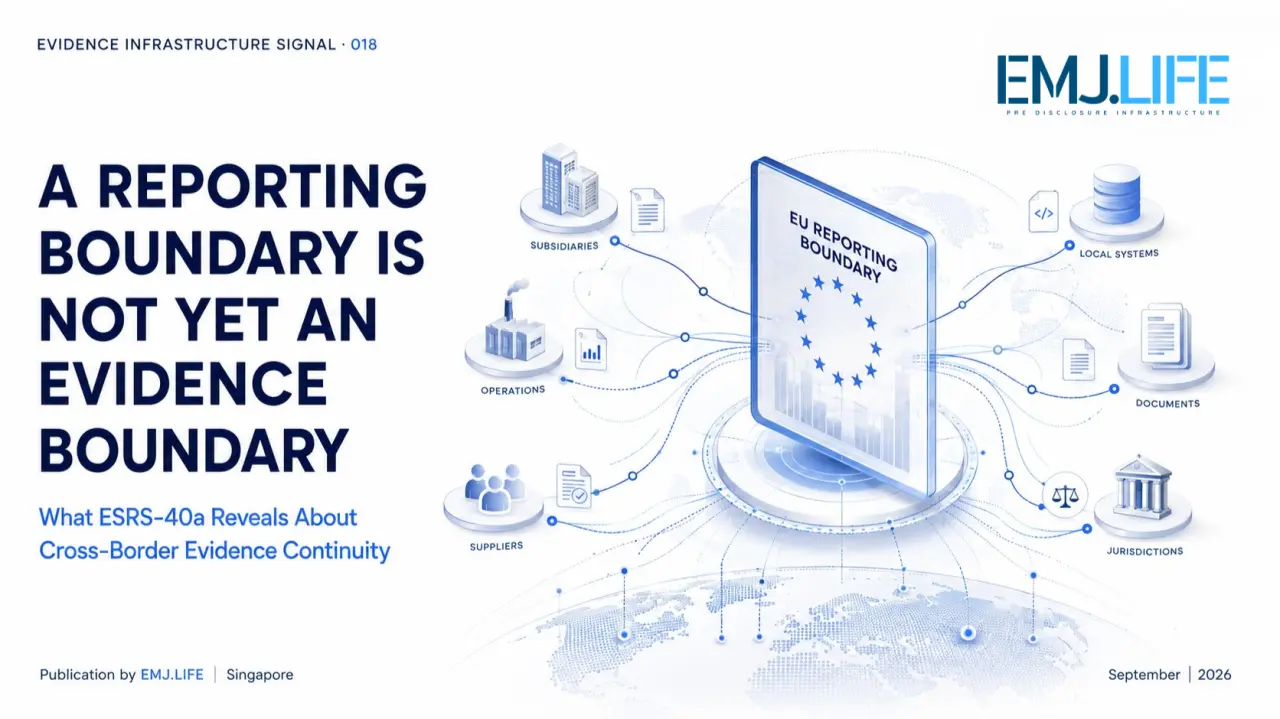
A Reporting Boundary Is Not Yet an Evidence Boundary: What ESRS-40a Reveals About Cross-Border Evidence Continuity
What ESRS-40a reveals about Cross-Border Evidence Continuity: law can define the reporting perimeter, but enterprises must preserve source, method, responsibility and version relationships before disclosure.
重點摘要
Executive Summary / LeadEFRAG 於 2026 年 9 月啟動 ESRS-40a 國際說明活動,配合持續至 10 月 31 日的公開諮詢,邀請可能落入《會計指令》第 40a 條架構的非歐盟企業回應。表面上,這是歐盟永續報導適用範圍向境外企業延伸;更深層的執行問題則是,報導邊界一旦跨越公司、司法管轄區、資訊系統與價值鏈,支撐報導的證據能否同步延伸。 法律可以界定誰需要報導,準則可以界定應揭露什麼,資料架構也可以提供彙整欄位;但它們不會自動建立每一筆資料的來源身分、方法、期間、責任與版本關係。企業即使完成集團層級的報導人口與欄位清單,仍可能無法重建某項重大揭露如何從地方營運紀錄進入最終永續聲明。 本期 Signal 因而區分「報導完整性」與「證據完整性」。前者回答必要欄位是否已填入,後者追問每一項重大主張為何可被信賴、能否沿跨境路徑回到原始紀錄。本文將這項能力稱為 Cross-Border Evidence Continuity;它是 EMJ.LIFE 對制度發展的獨立解讀,不是 EFRAG、歐盟執委會或歐盟採用的正式術語。
EFRAG began international outreach on ESRS-40a in September 2026 while the exposure-draft consultation remains open until 31 October. The events invite feedback from non-EU companies that may fall within the reporting architecture established under Article 40a of the Accounting Directive. On the surface, this is an extension of a European sustainability-reporting perimeter toward certain third-country undertakings. The deeper implementation question is whether the evidence supporting that reporting can extend across companies, jurisdictions, information systems and value chains at the same pace. Law can define who reports. A standard can define what is disclosed. A data architecture can provide fields for consolidation. None of those steps automatically creates the identity, method, period, responsibility and version relationships attached to each underlying record. An organisation may complete its group reporting population and still be unable to reconstruct how a material statement moved from local operating evidence into the final sustainability report. This Signal therefore separates Reporting Completeness from Evidence Completeness. The first asks whether required fields have been populated. The second asks why each material claim can be relied upon and whether an authorised reviewer can follow the cross-border path back to the originating record. This publication calls that capability Cross-Border Evidence Continuity. The term is an independent EMJ.LIFE institutional interpretation; it is not terminology adopted by EFRAG, the European Commission or the European Union.
企業與產業背景
Company & Industry ContextEFRAG 的 ESRS-40a 專案處理《會計指令》第 40a 條下特定非歐盟企業的永續報導。EFRAG 於 2026 年 7 月 23 日啟動為期 100 天的 Exposure Draft 諮詢,並說明依 2026 年制度變動後的適用範圍,包括連續兩個財務年度在歐盟產生超過 4.5 億歐元淨營業額,且符合特定子公司或分公司條件的第三國企業;預期報導年度自 2028 年 1 月 1 日或之後開始。 2026 年 9 月 1 日,EFRAG 另行公布當月一系列 outreach events,直接面向可能受第 40a 條影響的非歐盟企業。諮詢問題涉及歐盟法律概念在境外營運脈絡中的處理、全球影響與歐盟相關範圍之間的界線,以及與採用 IFRS 永續揭露準則之司法管轄區標準的互通性。這些是 EFRAG 正式程序可支持的制度事實。 然而,報導人口不是單一資料庫。集團永續聲明可能依賴不同子公司、國家、作業系統、內部控制、量測方法與價值鏈參與者。相同名稱的指標,在不同實體中可能由不同系統產生、採用不同估算方式、保存不同詳細程度,並由不同職能負責。法律把它們放入同一報導邊界,不代表其證據自然具有可比性、可歸屬性或連續性。
EFRAG's ESRS-40a project concerns sustainability reporting by certain non-EU undertakings under Article 40a of the Accounting Directive. On 23 July 2026 EFRAG opened a 100-day consultation on the exposure draft. Its project material describes the scope following the 2026 changes, including certain third-country undertakings generating more than EUR 450 million of net turnover in the Union in each of the previous two consecutive financial years and satisfying specified subsidiary or branch conditions. EFRAG indicates that reporting is expected for financial years beginning on or after 1 January 2028. On 1 September 2026 EFRAG announced a series of outreach events during the month for non-EU companies potentially affected by Article 40a. Consultation topics include how EU-law concepts should be handled when operations sit outside their direct legal context, whether the reporting perimeter should address global impacts or an EU-related scope, and interoperability with jurisdictional standards based on IFRS Sustainability Disclosure Standards. These are institutional facts supported by EFRAG's formal records. A reporting population, however, is not a single database. A group sustainability statement may rely on subsidiaries, countries, operational systems, internal controls, measurement methods and value-chain participants that operate under different conditions. The same indicator can come from different systems, employ different estimation techniques, preserve different levels of detail and be owned by different functions. Placing those inputs inside one legal reporting boundary does not make their evidence automatically comparable, attributable or continuous.
挑戰與重要性
Challenge / Why It Matters核心挑戰是報導邊界可能比證據邊界擴張得更快。企業可以行政上辨識所有納入範圍的實體,也可以要求各單位提交同一張表格;可是若地方資料的原始身分、方法、司法管轄脈絡、控制責任與轉換紀錄沒有隨資料移動,集團只會得到可彙總的數值,未必得到可重建的證據鏈。 跨境彙整尤其容易壓平重要差異。一個據點可能直接擷取設備量測,另一個據點可能依帳單或估算;一個子公司保存完整交易明細,另一個只提供合併總數;供應商資料可能經過問卷、平台轉換或顧問模型才進入企業系統。這些數值可以被放進同一欄,卻不應在沒有方法與來源標記時被視為同等證據。 當資料跨越實體、語言、系統與司法管轄區,來源到揭露的距離會拉長。任何一段遺失身分或版本關係,都可能在確信、內部稽核、監理問詢或更正時形成重工。問題不是資訊有沒有被交付,而是授權的覆核者能否回答:證據源自何處、屬於哪個實體、代表哪個期間與邊界、依何種方法形成、由誰控制,以及如何進入集團揭露。 因此,本期所稱 Evidence Boundary Expansion 並非新的法律概念,而是用來描述一個營運條件:揭露所需資訊跨越更多實體與環境時,支撐它的證據系統也必須擴大。報導範圍可以由法規界定;證據連續性必須由企業在營運層建立。
The central implementation risk is that the reporting boundary can expand faster than the evidence boundary. An enterprise can identify every entity administratively in scope and issue a common collection template. Yet if source identity, methodology, jurisdictional context, control responsibility and transformation history do not travel with the data, the group receives values that can be aggregated without necessarily receiving an evidence chain that can be reconstructed. Cross-border consolidation can flatten material differences. One site may use direct equipment measurement while another relies on invoices or estimation. One subsidiary may preserve transaction-level records while another provides only consolidated totals. Supplier information may pass through a questionnaire, platform transformation or consultant model before it reaches the enterprise system. Those values can occupy the same reporting field, but they should not be treated as equivalent evidence without source and method attributes. The distance from evidence to disclosure grows when information crosses entities, languages, systems and jurisdictions. The loss of an identity or version relationship at any stage can create repeated work during assurance, internal audit, regulatory enquiry or correction. The relevant question is not merely whether information was delivered. It is whether an authorised reviewer can determine where it originated, which entity it belongs to, which period and boundary it represents, which method formed it, who controlled it and how it entered the consolidated disclosure. Evidence Boundary Expansion is not presented here as a new legal concept. It describes an operational condition: when the information required for disclosure extends across more entities and environments, the supporting evidence system must extend with it. Reporting scope can be defined by regulation. Evidence continuity must be established through operating governance.
行動、方案與執行
Action / Solution / Implementation企業可以把跨境永續報導拆成七個彼此連接的治理能力。第一是實體綁定:每筆證據必須持續歸屬到產生它的子公司、分公司、據點、供應商或作業單位。第二是證據身分:原始紀錄要有獨立於最終揭露的穩定識別,不能只剩彙總欄位中的數字。 第三是司法管轄脈絡:資料形成時適用的法規、營運限制、語言、單位與保留規則要能被辨識。第四是方法綁定:量測方式、計算公式、排放係數、估算假設、轉換規則與版本需與結果共同保存。第五是來源脈絡:集團層資訊要能沿資料流回到地方紀錄、外部來源與中間轉換。 第六是責任綁定:資料產生、覆核、核准、控制與更正的角色必須明確。第七是受控合併:地方證據轉為集團揭露時,要保存抵銷、匯率、單位轉換、範圍調整、缺值處理與管理階層判斷。這七項能力形成「實體 → 證據 → 司法管轄 → 方法 → 來源脈絡 → 合併 → 揭露」的 Cross-Border Evidence Continuity。 落地時可先建立一份 disclosure-to-source map。每一項重大揭露連接到報導實體、營運邊界、原始紀錄、計算方法、資料擁有人、控制人、核准人及報告版本;當任一來源、方法或邊界改變時,系統新增版本與影響評估,而不是覆寫先前依據。集團層資料模型可以共通,但不應抹除地方差異。 執行順序應由高風險主張開始,例如跨多個據點、依賴估算、需要供應商資料、涉及重大管理判斷或預期接受外部確信的揭露。先測試覆核者能否在合理時間內從最終數字回到原始證據,再擴大到其他主題。揭露前證據基礎設施不是另一套報導標準,也不是要求所有證據公開;它是讓權限內的來源、方法、責任與版本在揭露形成前保持可追溯的治理層。
A practical cross-border reporting architecture can be organised around seven connected capabilities. The first is Entity Binding: every record remains attributable to the subsidiary, branch, site, supplier or operating unit that produced it. The second is Evidence Identity: an underlying record keeps a stable identity independent of the consolidated disclosure into which it eventually flows. A value should not survive only as a number in a group field. The third capability is Jurisdictional Context. The regulatory setting, operational constraint, language, unit and retention rule applicable when evidence was produced remain identifiable. The fourth is Method Binding. Measurement procedures, calculation formulae, emissions factors, estimation assumptions, transformation rules and their versions stay connected to the result. The fifth is Provenance: group information can be traced back through intermediate transformations to local records and external sources. The sixth capability is Responsibility Binding. Roles for production, review, approval, control and correction are explicit. The seventh is Controlled Consolidation. When local evidence becomes group reporting, the organisation preserves eliminations, exchange rates, unit conversions, scope adjustments, missing-data treatments and management judgements. Together, the chain is Entity → Evidence → Jurisdiction → Method → Provenance → Consolidation → Disclosure. This is Cross-Border Evidence Continuity. Implementation can begin with a disclosure-to-source map. Each material statement connects to the reporting entity, operating boundary, authoritative record, calculation method, data owner, control owner, approving authority and report version. When a source, method or boundary changes, the system creates a new version and impact assessment rather than overwriting the basis of an earlier disclosure. A common group data model is useful, but it should expose local differences rather than erase them. Prioritisation should start with claims that cross many sites, rely on estimation, require supplier data, involve significant management judgement or are expected to receive external assurance. Teams can test whether an authorised reviewer can travel from the final number back to the source evidence within a reasonable period before expanding the model. Pre-Disclosure Evidence Infrastructure is neither another reporting standard nor a demand that every record become public. It is the governed layer that keeps source, method, responsibility and version relationships traceable within authorised access before disclosure is produced.
證據、成果與影響
Evidence / Results / Impact本期以十五筆正式紀錄建立制度背景,來源涵蓋 EFRAG、歐盟法律資料庫與歐盟執委會、IFRS Foundation、GRI、IAASB、CEAOB 及 WBCSD。EFRAG 與 EUR-Lex 支持 ESRS-40a 的程序、法律架構與時間軸;IFRS Foundation 與 GRI 的資料支持跨準則互通性與司法管轄採用差異;IAASB 與 CEAOB 的文件補充確信程序對一致證據、重大錯誤與方法可重建性的要求;WBCSD PACT 則提供供應鏈產品碳資料交換、驗證與版本控制的實務脈絡。 這些來源沒有宣稱跨境報導已建立統一的證據制度,也沒有使用 Evidence Boundary Expansion、Evidence Boundary、Reporting Completeness、Evidence Completeness 或 Cross-Border Evidence Continuity 等概念。將這些制度紀錄組合成揭露前證據基礎設施的問題框架,是 EMJ.LIFE 的獨立解讀;SNN.TW 的台灣產業段落則是進一步的在地編輯推論,兩者都不能被改寫成 EFRAG、歐盟、IFRS Foundation 或其他來源機構的正式結論。 目前可支持的影響判斷仍是方向性的:跨境報導範圍增加,會使資料需要跨越更多組織、準則與系統;互通性文件可以降低重複整理,但不會自動補上實體、方法、責任與版本關係;確信準則可以界定程序品質,卻不會替企業生成缺失的原始紀錄。這些來源沒有提供企業導入成本、查核工時降低幅度或市場定價效果,因此本文不提出量化或因果聲稱。
This Signal uses fifteen formal records to establish the institutional context, covering EFRAG, EU legal and European Commission materials, the IFRS Foundation, GRI, IAASB, CEAOB and WBCSD. EFRAG and EUR-Lex support the ESRS-40a process, legal architecture and timeline. IFRS Foundation and GRI records support cross-standard interoperability and differences in jurisdictional adoption. IAASB and CEAOB materials add assurance context concerning consistent evidence, material misstatement and method reconstruction. WBCSD's PACT methodology provides an operational reference for product-carbon data exchange, verification and version control across supply chains. None of these sources says that cross-border reporting has already produced a unified evidence system. Nor do they use Evidence Boundary Expansion, Evidence Boundary, Reporting Completeness, Evidence Completeness or Cross-Border Evidence Continuity as institutional terms. Combining the records into a Pre-Disclosure Evidence Infrastructure problem frame is an independent EMJ.LIFE interpretation. The Taiwan industry section is a further SNN.TW editorial inference. Neither should be attributed to EFRAG, the European Union, the IFRS Foundation or the other source institutions. The supported impact assessment remains directional. A wider cross-border reporting perimeter causes information to move across more organisations, standards and systems. Interoperability material can reduce duplicate preparation, but it does not automatically create entity, method, responsibility or version relationships. Assurance standards can define procedural quality, but they do not generate missing source records for an enterprise. The source set does not quantify implementation cost, reductions in assurance hours or market-pricing effects, so this article makes no quantitative or causal claim about those outcomes.
產業與制度意涵
Industry & Institutional Implications對跨國企業而言,ESRS-40a 的制度訊號不是再增加一張中央收集表,而是把地方證據治理變成集團報導能力的一部分。總部若只規定最後欄位,卻未定義地方紀錄的身分、方法、責任與保留要求,合併系統會提升收集速度,卻可能把差異與不確定性藏在同一數值之下。 對資訊與資料團隊而言,共通資料模型必須同時保留 entity ID、source ID、method version、reporting period、control status 與 transformation history。對財務、永續與內控團隊而言,責任分工要涵蓋資料形成與更正,不只涵蓋報告送出。對確信提供者而言,測試焦點需要從集團總數延伸到跨境抽樣能否回到權威來源。 對標準制定與監理機構而言,互通性不只是欄位名稱相容。若不同司法管轄區採用相近的揭露要求,但證據類型、方法與控制狀態無法被辨識,技術 mapping 仍可能產生表面一致。較成熟的互通性應讓差異可見、讓轉換可追蹤,而不是假設資料在進入共同模板後就取得相同制度品質。 因此,報導完整性與證據完整性需要兩套可連接的檢查。前者確認範圍與欄位,後者確認每項重大揭露能否被重建。兩者都完成,跨境永續聲明才具備接受內外部檢驗的基礎。
For multinational enterprises, the ESRS-40a signal is not a request for another central collection spreadsheet. It makes local evidence governance part of group reporting capability. If headquarters specifies only the final fields without defining source identity, method, responsibility and retention requirements, consolidation technology can accelerate collection while hiding differences and uncertainty beneath a single value. For information and data teams, a common model should preserve entity ID, source ID, method version, reporting period, control status and transformation history. For finance, sustainability and internal-control functions, accountability must cover data formation and correction, not only submission of the report. For assurance providers, group-level testing should extend to whether cross-border samples can return to authoritative source records. For standard setters and regulators, interoperability is not limited to compatible field names. Jurisdictions may use similar disclosure requirements while relying on evidence types, methods and control states that remain different. A technical mapping can therefore create superficial consistency. A more mature form of interoperability keeps differences visible and transformations traceable instead of assuming that information acquires the same institutional quality when placed in a shared template. Reporting Completeness and Evidence Completeness consequently require connected but distinct checks. One validates scope and populated disclosures. The other validates whether every material statement can be reconstructed. Cross-border sustainability reporting becomes ready for internal and external challenge only when both conditions are addressed.
SNN 編輯與揭露前證據基礎設施觀點
SNN Editorial / Pre-Disclosure Evidence Infrastructure Perspective對台灣產業而言,ESRS-40a 的傳導不應被簡化成「所有企業立即新增一項歐盟義務」。較精確的判斷是:具有歐盟營業活動、符合相關子公司或分公司條件的台灣企業,可能需要直接評估適用範圍;其他出口製造、電子、半導體、金融與供應鏈企業,也可能因集團合併、歐洲客戶資料要求或價值鏈蒐集而間接受到影響。實際法律適用仍須逐案確認。 台灣企業的資料往往分散在總部、海外子公司、工廠、公用設備、ERP、供應商平台、顧問工作底稿與人工核准流程。若跨境報導只在總部設定統一欄位,地方數值進入合併後可能失去產生據點、原始語言、計算版本、組織邊界與控制責任。這會把歐洲報導需求傳導成台灣總部與供應鏈的補件、對帳與查核重工。 揭露前證據基礎設施可把準備工作前移:為每個法人與營運據點建立穩定識別;讓中英文欄位指向同一受治理主張;保存原始紀錄、方法版本、匯率與單位轉換;區分量測、估算與供應商聲明;記錄資料擁有人、覆核者與核准者;並測試從歐盟層級揭露回到台灣或其他地區來源的重建路徑。 這項台灣產業觀點是 SNN.TW 依 EFRAG 與 EUR-Lex 正式紀錄所做的條件式編輯推論,不代表主管機關已對台灣企業發布新的統一要求。其實務價值在於:無論最終適用範圍如何,只要跨境客戶、集團或確信程序需要更多資料,企業都能在權限與機密控制下說明資料從哪裡來、如何形成、由誰負責,以及何時進入最終揭露。
For Taiwan industries, the transmission from ESRS-40a should not be reduced to a claim that every company immediately acquires a new EU obligation. A more precise view is conditional. Taiwan enterprises with significant EU turnover and the relevant subsidiary or branch conditions may need to assess direct scope. Other export manufacturers, electronics and semiconductor companies, financial institutions and supply-chain participants may experience indirect demand through group consolidation, European customer requests or value-chain data collection. Actual legal application requires entity-specific assessment. Taiwan enterprise data may be distributed across headquarters, overseas subsidiaries, factories, utility equipment, ERP platforms, supplier portals, consultant workpapers and manual approval processes. If cross-border reporting is designed only as a common headquarters template, a local value can lose its originating site, original language, calculation version, organisational boundary and control owner after consolidation. A European reporting request then travels into Taiwan operations as repeated evidence requests, reconciliation work and assurance delay. Pre-Disclosure Evidence Infrastructure moves that work upstream. Enterprises can assign stable identities to each legal entity and operating site; make Chinese and English fields point to the same governed claim; preserve original records, method versions, exchange-rate and unit transformations; distinguish measurement, estimation and supplier representation; record data owners, reviewers and approvers; and test the reconstruction path from an EU-level disclosure back to Taiwan or another originating jurisdiction. This Taiwan industry perspective is a conditional SNN.TW editorial inference based on the EFRAG and EUR-Lex records. It does not represent a new uniform requirement announced by a Taiwan authority. Its practical value is that, whatever the final legal perimeter, an enterprise facing cross-border requests from customers, a group or an assurance process can explain within appropriate confidentiality controls where information came from, how it was formed, who was responsible and when it entered the final disclosure.
未來展望
Future Outlook近期最明確的制度節點是 2026 年 10 月 31 日的 ESRS-40a 諮詢截止日,以及 EFRAG 在 9 月持續進行的非歐盟企業 outreach。企業與產業組織若參與諮詢,應把法律適用、全球或歐盟相關報導邊界、資料取得可行性、司法管轄差異與互通性分開回應,避免用單一技術解法包覆不同治理問題。 低後悔措施可以立即展開:盤點可能跨境的重大揭露、建立 entity-to-disclosure 清單、標記方法與來源版本、定義合併轉換紀錄、抽測跨境重建時間,並辨識哪些關係仍依賴人工郵件或無版本試算表。這些工作不預設最終準則內容,也不把草案當成現行義務。 後續觀察重點包括 EFRAG 如何處理全球與歐盟相關範圍、與 IFRS 永續揭露準則基礎之司法管轄區標準如何互通、企業對境外 EU-law 概念提出哪些執行困難,以及最終規範是否對方法、邊界與可追溯性提供更清楚指引。真正的成熟度問題將不只是多少欄位完成,而是報導邊界擴張時,證據邊界能否保持一致、可控與可重建。
The clearest near-term institutional milestone is the ESRS-40a consultation deadline of 31 October 2026, accompanied by EFRAG's September outreach to non-EU companies. Enterprises and industry bodies responding to the consultation should separate legal scope, global versus EU-related reporting boundaries, data-access feasibility, jurisdictional differences and interoperability. A single technical answer should not be allowed to conceal distinct governance questions. Low-regret measures can begin now: inventory material claims likely to cross borders, establish an entity-to-disclosure register, record method and source versions, define consolidation transformations, test cross-border reconstruction time and identify relationships that still depend on unversioned spreadsheets or email. These steps do not presume the content of the final standard and do not treat an exposure draft as a present obligation. The next evidence points include how EFRAG addresses global and EU-related scope, how interoperability works with jurisdictional standards based on IFRS Sustainability Disclosure Standards, which operational difficulties non-EU companies identify for EU-law concepts, and whether final materials provide clearer direction on methodology, boundary and traceability. The mature question will not be only how many reporting fields are complete. It will be whether the evidence boundary remains coherent, controlled and reconstructable when the reporting boundary expands.
來源、證據鏈與責任編輯
來源媒體:sustainabilitynewsnetwork.net · 原文作者:Anderson Yu · 原文發布:
原始出版
外部論述與制度來源
以下外部公告、法規、研究或新聞用於支撐本文論述,並與原始出版分開呈現。
- Primary institutional project recordEFRAGESRS for Certain Non-EU Undertakings in Accordance with Article 40a of the Accounting Directive ↗出版日期 2026-07-23 · 查核時間 2026-09-04(時間未記錄)
Supports the ESRS-40a exposure-draft project, consultation period, proposed scope, timing and consultation topics for certain non-EU undertakings.
- Primary institutional outreach recordEFRAGSave the Dates: EFRAG Outreach Events on the ESRS for Certain Non-EU Undertakings ↗出版日期 2026-09-01 · 查核時間 2026-09-04(時間未記錄)
Supports the September 2026 outreach programme directed to non-EU companies potentially affected by Article 40a.
- Primary legal sourceEUR-Lex / European UnionConsolidated text of Directive 2013/34/EU — Article 40a ↗出版日期 2024-05-28 · 查核時間 2026-09-04(時間未記錄)
Supports the legal architecture in Article 40a for sustainability reports concerning certain third-country undertakings.
- Primary consultation launch recordEFRAGEFRAG Launches Public Consultation on the ESRS-40a Exposure Draft for Certain Non-EU Undertakings ↗出版日期 2026-07-23 · 查核時間 2026-09-04(時間未記錄)
Supports the 100-day consultation, 31 October 2026 response deadline, technical-advice process and expected reporting timetable.
- Cross-framework interoperability anchorIFRS FoundationIFRS Foundation and EFRAG Publish Interoperability Guidance ↗出版日期 2024-05-02 · 查核時間 2026-09-04(時間未記錄)
Supports the alignment analysis between ISSB Standards and ESRS, including the need to govern data once while preserving framework-specific disclosure requirements.
- Cross-jurisdiction implementation recordIFRS FoundationIFRS Foundation Publishes Jurisdictional Profiles Providing Transparency on Adoption of ISSB Standards ↗出版日期 2025-06-12 · 查核時間 2026-09-04(時間未記錄)
Supports the use of jurisdiction-specific profiles and snapshots to distinguish finalised adoption decisions from approaches still under development.
- Impact-and-investor framework interoperability recordGlobal Reporting InitiativeGRI and IFRS Foundation Collaboration to Deliver Full Interoperability ↗出版日期 2024-05-24 · 查核時間 2026-09-04(時間未記錄)
Supports coordinated identification and alignment of common disclosures while each standard setter retains its distinct scope and due process.
- GHG disclosure mapping recordGlobal Reporting InitiativeNew Resource on Emissions Reporting Using GRI and ISSB Standards ↗出版日期 2024-01-18 · 查核時間 2026-09-04(時間未記錄)
Supports the mapping of Scope 1, Scope 2 and Scope 3 emissions requirements across GRI 305 and IFRS S2 and the need to preserve method choices.
- ESRS-to-GRI datapoint crosswalk recordGlobal Reporting InitiativeESRS-GRI Standards Data Point Mapping ↗出版日期 2025-04-28 · 查核時間 2026-09-04(時間未記錄)
Supports the availability and publication date of the official ESRS-GRI data-point mapping used to connect disclosure requirements across frameworks.
- Global sustainability assurance anchorIAASBInternational Standard on Sustainability Assurance 5000, General Requirements for Sustainability Assurance Engagements ↗出版日期 2024-11-12 · 查核時間 2026-09-04(時間未記錄)
Supports a framework-neutral assurance standard applicable across sustainability topics, reporting frameworks and practitioner types.
- EU assurance interoperability guidanceIAASBISSA 5000 Frequently Asked Questions: Relevance to Assurance on Sustainability Reports in the European Union ↗出版日期 2025-11-03 · 查核時間 2026-09-04(時間未記錄)
Supports the relevance of ISSA 5000 to EU sustainability assurance and identifies materiality, scalability and interoperability considerations.
- EU implementation interpretation anchorEuropean CommissionFrequently Asked Questions on the Implementation of the EU Corporate Sustainability Reporting Rules ↗出版日期 2024-08-07 · 查核時間 2026-09-04(時間未記錄)
Supports official implementation explanations covering reporting scope, value chains, Article 40a and sustainability assurance under EU rules.
- EU limited-assurance procedure anchorCEAOBCEAOB Guidelines on Limited Assurance on Sustainability Reporting ↗出版日期 2024-09-30 · 查核時間 2026-09-04(時間未記錄)
Supports a common EU approach to limited-assurance engagements, including material misstatement, evidence procedures and the distinction from reasonable assurance.
- Primary ESRS legal instrumentEUR-Lex / European UnionCommission Delegated Regulation (EU) 2023/2772 as Regards Sustainability Reporting Standards ↗出版日期 2023-12-22 · 查核時間 2026-09-04(時間未記錄)
Supports the legal adoption and architecture of the first set of European Sustainability Reporting Standards used as the EU reporting-system context.
- Value-chain data exchange methodologyWorld Business Council for Sustainable DevelopmentPACT Methodology Version 3 ↗出版日期 2026-06-02 · 查核時間 2026-09-04(時間未記錄)
Supports harmonised product-carbon accounting, verification pathways, revision control and more reliable emissions-data exchange across supply chains.